The below article was originally given as a public talk at ISO’s Te Whanganui-a-Tara branch.
Ko wai au e tū ake nei?
Nō Kōtirana ōku tūpuna
Nō Ōtepoti ahau
Ko Ngāi Tahu to iwi mana whenua o korā
E noho ana au ki Pōneke
Ko Taranaki Whānui ki te Upoko o te Ika te iwi mana whenua o kōnei
Ko ISO tōku rōpū
Ko Brookes tōku whānau
Ko Grant tōku ingoa
Nō reira tēnā koutou katoa.
I’m Grant. Originally from Ōtepoti Dunedin, in the takiwā of Ngāi Tahu, I now reside here in Pōneke under the korowai of Taranaki Whānui. These places and their stories have shaped me, and I will speak about them in this talk.
So, before there was the nightly ThreeNews bulletin, produced by Stuff, there was Newshub. Before Newshub, there was 3 National News and its late edition, Nightline. On the first of October, 1997, this was Nightline’s lead story.
I will spend the rest of this talk unpacking what’s going on in this news story, and how we got to that point. But first, an anecdote from that day, which I offer for your amusement.
This was me, by the way, being led away by police from 1:10 in the video clip – one of many student activists arrested at Auckland University that day.
Also in the back of that police van was Martyn Bradbury, also known as Bomber Bradbury. Bomber would go on to found a website called The Daily Blog and various other media projects. But in 1997, he was the editor of Craccum, the magazine of the Auckland University Students Association (AUSA).
Back then, mobile phones were just starting to become a thing. The police, out of touch with social trends as usual, hadn’t yet caught up with how to deal with these new-fangled gadgets – one of which was in Bomber’s pocket as he was bundled into the van with me. The Nightline story mentioned that students sat down around the police vans to block them from taking us away to the police station, which we thought was just fabulous.
As chants rang out around us demanding our release, Bomber – ever the prankster – pulled out the phone the police had failed to confiscate, and began making calls. He thought about ordering pizza for the students surrounding the police vans. Then he started phoning talkback radio. As we sat immobilised for hours outside the Auckland University registry, he got the story of our student protest out to listeners across the country, and broadcast appeals for solidarity from the back of the police van. I found this quite amusing at the time, and I still do.
So how did we get to the point of where a mass of militant student protesters were wiling to take on police to fight for an end to tuition fees?
The story starts back in the 1980s. Up until 1979, tertiary education had been virtually free for all – overseas students and domestic students alike – with everyone paying the same “administration fee” of around $100 a year. In 1979, a $1,500 tuition fee was introduced for overseas students. The government said that this would help to fund more places for domestic students, and promised that domestic students would never have to pay. In reality, as per usual, attacks on migrants were the opening shots of a war on everyone.
At the 1987 election, the Labour Party repeated its promise of no fee increases for domestic students. Two years later, Labour education minister Phil Goff announced plans to increase fees by around 900 percent. This sparked the biggest wave of student protest ever seen in Aotearoa. In July 1989, more than 20,000 people across the country – a third of the total student population – took to the streets.
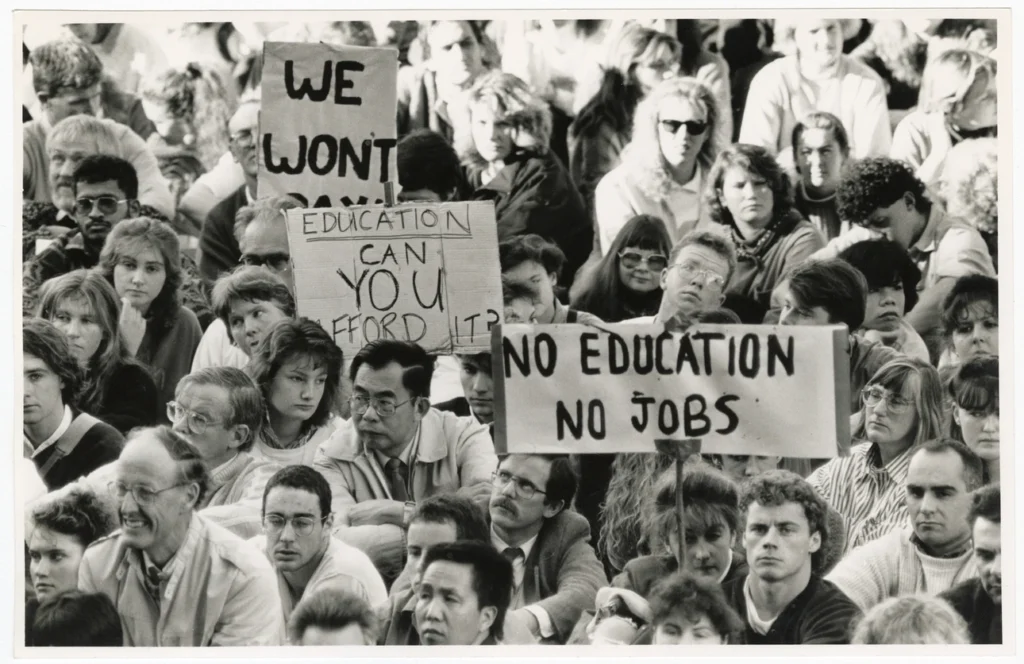
In Ōtautahi Christchurch, as shown here, 7,000 students brought the city centre to a standstill. The Press, not known for its support of student protesters, reported: “More remarkable than the numbers… was the lack of the usual heckling from bystanders; the mood of shoppers was one of quiet support.” In Ōtepoti Dunedin, 5,000 students blocked the main street. This was my own personal baptism into the student movement against fees.
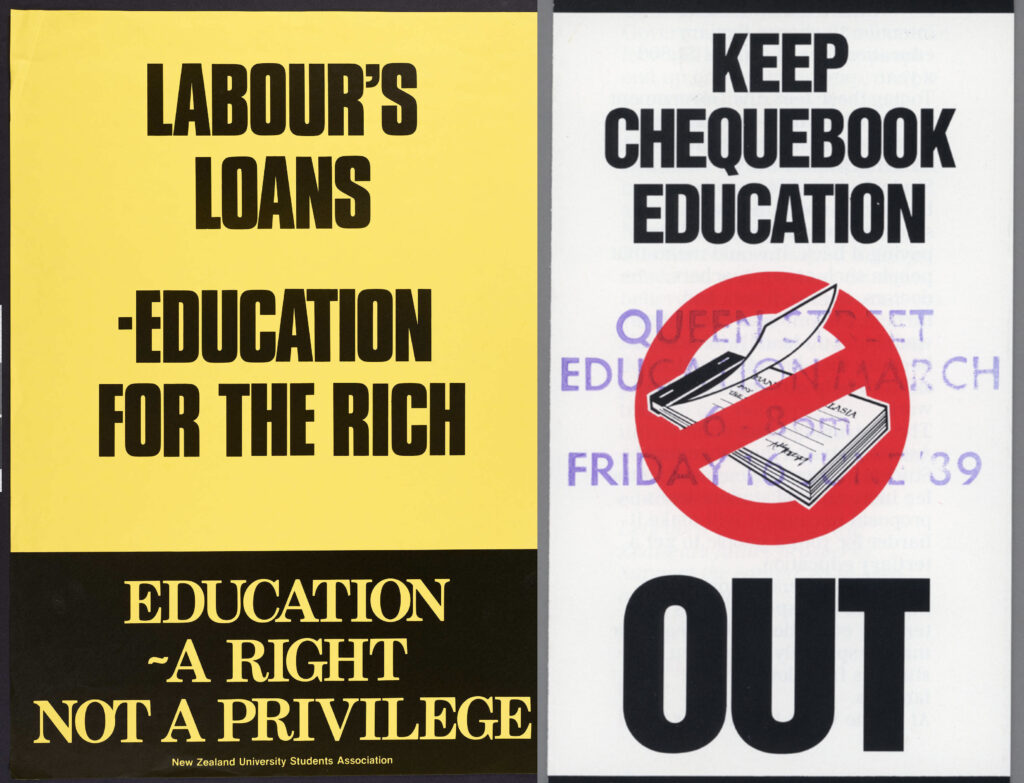
The 1989 protests were organised by the New Zealand University Students Association (NZUSA), Aotearoa Polytechnic Students Union (APSU) and local students associations on each campus. These official bodies had the resources and reach to bring tens of thousands onto the streets, including through distribution of thousands of these posters.
But their political limitations soon became apparent. From the outset, NZUSA and APSU had sought an alliance between students and campus bosses. The May 1989 issue of NZUSA’s campaign newsletter stated: “The vice-chancellors were faced with the choice of accepting user-pays and the tempting additional revenue it would bring or taking the moral high ground. To the credit of the vice-chancellors”, declared NZUSA, “they resisted the temptation.”
The belief that the vice-chancellors were on our side guided NZUSA’s next step. They called for a fees boycott. Students were told not to pay their fees and were given assurances that the vice-chancellors were “sympathetic”, so would not kick us out of our courses.
NZUSA was wrong, and the mistake was costly. Letters from the vice-chancellor advising students that they would be disenrolled if they didn’t pay up started to arrive. As individuals, the students boycotting fees were vulnerable and under pressure. But student leaders, from NZUSA down to local student executives, had painted the campus bosses as our allies as they mobilised students against the government. They were now confused and unable organise mass action against the vice-chancellors which could have given individual boycotters like me the backing we needed to win. The fees boycott collapsed. It seemed to many of us who’d been led by NZUSA that nothing more could be done and the protests dwindled.
The next major step forward for the student movement against fees came in 1993. New forms of organisation were springing up, new strategies were being developed and new tactics were being trialled.
The new form of organisation – led by students at Otago – was the Education Action Group (EAG). The EAGs were supported by students associations on the various campuses, but crucially they were also independent of them. Another new organisation, the International Socialist Organisation, was also established in 1993.
ISO members were at the heart of the Otago EAG from the outset. Our approach to the EAG was informed by Trotsky’s theory of the united front. The starting point for the united front is agreement on unity in action between revolutionary and non-revolutionary activists to win immediate demands. But equally important is acceptance of political independence for the groups within the united front, and openness to debate their different political perspectives on strategy and tactics.
On this basis, while working with the students association, ISO also criticised their official strategy of alliances with campus bosses, and argued instead for alliances with unions and workers – especially with academic and general staff – in a common struggle for free education, job protections and better pay and conditions.
At the same time, ISO drew upon the history of student protest tactics to advocate for more powerful methods of direct action – in particular, the tactics pioneered by students at the University of California in 1964, as shown in this documentary clip.
The issue for the California students was different from ours. In their case, they were protesting for the right to political free speech, which the university management was suppressing. But adapting their direct action tactic of occupying an administration building, under a strategy of confronting the campus bosses at Otago who were implementing government-mandated fee rises, was a more powerful tactic for us than street marches alone.
For a period of time, ISO members in the Otago EAG were viewed with suspicion, or as oddities. Two things changed that. The first was a spontaneous student occupation in July 1993 at the seemingly unlikely campus of Lincoln University.
It wasn’t the first student occupation in Aotearoa. Otago students had occupied their registry building in 1972, to protest university regulations banning “mixed flatting”, and Māori students at Auckland University had occupied in 1983 to demand a university marae. But the Lincoln occupation, which was all over inside of 24 hours, was the first in Aotearoa challenging a decision by campus bosses to raise fees. Occupying was no longer a curious idea in black and white newsreels from ancient history. A group of activists from the Otago EAG went up to Lincoln to take part in their occupation, and brought back enthusiasm for the tactic to Ōtepoti. Another short occupation protesting fees took place at Canterbury University in November 1993.
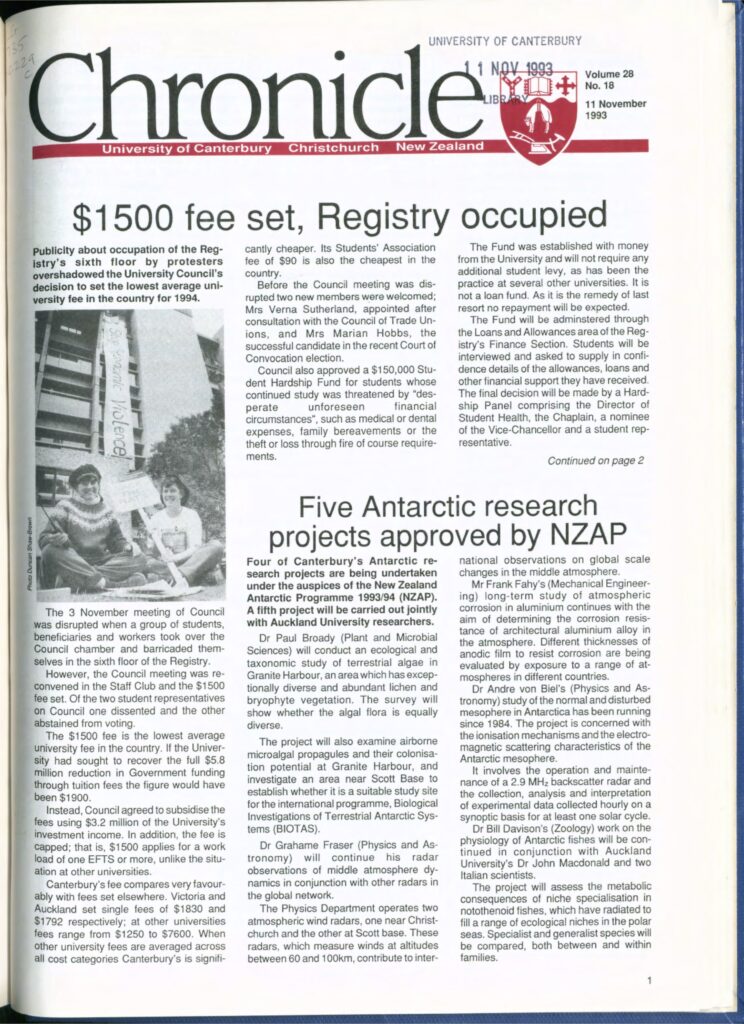
The second thing which broke down suspicion towards ISO members inside the Otago EAG happened in September 1993. The Otago University Council was meeting to decide on fee increases for the following year. Around 800 students gathered outside the registry building where the meeting was taking place, chanting in opposition to the fee rises. The meeting ended, but many students remained, now seated in a sit-down protest on the ground outside. Suddenly, and without warning, police burst out of the building in riot gear and began beating the students with long batons. 24 people were injured.
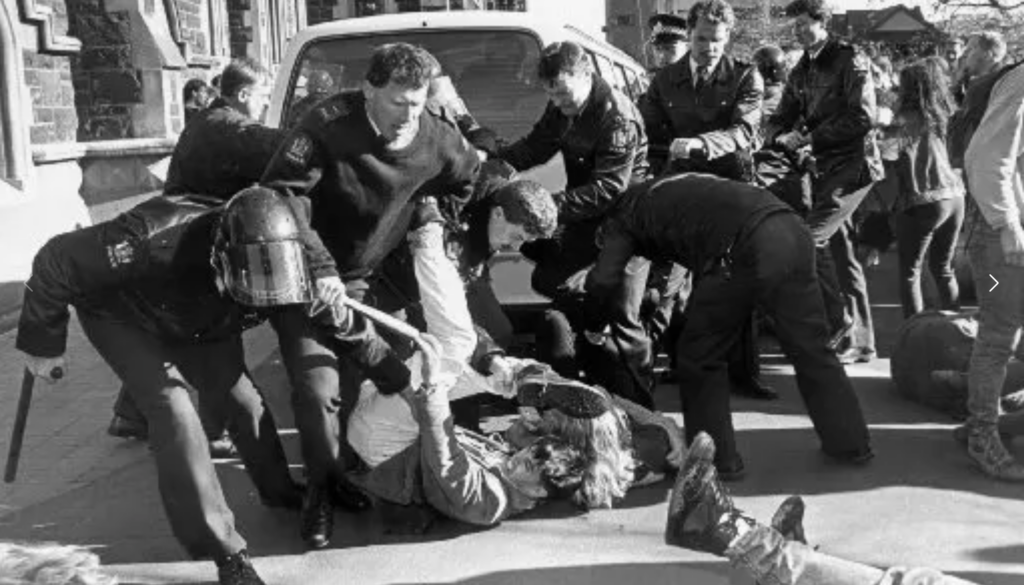
The police riot created a furore among the whole student body. Overnight, hundreds became convinced of ISO’s arguments about the role of the police as enforcers of capitalist rule. I was one of them. Along with 17 others, I joined ISO the following week. Leadership inside the EAG passed from the hands of the moderates, like Otago student president (later deputy prime minister) Grant Robertson, who had argued in favour of cooperation with police, against militant protest, and against the demand for free education. Robertson even believed that stopping the fee rise was unrealistic, promoting instead the idea of a small student hardship fund.
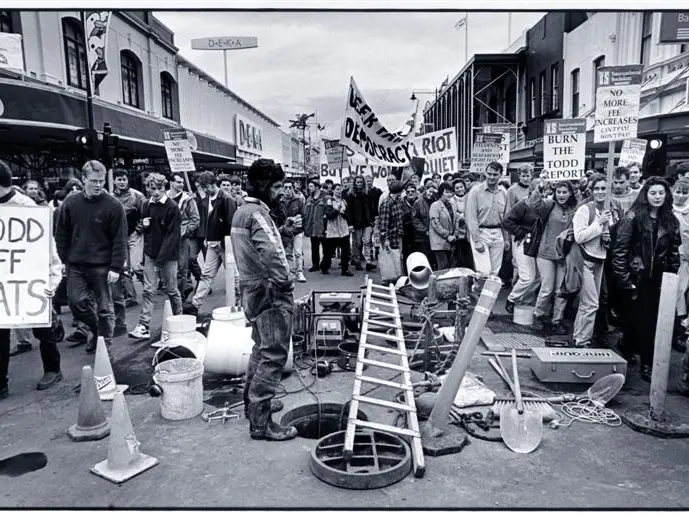
ISO founding member Brian Roper writes: “From this point on, the campaign went to yet another level both quantitatively and qualitatively. Numbers involved in major anti-fees and anti-debt protests at Otago in 1994 and 1995 ranged from two to three thousand.” ISO was so central to them that it’s hard to find protest photos from those years which don’t feature ISO placards. Here’s one from 1994, with a cluster of ISO’s distinctive mastheads in the top right corner.
Roper continues: “Around 60–70 activists were regularly attending EAG meetings. Qualitatively, the EAG and movement became increasingly sophisticated and effective in almost every respect. Protests were better advertised, better organised, tactically smarter, and more resistant to police infiltration and suppression. The latter was addressed through tactics such as having several civil disobedience targets, with a decision as to which would be used a short time before the march started. Police liaison was viewed as either best not happening at all, or else being delegated to someone who had no idea what was being planned. Targets for mass protest, sit-ins, and occupations were no longer confined to the university registry, but broadened to encompass government agencies – such as the Ministry of Education, IRD, and WINZ (Study Link) – that implemented the fees and debt regime.”
When the National Party foolishly decided to hold its conference in Dunedin in 1995, protests were staged at the venue, as I reported in this 1995 article.
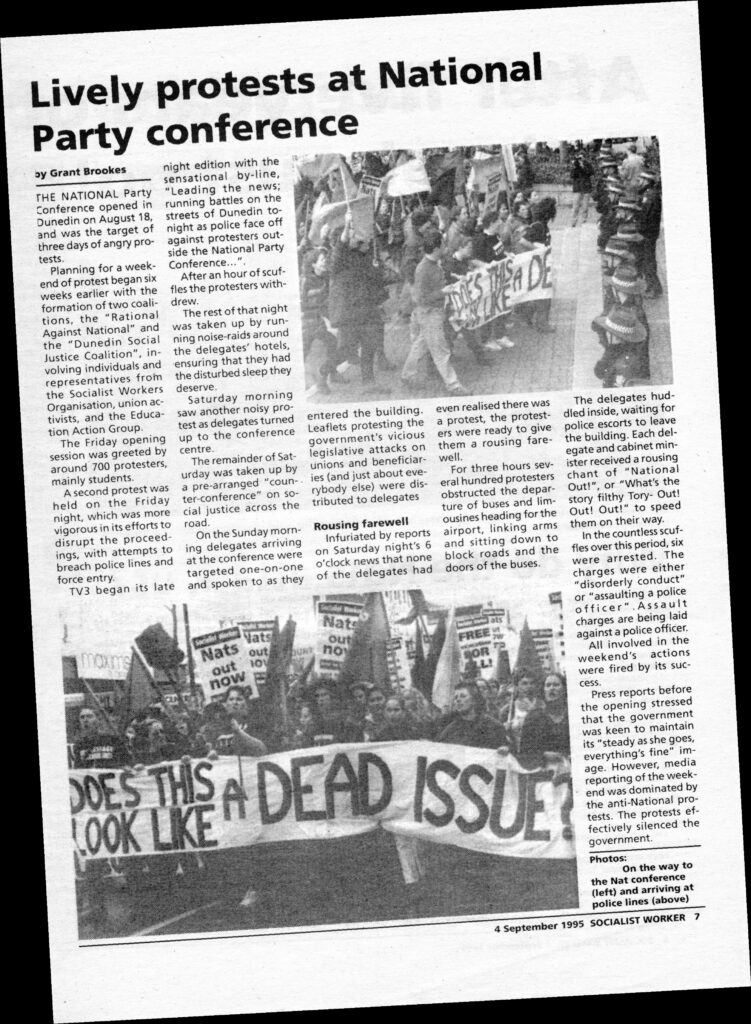
Also in 1995, ISO in Dunedin merged with the remnants of the Communist Party of New Zealand (CPNZ) to form the Socialist Workers Organisation. The “lively protests” article is from our newspaper, Socialist Worker.
The CPNZ had no experience organising on campuses, but the new, national organisation quickly learnt from ISO’s experience and spread the lessons to campuses across the country. Revolutionary socialists rose to leading roles in EAGs at Canterbury University, Massey, Waikato, and above all at Auckland. We are getting closer to understanding what’s going on in the 1997 Nightline story at the start of this talk.
Says Roper: “While during 1994 and 1995 the tactical focus had moved off campus, mainly to focus on the government as well as the university administration, in 1996 the focus returned to campus. Activists were determined to have a ‘big push’ focused on the Council meeting that was going to increase fees for another year.”
The Otago University Council had worked itself into such a feeding frenzy that the 1996 meeting was to consider options from the Senate Working Party on fees ranging from a 25 percent increase upwards. On Tuesday 13 August, the day of the scheduled council meeting, 500 Otago students stormed their registry building. I was one of them. This is a slideshow of some photos I took during what would be an eight-day occupation.
Our demand was a nil fee increase in 1997. The next morning we were still in the building and pickets stopped the few managers who tried to get into their offices. The authorities sent the clerical workers home and we controlled the building.
During the occupation, general meetings open to all students were held at least once a day to discuss every aspect of the campaign. The debates often went on for hours, but we felt for the first time that we had a real say. We knew that holding the registry would take hundreds of students. Rosters were drawn up for occupiers to speak at lectures and at the hostels calling on more students to join us. We created an occupation rota so we could take turns to go home for rest.
On Wednesday night, as chance would have it, Alliance Party leader and MP Jim Anderton was scheduled to speak at a local party meeting. We invited him to come to the registry afterwards. The media storm that erupted on Thursday after chancellor Judith Medlicott issued a trespass notice against him amazed everyone.
But even more importantly, Medlicott’s move outraged academic staff already bearing grievances over their wage claim and inspired by our militant action. The lecturers’ union called an impromptu stopwork meeting on Friday morning. The meeting filled a 350-seat lecture theatre. A student delegation, which included myself, was sent to address the staff. The meeting unanimously passed a resolution of support for the students and no confidence in the chancellor and vice-chancellor. They demanded that Medlicott drop the trespass order against Jim Anderton.
That afternoon, she did. By Friday night, the university authorities had completely lost control. They pleaded for negotiations and asked us to take over weekend security patrols to ensure safety on the campus. Then behind our backs they quietly contacted the police to discuss how to re-establish their authority.
Using commandeered computers and photocopiers in the registry, we produced and distributed thousands of our own bulletins. The bulletins were designed to counter media lies, keep the wider student body informed and involved in the action and build support.
The first one also explained “Why our action can work”. It said: “The council say they are sympathetic about fee increases. We want them to put their money where their mouths are. If the university does not increase fees as is the plan, they will have to borrow to continue operating… The government will bail the university out as it will be too embarrassing for them to have a university go bankrupt. They will then have to increase funding so the university doesn’t go into debt again. The government can afford to bail the university out. It is making tax cuts, it has excess money.”
We refused to accept lower fees if this meant cuts for staff or facilities. We demanded a nil fee increase funded through cuts to management salaries or borrowing. “We have to borrow”, we said. “Why shouldn’t they?”
ISO’s leading role in the Otago occupation (as part of the Socialist Workers Organisation at the time) was acknowledged by chancellor Judith Medlicott when she complained to the Dominion newspaper that “her students” had been “manipulated by the Trots.” We were leading alright, but there was no manipulation. We socialists announced ourselves openly at all meetings. We spoke our arguments frankly in democratic debate. Two of us were elected to the six-member negotiating team by a mass meeting of over 100 students.
The president of the Otago University Students Association (OUSA), Chris Tozer, didn’t stay with the occupation. He was not among its elected leaders. His daily visits to the registry were only to bring new arguments about why the occupation should end. In a moment of candour, he expressed perfectly the conflicts of his position. He said it was all very well for ordinary students to take this action against the managers, but as student president, “I have to work with [chancellor] Judith and [vice-chancellor] Graeme for the rest of this year.”
When the chancellor and vice-chancellor turned up to a meeting in the registry on Sunday night, they were staggered as 500 students were there to meet them. But facing imminent eviction by the cops, and after a tortuous debate, students voted on Monday to end the occupation the following morning.
We did not achieve a nil fee increase. But we did achieve concessions. The fee rise passed afterwards by the council was 17 percent, not the 25 percent upwards the Council was to consider. 15,000 students had been saved at least $100 each. But perhaps more important was the staff-student solidarity which had been built. The lecturers’ union had donated money to the occupation. And in a first for Otago University, 400 lecturers marched to the registry on the final day of the occupation to show support for the students.
I have a short video produced by some EAG activists, which gives a taste of what the occupation was like. It opens with chants against education minister Wyatt Creech, and shows the occupation of the building. Note the many Socialist Worker placards in the video and how socialist arguments for solidarity between students and workers against the campus bosses had become a core message from both groups. The video also shows the media storm that erupted over Medlicott’s trespass notice on Jim Anderton, and also a tearful statement of support near the end from the Mayor of Dunedin, Sukhi Turner. And don’t blink, or you’ll miss me on the microphone from 0:21. You will have to forgive the low quality of the video, created from grainy VHS handycam clips and 1990s computer graphics.
The inspiring struggle at Otago sparked a wave of campus occupations which delivered similar gains. At Auckland, a week-long occupation (which I flew up to take part in) forced the fee rise for 1997 down from 24 percent to 15.8 percent. Lecturers signed their support for the action on a petition.
A day after Massey students occupying their registry were evicted by police, they re-occupied. Their action forced the 1997 fee rise down from 21 percent to 16 percent. Students also occupied at Victoria University, Northland Polytech and the Auckland College of Education. Lincoln students occupied for a second time in October.
1996 was the high point of the student movement against fees. But it was not the end. Three years of sustained mass action followed. I’m sorry if this slideshow of Auckland protests from 1997-1999 is a little self-indulgent, but most of my photos from that time have me in them.
The student victories of 1996 met with a swift response. Auckland’s campus bosses relocated their finance registry to the ninth floor of an office block downtown. The administration building on campus was turned into a fortress with bars on the windows and swipe-card security locks on the doors. The Otago vice-chancellor pushed harsh new discipline regulations and threatened student protesters with expulsion.
On many campuses, members of the student executives played a smaller role in leading the 1996 actions than they did in 1989, but their conservative influence was still felt. In March 1996, NZUSA had launched the Public Tertiary Education Coalition. This sought to ally students and the lecturers’ union with the Vice-Chancellors Committee. The AUSA executive likewise called off the Auckland occupation in order to work alongside the vice-chancellor on a “cost-cutting” committee. But the biggest factor in putting down the rising movement was the heavy hand of the police.
At the Wellington protest in September 1997 there were a record 75 arrests. A young Chris Hipkins was one of the arrestees. In Auckland, scores of cops with riot gear ringed the registry building. Weekly attempts to break through police lines and occupy the registry were unsuccessful. One of these attempts is what’s shown in the Nightline story at the start of this talk. The arrests and the police brutality suppressed the mood of rebellion, but they did not extinguish it.
In 1999, the flames were fanned once more – this time at Canterbury.
On 15 September, two Socialist Worker students addressed an on-campus student rally against fees and debt. Pro vice-chancellor Phil Butler had let slip that the university was considering fee rises for the year 2000 of up to 45 percent. Students in Chemistry, Physics and Engineering were facing the biggest increases of nearly $2,000.
The two speakers called for an immediate occupation of the registry. 50 students marched into the building. I joined them there in Christchurch the next day.
With such small numbers, the occupiers decided to limit their occupation to 51 hours, symbolising the 51 years that was the average length of time it would take a female student to repay a $20,000 loan. This allowed the financial heart of the institution to keep operating. But in return, they secured a promise they would not be evicted.
By using the registry as a highly visible campaign base, the occupiers were able to raise awareness of the fee rise and how to fight it in spectacular fashion. They took the message out to the wider student body with petitions and leaflets and met with overwhelming support. The petition backing the occupation and a zero fee rise gathered 3,000 signatures in three days.
Learning lessons from the 1996 Otago occupation, their press release stated: “We demand no fee rises. The $12 million shortfall projected for next year is theoretical and not fact. The university could absorb this and go into debt. As a public institution, the government would be forced to bail the institution out.”
When they marched out at the agreed time, their warning chant to the campus bosses was: “pick up the slack or we’ll be back!” The newly radicalised student activists then set about building for the next action. A second occupation was planned for Tuesday 5 October, the day before the council’s fee-setting meeting.
At lunch-time on 5 October, masses of students began to rally outside the registry building. By 1.30pm, a reporter from the Christchurch Press put the number at 3,000. A leaflet circulated at the rally explained again that the university should borrow instead of raising fees: “But… to stop the fee rise, we have to put real pressure on the council. The best way to do that is an occupation.”
When the call went out, over 1,000 students stormed the registry. They kicked down a door and surged in through the windows. In a fantastic show of solidarity, the staff AUS union circulated an urgent memo explaining to lecturers that numbers are needed to beat back any eviction. The memo asked lecturers to send their students to defend the registry. For the night of 5 October, the university registry was under the collective, democratic control of 350 students.
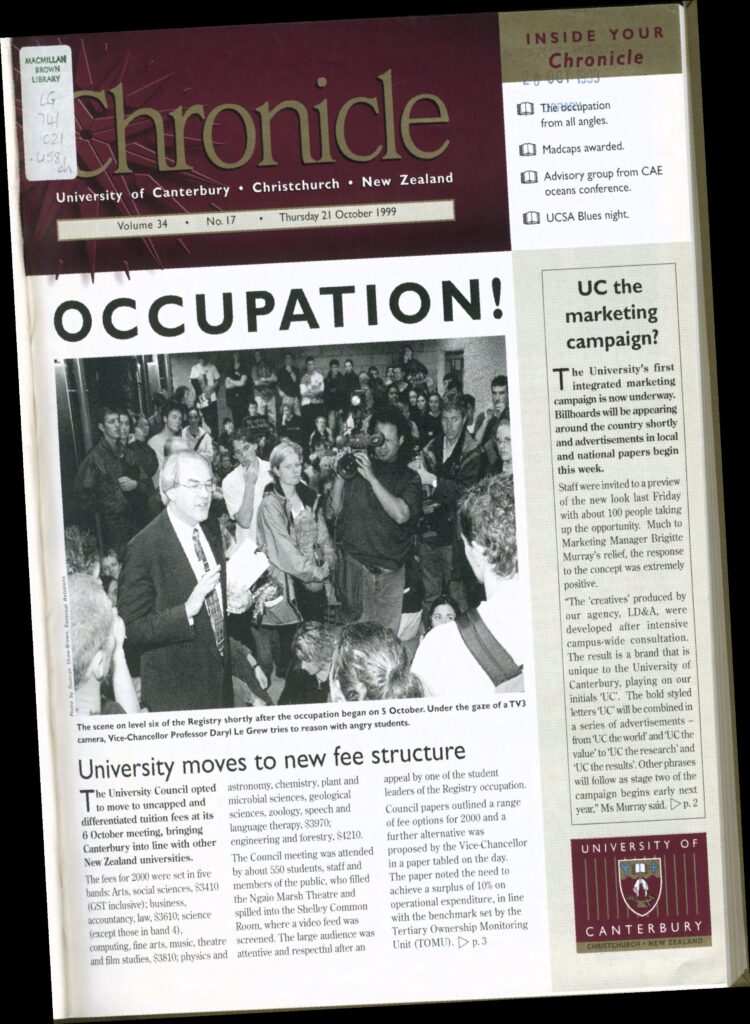
When morning arrived, the occupiers formed up in picket lines to stop management and clerical staff from entering the building. This action shut down the university’s financial operations. Through the day, most students guarded the doors while some toured lecture theatres spreading the news. When council met that afternoon, vice-chancellor Le Grew announced a backdown. He proposed lower fee rises ranging from 6 percent to 31 percent. 12,000 students are saved up to $800 each.
The occupiers, however, stuck to their demand for a zero fee rise. On Thursday morning, negotiations with management broke down. Believing the police had been called, the occupiers prepared again to resist eviction. The call went out for support. They cheered and chanted as columns of up to 100 students marched from their classes to join the mass pickets. Many staff members joined them. The police never arrived.
Defusing such a mass movement at Canterbury should not have been easy for the bosses. On the first day, Le Grew had called the police to evict the student occupiers. But when the police turned up, they said the numbers were too big and left.
It took a group around the president-elect of the University of Canterbury Students Association (UCSA) to do the job for him. Despite the fact that two days of occupation had just delivered the biggest single win for students in a decade, they argued that students should take their cause through “official” channels rather than continuing the mass action. They proposed a compromise with management to push the issue into the parliamentary arena. They said the occupation should end if Le Grew agreed to organise a national tri-partite forum of students, staff and management to lobby political parties in the run-up to the election.
After two hours of negotiations, management agreed and offered more concessions. Having already cut back fee rises for 2000, Le Grew now promised a zero fee rise for the 2001 year as well. The group of socialist students was too small to carry the arguments against the tri-partite forum. A majority of occupiers were swayed to accept the compromise. On Thursday afternoon, just hours after hundreds had rallied to their defence, they voted to leave.
The decline of the mass movement would again lead student executives to promote alliances with the bosses. The 1999 UCSA president announced: “Students commend the vice-chancellor for committing to this action.” The OUSA president went further. “University councils, students and staff from around the country”, he said “have been unanimous.” In the event, only one of the vice-chancellors invited to Le Grew’s national forum bothered to turn up.
But the action in Christchurch inspired students on other campuses. A day into the Canterbury occupation, students at Victoria stormed the registry building here. VUWSA Welfare vice president Alice Revell told the NZ Herald, “We are here to support Christchurch students and protest against the rising cost of education and the indication that our fees will be set after the term break, when we will not be here to speak out about it.” The protesters also said their action was in support of university staff who had voted to strike over the university’s demand for a wage freeze. The following Tuesday, Auckland students succeeded in breaking through and occupied too. I was there for that one, as well.
These actions further north did not succeed in reducing fee rises on those campuses. But the spread of mass opposition by students and staff up and down the country – and the huge support they were receiving – forced the National Party government onto the back foot during its third term. In 1996, National was forced to reverse its long-held policy of “targeting” for student allowances and promised to “work towards a universal system of living allowances for tertiary students.” Only the waning of militant action from 1997 would allow the government to renege on this promise.
And just one day before the Canterbury occupation in 1999, prime minister Jenny Shipley had publicly ruled out any move to cut interest on student loans. But two weeks later, after the occupations had spread from Canterbury to Victoria and Auckland, she did a u-turn. The National government announced that they would bring forward a 25 percent cut to interest rates and double the amount students could borrow for course-related costs. TV2 Headline News commented: “The government seems to have got the message from student protesters.”
A week after the Canterbury occupation, Labour Party leader Helen Clark spoke at the campus and thanked students for helping to push National from office – something that would finally happen the following month at the 1999 general election. At the same time, the protests also pushed the Labour Party to strengthen its tertiary education policy. As election year got under way in 1999, Labour’s policy announcements were all about interest on student loans. The anti-fees protests forced them to address the upfront cost of study as well.
Roper says that commentators would later claim that the 1990s student protests “were ineffective, pointless, or counter-productive. But the historical evidence suggests otherwise.” Much more could be said about the effect of the 1990s student movement on course cuts, job cuts, privatisation, corporate influence on teaching and research, academic freedom and attacks on student unions. But this talk has been about fees. It’s safe to say that the anti-fees protests saved students tens of millions of dollars.
Although we didn’t know it at the time, the 1999 Auckland occupation would mark the end of a decade of struggle. A year later, the student movement against fees was gone, almost without a trace. By the end of 2001, the only EAG still functioning was at Victoria University.
Why did this happen?
Two things spelled the end for the mass militant student movement against fees. Firstly, the Helen Clark Labour government which took office at the end of 1999 imposed a one-year nationwide freeze on tuition fees. This represents perhaps the biggest victory achieved by the 1990s student movement. But it also took the immediate heat out of the issue and defused the mood for protest.
And secondly, Labour’s election win splintered the unity between revolutionary and non-revolutionary activists in the Education Action Groups.
Many of the elected politicians on student association executives, although they usually keep quiet about it, are in fact members of the Labour Party or aligned with it. The convergence of views between student executive members and Labour is natural. Both rely on offering small improvements from above, within the existing system, to keep their privileged status. For some current MPs, like Chris Hipkins, Rachel Brooking and Ayesha Verrall – and past MPs like Grant Robertson, Andrew Little and Helen Clark – toeing Labour’s line as a student politician leads to a high-flying parliamentary career. Even though student politicians played minor roles, at best, in the EAGs, their official support still mattered. After 1999, they withdrew support for student protests against their own party in government.
Compounding this problem was the entry of the Alliance Party into a governing coalition with Labour. Staunch Alliance, the party’s youth wing, had been one of the main groups active at the national level within the EAGs, along with the left-wing Student Christian Movement and the now-defunct Radical Society and Aotearoa Youth Network. With their own party also now in government, Staunch Alliance was divided. The activists who wanted to keep campaigning against fees were sucked into internal struggles within the Alliance Party. This left ISO, the Socialist Workers Organisation, and the other revolutionary groups. And we were simply too small to sustain the mass organising needed to take on the Labour government when they started raising fees again.

Today, a new generation of students is rising to take action against fees, like these people in Ōtepoti this year. From the photos, you can see ISO is there again at the heart of the action.
The important role played by socialist organisations, like ISO, is generally written out of the history of the struggles in the 1990s. Without our involvement, there’s no doubt that those struggles would have been smaller, less militant, less tactically sophisticated, not as well informed politically, and less effective. Our view has always been that building the campaign against fees and building ISO are not mutually exclusive goals, but inextricably linked and mutually reinforcing.
ISO is fighting to change the government at the 2026 general election. But we know that Labour will only disappoint students and that we will need to protest against Labour again, like we did in 1989. To avoid demobilisation under a future Labour government, we need to grow the organised socialist presence on campus. If you agree, please consider joining us.
Nō reira tēnā koutou, tēna koutou, tēnā tātou katoa.
Banner image: Student protestors march up George St to protest fee hikes, 1994