As the New Zealand 2026 general election draws ever nearer, each party is announcing new policies that aim to tackle the ongoing rise in food costs amidst the current cost-of-living crisis. While the National Party and Labour Party argue over whether splitting the supermarket duopoly vertically (splitting Foodstuffs in half) or horizontally (separating wholesale from retail) would be better for workers, the Green Party have announced a proposal to open 120 state-owned supermarkets to regulate, and drive down, food prices. The Greens’ proposed reform has unsurprisingly been met with hostility by their party oppositions: Winston Peters called it “textbook communism by stealth”, while David Seymour likened it to slicing a star tennis player in half. These types of responses are undoubtedly reactionary but they do beg the question: what would food production and distribution look like under socialism, and, are these policies how we get there? (Spoiler: no.)
The Local Debate
While the new Red Scare haunts the Greens, their own reasoning for state ownership is to encourage competition, a fundamental tenet of capitalism. At the same time, responses to both National and Labour’s aims to intervene in the market have been negative amongst the right for their supposedly “anti-business” agendas. Metiria Stanton Turei, former Green Party co-leader, summarises these contradictions: “The Green Party’s policy will increase competition, which is confusing, by setting up a publicly-owned supermarket, which is totally on-brand. The National Party’s policy will increase competition which is on-brand, by confiscating private property, which is totally confusing”.
The seeming ruptures to party positions that the supermarket duopoly reveals is a microcosm of a key contradiction of capitalist economics: competition for profit (which capitalism relies upon) will necessarily lead to uneven accumulation and concentration of wealth, resulting in the formation of monopolies. The series of mergers and acquisitions that led to Foodstuffs and Woolworths now occupying 82 percent of the market, and hiking prices as they choose, is a clear example of this. Yet, the presence of monopolies in the market threatens the very competition that capitalism relies upon to incentivise making more profit. When this happens, the state must intervene. While parties like ACT want to pull down any legal barriers to supermarket development and let the free market run its course, we, as revolutionary socialists, understand that the notion of self-regulating competition in the “free” market is an ideological and ahistorical fallacy. Capitalist wealth accumulation and the crises it generates are the result of the relentless drive for short-term profit, and any legislative reforms that aim to regulate this drive, whatever relief they provide in the short term, ultimately work to uphold and sustain the tides of capitalist production that created those problems in the first place.
To be clear, this does not discount reforms altogether. The Greens and Te Pāti Māori, like Mamdani in New York, put forward their reforms under the philosophy that people shouldn’t be priced out of access to healthy food. This is good, necessary, and true. But they do so through a system that is fundamentally opposed to that aim, using mechanisms that do nothing to advance the working class on its own terms. These reforms are band-aid fixes for a broader system of production that is violently unsustainable and exploitative. To properly tackle the problem of people going hungry, of unhealthy food, and inhumane and irrational agricultural practices, we need to tackle the production process itself.
The Global Reality
The food system is a global supply chain that, under global capitalism, is focused entirely on producing profit. Within this system, food is treated as a commodity: it is something to be bought and sold for a profit. This drive for profit encourages cheaper production in pursuit of higher sale prices, incentivising lower quality food and more extreme labour exploitation. Animals become products, pumped with hormones and antibiotics and crammed into tiny enclosures filled with excrement and corpses. Agricultural workers are also deeply exploited, working in high risk jobs with very little safety precautions or labour rights to support them. In Aotearoa, 25 percent of work fatalities and injuries happen in agricultural jobs, despite only making up 5 percent of employment. This work is also predominantly left to poorer or immigrant populations who, because of their societal precarity, will work in worse conditions for less pay.
Food production under capitalism is also ecologically-irrational and one of the largest contributors to the climate crisis. COVID, avian, and swine flu all have their roots in capitalist agricultural practices that strip areas of diversity in order to collate livestock into inhumane and unclean spaces that foster virus transmission. Equally, agriculture accounts for 70 percent of deforestation and 78 percent of ocean and freshwater pollution, creating massive dead-zones in the sea. The climate crisis, in return, causes detrimental impacts to food production through droughts, floods, and fires. Internationally, single-crop farming not only decimates the ecosystem but makes the communities that produce it, largely located in the Global South, reliant on imports from overseas, meaning the Global North can export food to those places at exorbitant prices, often leading to famines. This loss of self-sufficiency has been called “food imperialism”.
Essentially, cheaper food prices at the checkout does not mean that exploitation stops along the way. In fact, it often relies upon that exploitation – cheaper labour can be employed by capitalists, either through a local precarious strata of the working class or the purchasing of foreign labour power, to lift profits through higher rates of exploitation. Famines and starvation today are a result of structural and political conditions. And we are seeing how these cycles of production under capitalism can be, and are being, weaponised. Israel is not only blocking aid from entering Gaza, it is further entrenching its genocidal assault through ecocide: spraying their crops, destroying their fields, and making targeted attacks at their bakeries that strip Palestinians of any agency over their land and food production.
It is well known that we produce enough food to feed the entire world population, and more. Food insecurity is not an issue of our productive potential, but of the structures that have been built that hoard wealth and resources at the expense and exploitation of the masses. A 2025 study revealed that Aotearoa wastes 1.22 million tonnes of food every year, which equates to 237kg per person, annually. More frightening is the estimation that this is 30–40 percent lower than the international average. How can the overproduction of food equate to the perpetuation of hunger? John Peterson from Socialist USA sums it up well: “In short, the knowledge, technology, and collective potential to completely transform the way the world eats exists now. What doesn’t exist is a social structure that allows for a rational and balanced approach to food production, distribution, preparation, and consumption.”
A socialist food system would not mean a return to a mass peasant population who toil the land day in and day out. It would utilise the means of production already available to us for the good of all – humans, animals, and the planet – not the benefit of the few. Capitalism has reframed “excess and waste” into “abundance is power”. When profit accumulation is out of the equation, there will be no incentive to ravage the land and destroy the very earth that provides us with the sustenance we need to survive. Communities would no longer be reliant on mass-producing crops for exportation, and could return to sustainable practices and regain agency over their reproductive labours. Food production would be reciprocal, both with the land and with others, while we also maintain collective power to distribute food across the world where it is needed, rather than where it is profitable.
In the context of Aotearoa, legacies of colonialism are also embedded within these problems. Confiscation of land, pollution of waterways, and the active destruction of mātauranga Māori destroyed sustainable food practices and violated the right to tino rangatiratanga. Māori and Pasifika communities are disproportionately more likely to experience food-related, preventable health issues, and face twice the rate of food insecurity than non-Māori. The commodification of food under capitalism impacts physical, spiritual, and cultural wellbeing, and only through restoring food sovereignty to all, by forming a system around human need not private profit, can reparations be made.
Fundamentally, we, the workers, should have control over how we produce and distribute food; it should be a public question, not a private one. Putting a vote towards a party that may or may not work towards giving us cheaper food prices at the end of the supply chain, while a necessary democratic act, is nowhere near the amount that needs to be done to decommodify and de-weaponise food. At a time when supermarkets store shelved food in security boxes, and employ guards to man the entrances, we need, now more than ever, an international socialist revolution to enshrine food as a basic human necessity that everyone should have access to, and agency over.
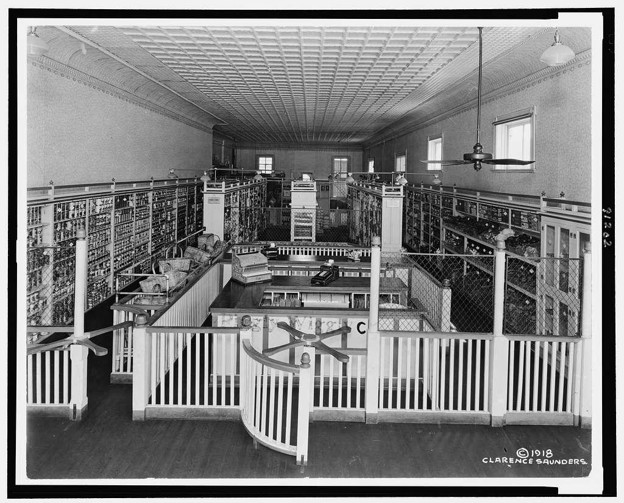
Banner image: The gloomy interior of the first self-service, one-stop supermarket (located in America): The Piggly Wiggly. Turnstiles were implemented to stop people stealing and had the effect of creating a prison or barn-like atmosphere. Clarence Saunders, 1918. Public Domain.