A wave of privatisation is headed for Aotearoa’s public education system. The Coalition Government has enacted a “shock doctrine” that has eroded, from all sides, the public system’s capacity to provide appropriate education for our ākonga, and part of this attack has targeted teachers. Specifically, New Zealand faces a chronic teacher shortage, while attrition rates for student teachers are as high as 45 percent.
This is because student teachers must complete, roughly, six and a half months of placement in schools to earn their qualification. This is a crucial part of their training. Their profession demands that they are educated, cognisant of the needs of the individual, and yet able to manage a classroom of up to 28 children (from years 4 to 8) by themselves. Talented teachers cannot learn and develop these skills by doing coursework or through observation alone. This kind of expertise is only learnt by actually doing the mahi.
However, at least 14 weeks of this work is full-time; the other 14 weeks are part-time. Often they are supporting stressed out teachers in understaffed classrooms. All of this work is unpaid.
Many students, as a result, experience “placement poverty”. Due to their demanding workloads, as well as having to complete regular coursework, most aren’t able to secure an income while on placement. Some are eligible for the student allowance – a couple hundred dollars per week – but most are not. The financial strain of training, amid a cost-of-living crisis, means that the students are dropping out.
In response to this crisis, NZEI Te Riu Roa, New Zealand’s largest trade union, has begun to campaign to secure paid placements for its student teachers.
Socialists and Reforms
So why do socialists fight for such reforms? Chapters of Marxist history are dedicated to the demolition of the idea that socialism can be made manifest by conscientiously reforming capitalism to make it more democratic and worker friendly. Capitalist accumulation relies on exploitation; only revolution provides the creative (and destructive) forces necessary for remaking society.
That being said, reform and revolution are not two diverging paths in the woods. As Rosa Luxemburg writes, “They condition and complement each other, and are at the same time reciprocally exclusive, as are the north and south poles, the bourgeoisie and proletariat.”
In other words, reform and revolution exist in relation to each other. The purpose of reform isn’t the realisation of socialism but, 1) as a means of immediately improving the condition of the workers and 2) as a front for the proletariat to engage in class war, to develop its capacity for self-organisation and class-consciousness.
On the other hand, revolutionaries don’t sit around waiting for the all-important revolution. Ultra-leftism – opting not to fight for reforms, vote, or work with trade unions – will only ensure that said revolutionaries will be isolated from whatever workers’ movement occurs. It is not a given that the working class will turn to socialism. Therefore, it is necessary that socialist revolutionaries connect the relevant working class struggles to a socialist future and, by having that tangible link, when the time comes, the proletariat will more likely take on its revolutionary role. This was the challenge André Gorz sought to overcome in his 1964 book, Strategy for Labour: A Radical Proposal. The communist movement in France at the time was politically isolated, relying on the idea that capitalist collapse was inevitable and that the general immiseration of the proletariat would make socialism self-evident. Revolutionaries were reluctant to fight for real reforms. Better conditions for the working class, they believed, would weaken their appetite for revolutionary upheaval and mean inadvertently strengthening the system itself.
Gorz took issue with the way in which this strategy led the movement to act defensively. By not acting proactively, communists were allowing capitalism to define what changes occurred to make the system somewhat bearable. These measures, while posed as dividends to everyday people, do so by subordinating people’s real needs to the logic of the system. For example, the Green Party’s policy to break-up the supermarket duopoly by creating a third, nationally-owned competitor is a welcome change, but it sees the cost-of-living crisis as resulting from a lack of competition. Should the Greens be elected, this reform would likely bring some immediate respite for the working class amidst an economy that is increasingly hostile, but it wouldn’t solve the crisis. In the meantime, it hands the mandate for issuing reforms to parliament and reinforces the sentiment that there is indeed no alternative. This is what Gorz would call a “reformist reform”.
In contrast to this, he develops the idea of “non-reformist reform”, a strategy that centres the struggle for immediate material gains, whilst keeping in mind the long-term goal of radical rupture from capitalism. “A not necessarily reformist reform,” Gorz writes, “is one which is conceived not in terms of what is possible within the framework of a given system and administration, but in view of what should be made possible in terms of human needs and demands.” The priority is to platform a method of political change that is based on what is necessary to live, not what is necessary for the system. “Non-reformist” reforms deliver immediate material relief – we are not fighting for police bodycams and women CEOs – and are aimed at the whole of the relevant group, not just a token minority. The idea is to pursue changes that strengthen the working class and prepare them for future battles.
In the struggle for “non-reformist” reform, the working class has to organise for itself the political momentum necessary to win. It cannot rely on capitalist functionaries to deliver its demands, and reformist tendencies will look to filter worker demands through the apparatuses of parliament and the electoral system in order to disempower workers and subordinate their needs to the needs of the state. To this extent, how a reform is won is almost as important as the material relief it provides. As Mark Engler writes, “a $1 an hour raise extracted through a bitterly contested strike is very different from an increase arbitrarily handed down by an employer or government functionary.” The experience gained by, for example, democratically organising within unions or campaign groups, agitating and gaining mass support, and winning fights against employers and/or police, teach the working class of today lessons that will inform their struggles tomorrow. In the words of Rosa Luxemburg, “The struggle for reforms is its means; the social revolution, its aim.”
The Case for Paid Placements
In April 2024, paid placements advocate Bex Howells presented a petition with over 16,000 signatures to parliament, urging the government to consider a placement stipend for students training in healthcare, education, and social work. Over a year later, in June 2025, the Select Committee report concluded that “all parliamentarians should take note of this petition when developing policies” yet did not refer it to the minister.
As it stands, the trade unions and Paid Placements Aotearoa will have to mount a greater and more organised struggle in order to coerce these demands from the government. In September 2026, NZEI Te Riu Roa hosted a webinar in which it invited Australian unionist Oscar Jolly to share his experience winning this reform in 2024. The strategy employed by the Australian Education Union involved expanding its pre-service student membership massively as well as engaging over 200 active student organisers. The extent to which this has/will be achieved in Aotearoa remains to be seen, but it should be noted, however, that a victory here can be the impetus for further struggles in the education sector. For tertiary students reeling from the cancellation of the fees-free programme, the skills and experiences learnt from NZEI’s campaign and the associated resources and networks established can provide crucial inroads in their campaign to restore fees-free. Similarly, a generation of teachers will also have had experience organising and fighting for “non-reformist” reforms and carry that experience on to fight for more expansive reforms. At its most essential, however, the paid placement stipend will mean that student teachers can have the financial confidence to continue their studies which means more support for teachers in the classroom and more support for our ākonga.
NZEI’s campaign is focused on teachers, but the desperation is felt outside this sector, in nursing, counselling, and beyond. A victory on this front can flow on to victories in other sectors. In Gorz’s time, socialist revolutionaries were reticent to fight for reforms out of fear that those reforms would be co-opted by capitalism and strengthen the system. This is a risk, of course, but it is a risk that needs to be met head-on. The most important aspect of “non-reformist” reforms is that they continue the fight: a victory on this front is the beginning of struggles in other sectors. For these reasons, the campaign for paid placements can be considered a “non-reformist reform.”
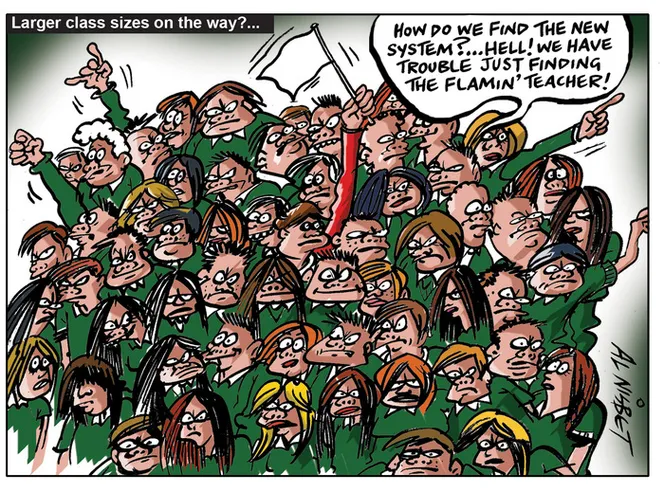
Image: Press (Christchurch, N.Z.). Nisbet, Alastair, 1958- :Larger class sizes on the way?… “How do we find the new system?… Hell! we have trouble just finding the flamin’ teacher!” 19 April 2012. Nisbet, Alastair, 1958- :Digital cartoons. Ref: DCDL-0021545. Alexander Turnbull Library, Wellington, New Zealand. /records/30665561