A Crisis in Achievement or a Crisis in Society?
Is education in crisis? It certainly seems so. Those of us who are working in schools have had to deal with the cavalcade of changes. That includes curriculum changes, attendance requirements, burgeoning school rolls, new systems, and administrative tasks. On top of this, operational funding per school is still declining since the increases announced thus far haven’t met inflation since 2022. As a result, schools have had around 13 percent less funding since then, forcing them to do more with even less. We still have a severe teacher shortage: one in five appointments in secondary schools are unable to be filled. It certainly feels like a crisis.
A Crisis in Achievement
At the end of 2023, New Zealand recorded its worst-ever results in the OECD’s Programme for International Student Assessment (PISA) tests of reading, maths, and science amid an unprecedented global decline in performance. This was seen by many in the media and parliament as the real crisis in education. But PISA scores themselves are not an effective means of comparison, with relatively few actual comparable countries. There are real questions as to its usefulness in being able to judge the effectiveness of educational systems when so many other things impact on whether a student learns.
Significantly, over this period of time domestic testing (National Monitoring Survey of Student Achievement, NMSSA) has not shown any significant changes in achievement in 20 years of study. Indeed it seems that since the Tomorrow’s Schools Act there has been little to no meaningful movement in writing, reading, and mathematics. It should be clear from this data that solving educational achievement problems cannot be separated from health, welfare, housing, and employment policies.
In the lead up to the 2023 general election, the National Party focused on this crisis in education, saying that radical change was needed. New Zealand First and ACT both focused their ire on the new Aotearoa Histories Curriculum, as well as pursuing their goals of the expansion of charter schools. Much of the policies put forward by minister Erica Stanford had already been drafted by the New Zealand Initiative, the right-wing think tank that has long pushed for a complete restructure of the education system in New Zealand. Its blueprint for education and the recommendations it has put forward have been adopted word-for-word by this government. This embellished crisis in education has allowed the Coalition to justify their attacks. Rather than actually funding education appropriately, the Coalition’s plans set the stage for a wholesale privatisation of our education system.
The Medicine
Quickly announced after the election was a restructure of the curriculum: a curriculum dictated to us by the Ministerial Advisory Group (MAG) with ties to the New Zealand Initiative and an Australian education company. The stated intent was to reduce teacher workloads and provide clarity. The actual effect is to effectively script teacher work and reduce teacher agency so as to make it easy to replace qualified professionals with lower-paid replacements.
The extra workload it now takes to adjust to this new curriculum, the fourth draft of which we are expecting to see in a couple of months, has had little to no effective consultation with the wider body of professionals. In key areas such as History, Physical Education, Health, and English, the curriculum has suffered under culture war attacks. These are ideological changes that have a deep resonant change and in many respects reflect a nostalgia for education styles from the 1950s along with the racism that entails. This is all to say nothing of the last-minute amendments to Acts covering the education sector to remove Treaty of Waitangi references, passed under urgency.
Built within the new curriculum is the expectation that over time the marking of work will be performed centrally through the use of AI. The judgments of professional teachers are no longer to be trusted. Centralisation also enables the deprofessionalisation of the education workforce. We can see the beginning of this in the use of the SMART tool. This tool is to be used by every primary school in the country using AI-developed questions and centralised marking to track student progress ultimately for ranking purposes. The tool itself was created by Janison Education Services in an $85 million deal that occurred without the usual tender process; a recurring issue in the provision of education resources throughout minister Erica Stanford’s tenure.
Profession Under Attack
The Education and Training (System Reform) Amendment Act 2026 passed its third reading on 23 June. It, like so many others, passed under urgency with little debate, and with last-minute revisions that fundamentally attack teaching as a profession.
The Teaching Council is the body that regulates teachers in Aotearoa New Zealand. It deals with registration, practising certificates, professional standards, conduct, competence, and the rules teachers are expected to meet. Until recently, teachers still had a majority voice on that body. There were 13 governing members: seven elected by teachers. six appointed by the minister.
Last-minute amendments to the Act mean that now all of these roles are appointed directly by the minister. At the minister’s discretion they may change the curriculum at will without consultation. All setting of teaching professional standards and codes of conduct has been taken from the Teaching Council and placed in the Ministry. The attacks on the professional body of teachers mirrors those on the Nurses Council and Medical Council, seeking to silence critics of this government’s policies.
The changes to the Teaching Council passed under urgency, reflecting an already challenged professional body. David Ferguson became the new chair of the Teaching Council last year, appointed to the role by the minister after the previous chair was removed following accusations of misspent funds. This is seen as a massive conflict of interest, as Ferguson is also the founder of the Teacher’s Institute – a private Initial Teacher Education Provider that was started last year. The Teaching Council not only upholds the standards for the teaching profession and other jobs listed above, it also regulates Initial Teacher Education. Student teachers pay the Institute to learn, and schools have to pay the institute $4,000 for the privilege of training a teacher, and that student teacher is then supported and taught by a full-time teacher for minimal reimbursement ($3.20 per hour). One of the main pushes by this series of reforms is to push universities out of training teachers to further de-professionalise education.
Soon after this controversy surfaced, David Ferguson was then appointed to head ERO (Education Review Office), and he now also sits on the board of NZQA. ERO has also undergone significant changes under this Act. The ERO will be empowered to deeply investigate and rank schools according to very broad criteria, including attendance and achievement. If schools are really challenged they will get ranked down on their review, and they will then be labelled a “School of Concern.” Once so-ranked, they can then be taken over by a charter school. What this new system does – and this is where all the standardised curriculum, script teaching and consistent test tracking, the SMART tool, and the ranking of schools is focused – is to enable the identification of low-ranked schools to enable privatisation.
Also in the Education and Training Amendment is a massive expansion to charter schools. They will now be allowed to form chains of schools. Under the current legislation, New Zealand schools could be “forced” to become charter schools by an authorisation board, with teachers, principals, and communities having no recourse to this decision. Charter schools are private businesses that get their assets transferred over from the state and have free rein to abandon the curriculum and hire whomever they want, for whatever pay they wish. They are also currently funded at an average of seven times the amount the state system provides per student. This is just another money-making exercise built upon the exploitation of our ākonga.
The Crisis in Society
We can now see that everything is in place for a massive wave of privatisations in schools. We know this because these are the exact steps taken in the UK by successive conservative governments. In the UK in 2010, academies (their version of charter schools) were a fringe, just 2 percent of schools nationally. Cut to 2025 and now 80 percent of secondary schools, 40 percent of primary schools, and 44 percent of special schools are academies. This explosion in privatisation was facilitated by a standardised curriculum, the de-professionalisation of teachers, and the expansion of Ofsted (the UK’s version of the ERO). James Kerr, a London-based teacher and national executive member of the National Education Union, states:
A school that fails their Ofsted inspection can be forced to become an academy and join one of the big chains of academy schools. This also applies to schools that have been graded with a ‘notice to improve’ in consecutive inspections. This puts a huge amount of power into the hands of the Secretary of State for Education. Government claims that academies would increase local control and democratise education just aren’t true.I’ve seen funding taken away from teachers, children and learning support on the front line, and diverted to pay packets for managers.
Ofsted has come under increasing scrutiny after one of their intense inspections lead to the suicide of a head teacher, Ruth Perry, after declaring the school she ran to be a “School of Concern” and forcing it to become an academy.
This government has consistently suggested that there is a crisis in education that only a wholesale restructure of education can fix. This is our own shock doctrine, the embellishment of a crisis in curriculum, in teaching standards, in education oversight, in our schools, to justify the privatisation and commodification of education.
We don’t need to be told that there is a crisis, but it’s not so much a crisis of numeracy and literacy. It’s much larger than that, it’s a crisis of a society struggling to do the bare minimum for our ākonga. It is no wonder that students struggle to learn, arriving at school hungry, cold, and unprepared, when having to deal with the poverty and inequity inherent under late-stage capitalism. Privatisation will not improve education, only increase this divide between the haves and have-nots.
The government’s attacks on education are a galling change when we consider the world we want our ākonga to be ready for. A world where AI challenges their very concept of employment, where climate disasters ravage the planet. We need a society of critical and creative thinkers that can take on the challenges that are at our front doorstep. All this government is offering is privatisation and exploitation.
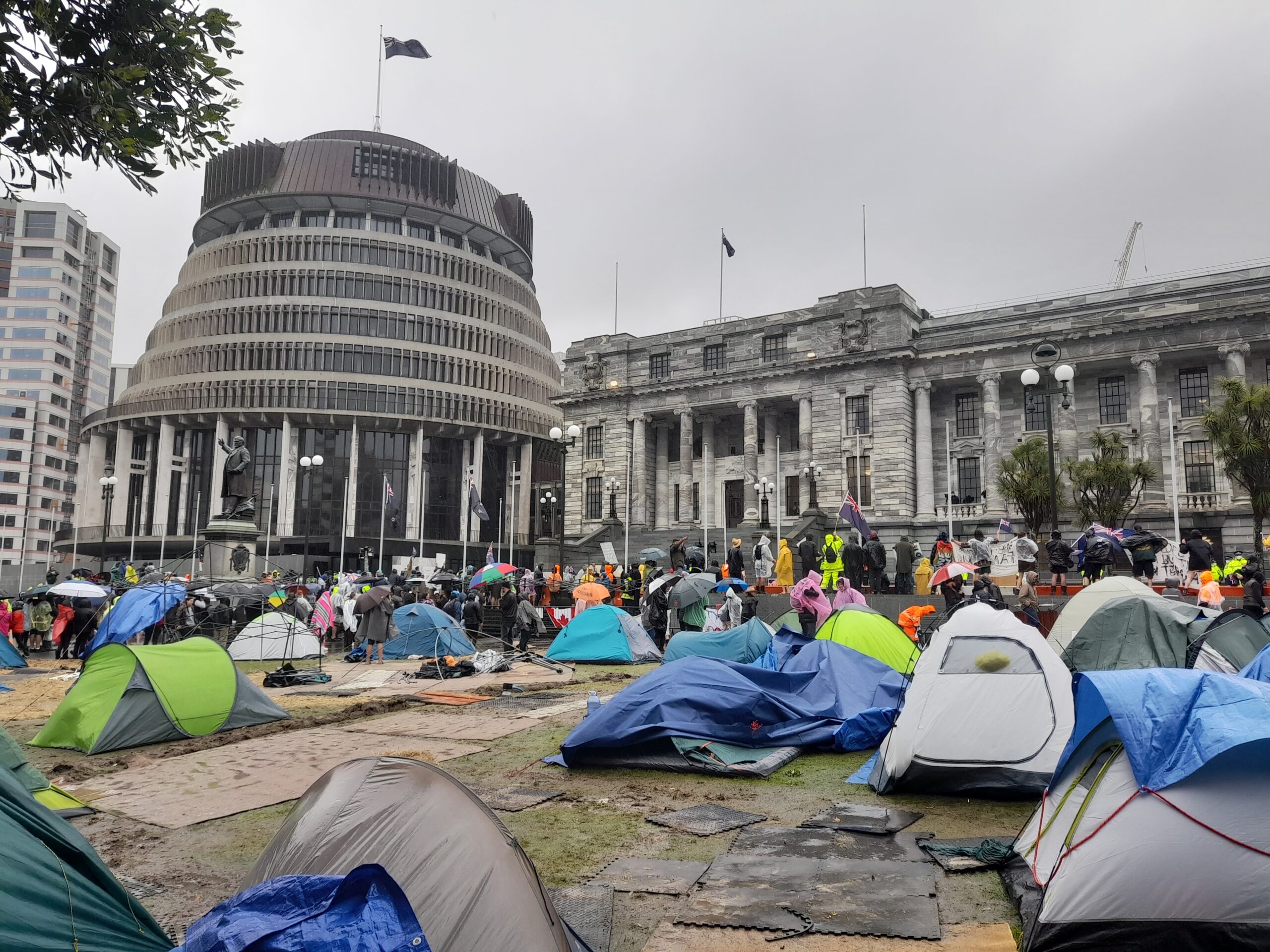
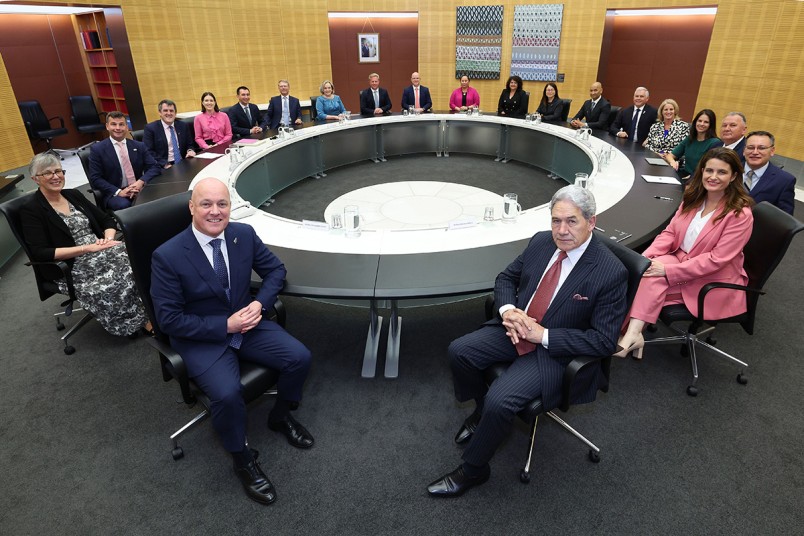
Photo caption: Luxon Cabinet, November 2023, including minister of education Erica Stanford 5th from front on the right side. Photo credit: Department of the Prime Minister and Cabinet, Wikimedia Commons, CC BY 4.0.