We can learn much of value from the student struggles of the 1990s for the student struggles in the second half of the 2020s against high fees, inadequate provision of student allowances, and rising student debt.
General Context – Rapid and Comprehensive Implementation of Neoliberalism
The background to the big student struggles of the 1990s was the rapid and comprehensive implementation of neoliberal policies from 1984 to 1999. The Fourth Labour Government adopted a monetarist approach to managing the economy, with the Reserve Bank pushing interest rates beyond 20 percent, crashing the economy, and dramatically increasing unemployment. 132,000 public sector workers lost their jobs due to a programme of commercialising, corporatising, and privatising large areas of state activity. The resulting recessions eventually reduced the rate of inflation, but only through the permanent entrenching of mass unemployment, which had been virtually non-existent for the entire period from 1945 to the mid-1970s. In the 1988 budget, this Labour Government implemented the largest tax cuts for the rich in New Zealand’s political history, while increasing the amount of tax paid by those on low and middle incomes.
Disgusted by openly pro-business neoliberal policies such as these, Labour was abandoned by many of its working-class and middle-class supporters in the 1990 election. Just over 5 percent voted for the breakaway New Labour Party – formed by Jim Anderton in opposition to Rogernomics. Others simply didn’t vote or voted National, attracted by its promised moderation of Labour’s extreme policies. National won the election, but as a political scientist observed at the time, “this result was much more a condemnation of the performance of the Labour Government than any endorsement of National’s policies” (McRobie, 1992, p.409).
Far from creating the “Decent Society” it promised, once elected the Fourth National Government proceeded to attack unions and cut social spending in areas such as education, health, housing, welfare, and superannuation. These policies were very unpopular. As Vowles and others observe, “National’s reforms were profoundly unwelcome. Its reputation further damaged by a sluggish economy and record unemployment, National’s popularity in opinion polls reached an all-time low for any government. From a high of 50 percent support just after the 1990 election, National dropped to a mere 22 percent by late 1991” (1995, pp.7–8). By September 1991, 66 percent of those polled considered that “things in New Zealand are … on the wrong track” and 72 percent were dissatisfied with Bolger’s performance as Prime Minister (NBR, October 18, 1991, p.4). Nine months later, 81 percent of New Zealanders considered that parliamentary politics was corrupt, 90 percent thought that all donations to political parties should be publicly declared, and 57 percent thought that business donations to political parties should be banned (NBR, June 19, 1992, p.1). The big student struggles of the 1990s emerged in opposition to a government that was widely hated.
Specific Context – Neoliberalism in Tertiary Education
The implementation of neoliberal policies during the period from 1984 to 1999 encompassed every major area of government policy-making, including tertiary education. The fundamentals of the neoliberal policy framework for tertiary education were introduced by three key sets of reforms. First, the introduction of tuition fees and neoliberal public sector management by the Fourth Labour Government in the late 1980s. For much of the social democratic Keynesian period in New Zealand’s political history from 1935 to 1984, university students had enjoyed close to fees-free tertiary education (average annual fees were $129 in 1982), a universal living allowance, and consequently no student debt. Labour tried to replace this funding model by introducing substantial fees, which were to be set at $1,250 in 1990. It also tried to introduce a fully privatised loans scheme with students having to apply to the banks for their loans at market rates of interest (which had been recommended by Treasury, but the largest student protests since the 1970s forced the government to abandon this plan. As Brookes and Colyer (1999, p.26) observe, “The July [1989] protests were the biggest student demonstrations ever seen in New Zealand. Across the country, more than 20,000 – a third of the total student population – took to the streets. In Dunedin, more than 5,000 students from the university, teachers’ college and polytech occupied the Exchange.” 7,000 marched in Christchurch, and thousands marched in Auckland and Wellington. The first attempt to introduce a student loans scheme was defeated by mass student resistance.
The second key set of reforms was the shift towards tightly targeted student allowances, student loans, and declining government funding per student under the Fourth National Government during the 1990s. This shift is what provoked the big student protests of the 1990s. This will be discussed in the next section.
The Fifth Labour Government introduced a further set of neoliberal reforms. It maintained tightly targeted student allowances and student loans, while reorganising the funding and governance of tertiary education with the establishment of the Tertiary Education Commission (TEC) and introduction of the Performance Based Research Fund (PBRF). It did, however, do several things that helped to quell struggles against the neoliberal funding regime for tertiary education: it made student loans interest free while students were studying, slowed the rise of fees, and boosted funding for tertiary education providers. None of these changes seriously rolled back neoliberalism. Rather, it helped it to become more deeply entrenched.
The Spark – The Revival of Militant Student Protest at the University of Otago
Student resistance to the Fourth National Government’s imposition of rising fees, declining allowances, and rising student debt started at the University of Otago with several important protests in 1993. To understand what prompted this resistance, it is necessary to grasp some details pertaining to how the government changed the funding model for tertiary education. It further tightened the eligibility criteria for student loans by lowering the parental income threshold, thereby depriving around two-thirds of students of access to a living allowance. In its 1990 election campaign, it promised to abolish Labour’s unpopular fees but then sharply reduced government funding per student, which forced universities to raise fees by a large amount each year (involving proposals and actual increases ranging from 17 percent to 45 percent each year from 1993 to 1996). Finally, it introduced a student loans scheme that was state-funded but charged students with a rate of interest that was well above the rate of inflation (e.g. a 9 percent interest rate in 1993 when inflation was 2 percent).
The first of the Otago protests took place as part of a national week of action, with the government releasing its budget on 1 July. That day, around 200–300 students marched and staged a sit-in outside the National Party offices. It was a successful protest and helped build the campaign. This was the first protest in which the International Socialists (IS), established in March, had a small but organised presence. The IS, along with other groups favouring militant civil disobedience as a tactic, then argued for further mass militant action. The next important protest aimed to set down the University Council meeting scheduled for 3 August. This meeting was to make a final decision to increase fees by 33 percent to 45 percent for different categories of students.
At the Education Action Group (EAG) organising meeting prior to this protest there was lengthy debate as to whether or not an attempt would be made to occupy the Registry for the first time since 1971. Moderates, which included OUSA Campaign Coordinator Joss Debreceny and OUSA Executive members such as Rachel Brooking, argued against an occupation [Editor’s Note: Brooking’s involvement began in 1994, not 1993, having commenced study in 1994 and being elected to the 1996 OUSA Executive]. OUSA President – Grant Robertson – although not present at the meeting, repeatedly argued against mass militant action to stop fee rises. Members of the IS, an environmental activist group, the New Labour Party, and the Student Christian Movement consistently argued for it.
On 3 August, over 400 students, many going on a protest for the first time, marched to the Registry, entered the building through the main entrance, and filled the corridor leading to the Council Chamber. A police officer warned the crowd that if they didn’t leave, then they would be arrested for trespass. In response, IS members led a chant, “We won’t go, fees must go!” In the space of several hours, this group of protesters had become sufficiently radicalised to stage a sit-in that forced the Council to adjourn the meeting. The chanting was so loud that they couldn’t conduct the meeting. It was a rousing victory that further built the campaign.
The next protest was the most important of the year. The next Council meeting, scheduled for 28 September 1993, was intent on putting up fees substantially for 1994. The organisation of this protest took things to another level. Four protesters entered the building in advance to try and open the doors from the inside, and the protest of around 800 students split into three groups seeking entry. As it turned out, protesters were kept out of the building by a large police presence and security guards. Being unable to gain entry to what was legally a public meeting, the aim shifted to preventing the Council members – who had voted for large fee rises – from leaving the building. There was also an aim to prevent the police from removing protesters who they had arrested. In response, police, some with riot gear, charged out of the main entrance, violently attacking the protesters to clear a path to a waiting van for the Council members. They injured around 24 protesters. But this didn’t break the spirit of the protesters, who then gathered around the van – some standing, most sitting down – to prevent it from leaving.
One of the risks of using violence to suppress a protest or campaign, from the perspective of the powers that be, is that it can have an unintended consequence. Far from effectively suppressing the campaign, it can fan the flames of revolt. Students were so outraged at the use of violence by the university administration and police to suppress a legitimate protest, that they became radicalised and even more determined to continue the struggle. The OUSA called a special general meeting to discuss what had happened and more than 600 turned up. The IS held a public meeting on police use of violence to suppress protest, with 68 attending, and 18 joining the organisation.
From this point on, the campaign went to yet another level both quantitatively and qualitatively. Numbers involved in major anti-fees and anti-debt protests at Otago in 1994 and 1995 ranged from two to three thousand. Around 60–70 activists were regularly attending EAG meetings. Qualitatively, the EAG and movement became increasingly sophisticated and effective in almost every respect. Protests were better advertised, better organised, tactically smarter, and more resistant to police infiltration and suppression. The latter was addressed through tactics such as having several civil disobedience targets, with a decision as to which would be used a short time before the march started. Police liaison was viewed as either best not happening at all, or else being delegated to someone who had no idea what was being planned. Targets for mass protest, sit-ins, and occupations were no longer confined to the University Registry, but broadened to encompass government agencies – such as the Ministry of Education, IRD, and WINZ (Study Link) – that implemented the fees and debt regime. When the National Party foolishly decided to hold a regional conference in Dunedin in 1995, protests were staged at the venue entrance, and delegates struggled to sleep as protesters used all sorts of noisemaking devices outside their hotel.
The Struggle Grows and Spreads
The Otago protests sparked and inspired protests at other campuses. Later in the year, Lincoln students occupied part of their Registry on 21 October. Canterbury students occupied their Registry for a week and forced the cancellation of the Council meeting that was going to put fees up on 3 November. Student protests were held on virtually every other university campus, even if they were smaller and less militant than the Otago and Canterbury campuses.
The Highpoint – 1996 Otago Registry Occupation
Although the student movement against fees and debt had grown and spread throughout the country, from 1993 to 1995 it remained strongest at Otago, in part due to the strength of its activist core, within which the IS played a leading role. While during 1994 and 1995 the tactical focus had moved off campus, mainly to focus on the government as well as the university administration, in 1996 the focus returned to campus. Activists were determined to have a “big push” focused on the Council meeting that was going to increase fees for another year.
As Brookes and Coyler (1999, pp.28–29) observe,
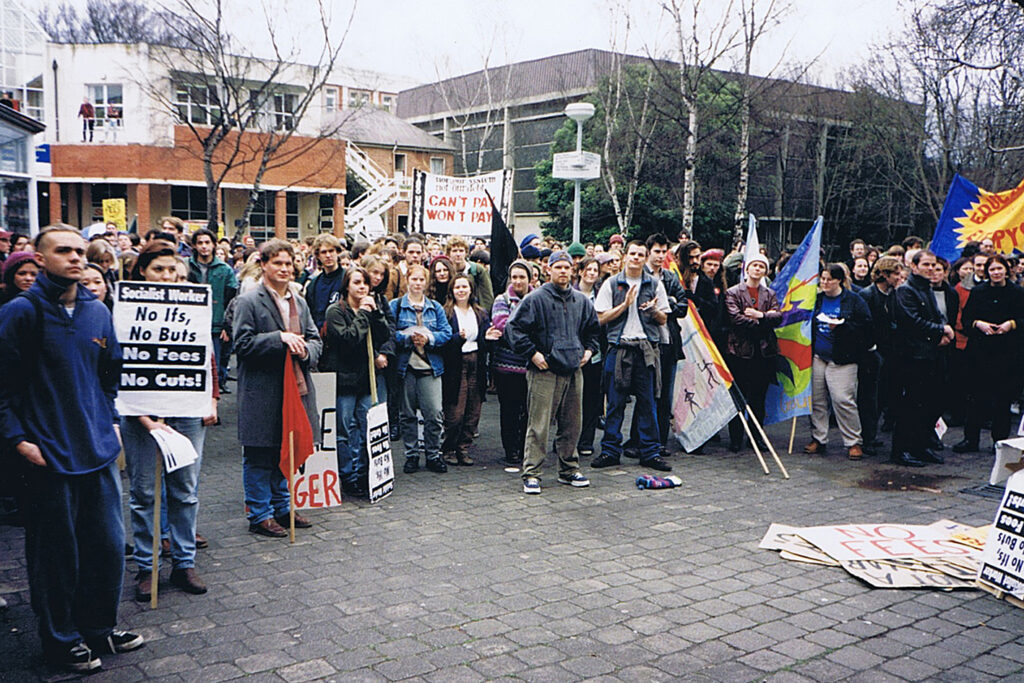
Council fees-setting meetings are traditional targets for student protests. But the Otago University Council had worked itself into such a feeding frenzy that the 1996 meeting was to consider options from the Senate Working Party on fees ranging from a 25 percent increase upwards. On Tuesday 13 August, the day of the scheduled council meeting, 500 Otago students stormed their registry building. Their demand is a nil fee increase for 1997. The next morning sees them still in the building and pickets stop the few managers who try to get into their offices. The authorities send the clerical workers home and students control the building.
During the occupation, general meetings open to all students are held to discuss every aspect of the campaign at least once a day. The debate often goes on for hours, but students feel for the first time that they have a real say. The occupiers know that holding the registry will take hundreds of students. Rosters are drawn up for occupiers to speak at lectures and at the hostels calling on more students to join them. They create occupation rotas so they can take turns to go home for rest.
On Wednesday night, as chance would have it, Alliance leader Jim Anderton is scheduled to speak at a local New Labour Party branch meeting. The occupiers invite him to come to the registry afterwards. The media storm that erupts on Thursday after chancellor Judith Medlicott issues a trespass notice against him amazes everyone.
But even more importantly, Medlicott’s move outrages academic staff already bearing grievances over their wage claim and inspired by the militant student action. The lecturers’ union calls an impromptu stopwork meeting on Friday morning. The meeting fills a 350-seat lecture theatre. A student delegation is sent to address the staff. The meeting unanimously passes a resolution of support for the students and no confidence in the chancellor and vice-chancellor. They demand that Medlicott drop the trespass order. That afternoon, she does. By Friday night, the university authorities have lost control. They plead with the occupiers to take over weekend security patrols to ensure safety on the campus. Then they contact the police to discuss how to re-establish their authority.
When the chancellor and vice-chancellor turn up to a meeting in the registry on Sunday night, they’re staggered as 500 students are there to meet them. But facing imminent eviction by the cops, students vote on Monday to end their occupation. They did not achieve a nil fee increase. But they did achieve concessions. The fee rise passed afterwards by the council was 17 percent. 15,000 students had been saved at least $100 each. But perhaps more important was the staff-student solidarity which had been built. The lecturers’ union had donated money to the occupation. And in a first for Otago University, 400 lecturers marched to the registry on the final day of the occupation to show support for the students.
In the wake of this occupation, students on other campuses throughout the country took similar action, also forcing smaller fee increases than originally planned.
Takeaways for the Current Struggle Against Funding Cuts, Fee Rises, and Debt
Of course, the socio-political forces, political parties, governments, and media commentators who have supported the implementation and maintenance of the neoliberal policy regime claim that protests are ineffective, pointless, and counter-productive. But is this really the case?
The historical evidence suggests otherwise. Although it is true that these protests did not prevent the implementation of a neoliberal policy framework for tertiary education, they slowed, limited, and, to some degree, shaped the formulation and implementation of this framework. They forced university administrations to implement smaller fee increases than originally planned. But much more importantly, the scale and militancy of these protests prevented the first attempt to introduce VSM legislation (in 1994), and privatisation of the universities and the introduction of a voucher system, with the universities charging students the fees equivalent to the full cost of providing their courses (Roper, 2005, p.202). They also ensured that the student loan scheme was state-funded and administered, unlike the privatised scheme that was originally proposed by Treasury in 1987 and that exists in the US today.
More concretely, the student struggles of the 1990s show that from little things, big things can grow. In the early stages of a campaign, the work of communication, education, and politicisation is crucially important. Students won’t just spontaneously show up to a protest opposing fees and debt. They must be convinced that the current funding regime is wrong, that there is a viable alternative, and that a movement can be built to achieve this alternative. We need to get enough accurate information out there to counter the disinformation used to justify the status quo.
With respect to protest tactics, the most important take-away is the need for mass resistance. It’s a mistake to engage in collective forms of civil disobedience with insufficiently large numbers. Not only are bigger protests more effective than smaller protests with respect to raising the consciousness and morale of those involved, but there is also safety in numbers. The police love to pick off a few key activists to kill a progressive campaign. Dragging activists through the criminal injustice system absorbs a large amount of their time, energy, and money. But when several hundred protesters stage an occupation or sit in, there isn’t much that the cops can do about it, because making arrests on that scale chews up too much of their time and resources.
Finally, the important role played by healthy socialist organisations, like the ISO, is generally written out of the history of these struggles. For example, without the involvement of the International Socialists (which became the ISO) in the Otago student struggles of the 1990s, there is no doubt that those struggles would have been smaller, less militant, less tactically sophisticated, not as well informed politically, and less effective. Our view was that building the education campaign and building the IS were not mutually exclusive goals, but inextricably linked and mutually reinforcing.
Sources
Brookes, Grant and Coyler, Dave. (1999). Students and the Degree Factory: A Marxist Analysis of the Crisis in Education. A Socialist Worker Pamphlet. Auckland
McRobie, A. (1992). ‘The Politics of Volatility, 1972–1991’, in Oliver, W.H. and Williams, B.R. (eds), The Oxford History of New Zealand. Wellington: Oxford University Press.
Roper, Brian. (2005). Prosperity for All? Economic, Social and Political Change in New Zealand Since 1935.Southbank: Thomson/Dunmore Press.
Vowles, J, and Aimer, P. (1993). Voters’ Vengeance: The 1990 Election. Auckland: Auckland University Press.
Banner Image: Otago students rally on 13 August 1996 before taking their protest to the University Council’s fee-setting meeting. Photo Credit: SocialistWorkerNZ’s photo, licensed as CC BY-NC-SA 2.0.