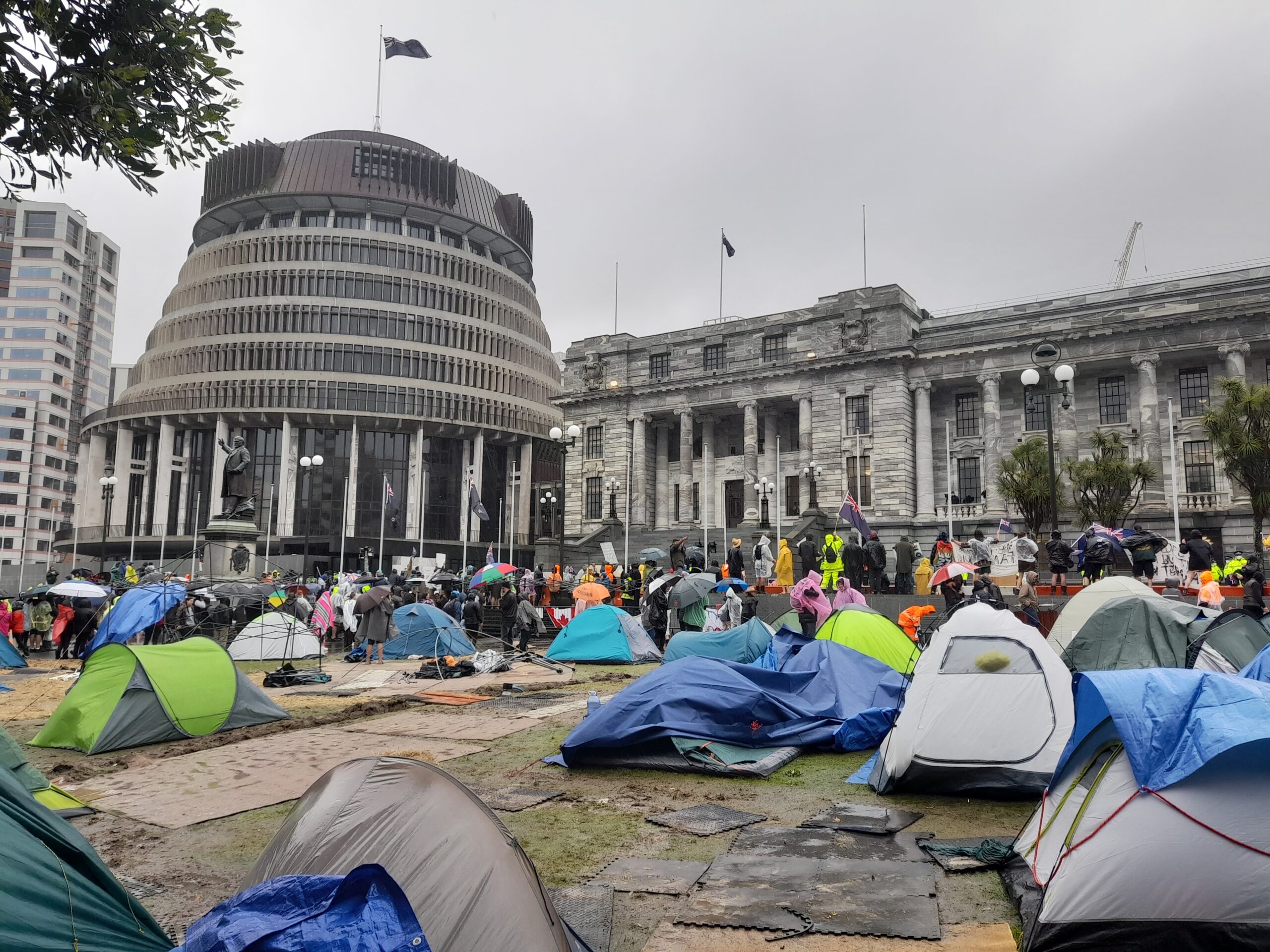
2026 may be seeing the birth of a new wave of student activism across Aotearoa. On 29 July, approximately 500 students struck and marched through the University of Otago campus to make themselves heard. The demonstrators called on the Government with four key demands: Fees-free education, funding above inflation, independent student unions, and universal student allowance. Three demands were also made to the university itself: No cuts, no fee hikes, and to defy government austerity.
Gathering at midday on the Union Lawn, the protest started with a shared speech given by representatives from the student union (OUSA) dressed in their green “debt monster” onesies. Already facing attacks on the education system across the board, several secondary school students were also in attendance. In a shared speech given by three local high school students, they outlined clearly that “this is what we want: a chance to learn without crippling debt.” Representatives of a generation of young people who will bear the full weight of tertiary cuts in the years to come, they were furious at “a government we had no say in electing, a decision we had no voice in, polluting our futures that they won’t even live to see.” Calling for defiance against the “myopic greed and individualistic mindset of our ruling class,” they rallied the crowd to not “let yourselves, your friends, your classmates fall into the fugue of political apathy.”
After some brief chant practice, the students began to march. Together they passed through the Link and back around past the Quad lecture theatre complex. The momentum and energy of the protest could be heard throughout the campus, with the sound of chants resonating through the halls and lecture theatres. Reverberating chants demanding “No ‘Ifs’, No ‘Buts’! No Fees! No Cuts!” shook the glass and concrete like the very architecture were in agreement. The day also saw the return of another popular call/response chant: “[politician name]! Wanker!” Some humorous tongue-in-cheek and a chance to vent, but what else would you call them?
For the last three decades, successive Labour and National-led governments have continued to maintain an ever-tightening neoliberal policy regime. This consistent trend towards fiscal austerity has seen steadily rising fees and simultaneous funding strangulation as our tertiary education is plunged deeper into the meat-grinder of the private market. Political figures from both major parties have essentially become talking heads for a doom-spiraling capitalist system set to leeching every cent and pound of blood from these students’ futures.
The march took a brief rest at the base of the University Clocktower for additional speeches given by Tertiary Education Union members Liz Breslin and Brandon Johnstone. The protesters and speakers weren’t the only ones gathered there. A small but noticeable gaggle of police officers and Campus Watch staff could be seen huddled closely to the entryway. After his own participation in the student occupations of the 1990s, vice chancellor of the university Grant Robertson seemed to be rather keen to ensure the door was closed behind them.
Brandon in particular spoke to the utter fatigue of inept bosses and representatives “pretending that they care – these bureaucrats, and focus-grouped politicians calling themselves ‘continuity candidates’, and this miserable chud government.” Instead, pointing to the strength of collective worker and student power, he reasserted that in the face of “being treated like cash cows to be bled dry by vampires here or in the Beehive” students and workers can “simply… stop. Stop working. Stop doing what you’re told.” As individuals, we hold very little negotiating power, but in organising and striking together, “they can’t argue with mass, collective disruption driven by a mass, militant movement. Instead, they’re forced to come to the table and bargain with you. United, you bargain. Divided, you beg.”
The final speech was presented by ISO member Annabel Hankin just outside the St David lecture theatre complex. In it she directly tackled the feckless complicity of the university in the face of austerity. She aptly identified that adjusting for inflation, the current tertiary education budget means “$310 million less going into tuition, research funding, community education, and access for those most underserved by the tertiary system,” with the university itself slashing “$16 million in ‘permanent savings’ – a nicer way of saying cutting staff and programmes.” This is on top of impending 6 percent fee hikes for the year that, if the university implements, “will be an almost 20 percent increase since the start of a three-year undergraduate degree.”
Annabel then finished her speech with a rallying call to action, emphasising that “Now is the time to be militant, now is the time to be strong, to stand together until we win.” Spurred on by this, the students were ushered in to occupy the St David building. In a calm procession abuzz with stifled excitement, people began to flow into the building. By the time the befuddled gaggle of officers at the Clocktower arrived at St David, it was counted that around 190 people were already in place in an active and committed act of civil disobedience.
The occupation proved to be a testing ground in democratic and collective decision-making. Decisions on various topics were called to a vote of yea or nay. Using a hands system, people were called to contribute in discussions towards the aims and next step of the occupation. After some collective deliberation, the occupiers unanimously decided to call on the vice chancellor to meet the crowd and speak to their list of demands. Despite initially demanding students come speak with him at another location, the crowd of student activists unanimously rejected this and pushed for Robertson to come to them, which he then did.
He spoke with all the smugness and noncommittal grace of a career politician, with much of the crowd being visibly irked by the lack of substance to his answers. Answering in the language of “fiscal responsibility,” Robertson placed particular emphasis on the need to return to surplus and continue cutting: the whole reason the crowd was protesting to begin with.
When asked if he “would be willing to personally take on any risk in [his] role as vice chancellor” to defend the university, Robertson was quick to state he “take[s] a huge risk being vice chancellor every single day.” What those personal risks are is somewhat unclear. Beyond the empty content of his answer, the former finance minister and deputy prime minister takes home a salary of $629,000 a year plus a house: hardly the position of a student activist being paid in debt.
When further challenged on this he was quick to pat himself on the back for giving a piddly 10 percent of it back to the university as scholarships, leaving him over half a million dollars of annual income before tax. As one can imagine, this wasn’t exactly popular with a crowd actively risking themselves in a sit-in. While Robertson may have the advantage of institutional backing in his bureaucratic appointment and a heavy windfall to land on, protesting students have no such safety-nets.
At three in the afternoon the crowd of young activists voted to disperse. Again, the vote was unanimous with everyone deciding together that the occupation should end on a high note. By making the call to end the sit-in together, it was agreed that the protest could be wrapped up with commitments to future action. Dissatisfaction with Robertson’s answers had reaffirmed the crowd that if they’re to gain concessions from the government and university, much more organising and participation from the student body will be needed. LikeBrian Roper’s own observations made in issue 23 of The Socialist on the student protest of the 1990s, “the most important take-away is the need for mass resistance … when several hundred protesters stage an occupation or sit in, there isn’t much that the cops can do about it.” If you want to join the student fightback, then contact the ISO and get involved.
Banner Image: Protesters gathering at union lawn for the 29 July protest. Credit: Mark McGuire. Creative Commons 3.0