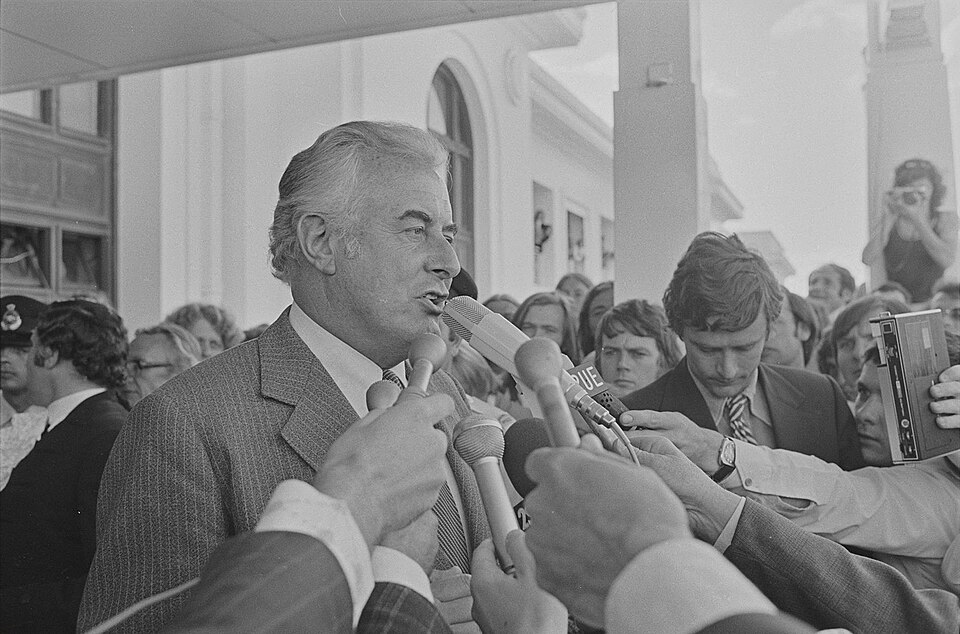
In the three short years he was in government (1972–75), Australian prime minister Gough Whitlam repealed conscription, withdrew Australian troops from Vietnam, introduced a universal health insurance system, abolished tertiary education fees, implemented equal pay for women, increased pensions, established a Department of Aboriginal Affairs, and much more. Yet, because he was beholden to the ballot box, he still had to capitulate to the ruling class. When working- and ruling-class interests began to conflict more sharply into the mid-1970s, he found himself subject to insidious abuses of capitalist power.
The Australian Labor Party (ALP) under Whitlam came to power in 1972, breaking 23 consecutive years of centre-right Liberal-Country/National Coalition rule. Whitlam and the ALP went to work immediately. Labor had clearly won before the vote count was completed, and Whitlam was unwilling to wait. He was sworn in alongside Lance Barnard in December 1972, and even though they were unable to put through legislation until the full results came in, they were able to enact some change, particularly around conscription and the Vietnam War. Though they were not able to end conscription at this time, Whitlam made Barnard the defence minister, and he was able to grant conscription exemptions to everyone who applied. Whitlam arranged for those imprisoned for resisting conscription to be freed, and ordered that Australian troops remaining in Vietnam were to return. When the full Labor government was in place, this trajectory continued. Whitlam put forward a truly staggering number of reforms, ones that Australians had been fighting for for decades. He showed that far from their hands being tied, the government did have the ability to act for its people.
However, Whitlam was still limited by the system he had been elected under, in the sense that the changes he instituted were both temporary and highly subject to the ire of capitalists and lobbyists. Although the ALP had a majority in the House of Representatives, the Senate (the upper house of the Australian Parliament), had been elected out of sync with the general election, in 1967 and 1970. ALP did not have a Senate majority, and the relationship between the House of Representatives and the Senate was somewhat hostile during the Whitlam years. Although they passed many of Whitlam’s bills, the Senate rejected 93 of them over his three-year term. For context, over the entire 71 year period from 1901–1972, only 68 bills had been rejected. In response to this deadlock, governor-general Paul Hasluck (under the advice of Whitlam) called for a double dissolution election (meaning both the House of Representatives and the Senate would be re-elected) in May 1974.
The ALP won again (by a narrower margin), but the House and the Senate were still deadlocked. Whitlam called for a joint sitting of both houses (the only one in Australia’s history), and here passed six of the bills the Senate had repeatedly rejected. This turbulence within Australia’s Parliament coincided with a global economic crisis. Capitalists grew more and more unhappy with the way Whitlam was spending government money on improving material conditions for working Australians. The ALP in large part bowed to these sentiments.
In late 1974 to early 1975, they began to denounce militant trade unions, cut corporate taxes and public sector jobs, and gave subsidies to companies that were threatening to fire workers. But despite the ALP’s best efforts to rein in the working class, their political opponents still saw them as a liability. Whitlam had requested funding that the Senate was blocking, and the new governor-general John Kerr believed that he should either resign or call an election. Because of the ALP’s recent political attack on the working class, Whitlam was aware that his popularity had dropped, and was not willing to call a general election. On 11 November 1975, Kerr informed Whitlam that he was dismissing him from his position as prime minister. While this was technically within Kerr’s rights as governor-general, it was and is a de jure position, and Kerr’s use of these discretionary powers was unexpected and extremely controversial. The Australian government had another double dissolution, and in this re-election, the Liberal-Country Coalition won by a significant margin.
Australians were angry about Whitlam’s dismissal, and though he encouraged them to “maintain [their] rage and enthusiasm”, he directed this energy towards the electoral system. In trying to appease both the worker and the boss, he alienated himself from his supporters. The limits of elected reformists are the limits of the capitalists, who will intercede when their profit margins start shrinking. While those in government can improve the material conditions of the people, they must stand staunch with the working class and understand that reform under capitalism is not a permanent solution.
Banner Image: Gough Whitlam speaking after the dissolution of Parliament, 1975. Source: National Archives of Australia (Crown copyright, public domain).