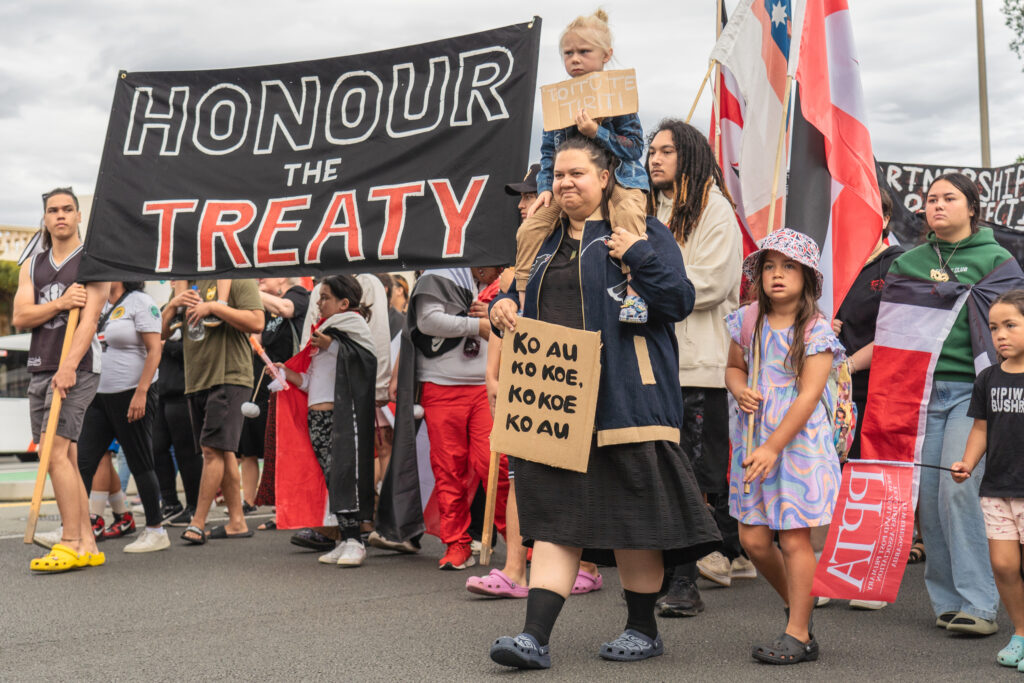
As we wade into this year’s election period, let’s remember that parliament is not the only, or even the primary, seat of power in our society. Power also resides in the unelected branches of the state: in the judiciary, in the bureaucracy, in the armed forces of the state, and – importantly – in the boardrooms of private enterprise. These institutions are not neutral, but are structured to maintain a system of exploitation and profit-making. While workers are given the right to vote in elections, there is a limit to how far we can achieve our aims in a system so stacked against us.
Luckily, we have our own forms of power. There is power in our neighbourhoods and marae, on our campuses, and in our workplaces. When we protest, we take this power out into the streets. In doing so, we do not only demonstrate our strength; we also build it – by gaining confidence, forging connections, learning and organising. This strength is needed, as gains for workers are rarely handed down without a fight.
The historical record shows that protest is effective. Mass protest was a key part of gaining women’s suffrage in countries around the world, dismantling apartheid in South Africa, and ending the American war on Vietnam. In Aotearoa, protest has been critical for winning an eight-hour workday, decriminalising homosexuality, and resisting land confiscation. Recently, student protest has led to universities divesting tens of thousands of dollars of Israeli investments. The historic Hīkoi mō te Tiriti killed the shameful Treaty Principles Bill, though the government has continued to attack Tiriti protections through other avenues. After an exhausting three years of ruling-class attacks, it is easy to feel demoralised. Rather than giving in to apathy, we should remember how and why we protest.
The Power of Protest
Why is protest effective? In the first instance, protests are effective because they cause trouble. The managers of our society, those tasked with maintaining the orderly running of the profit-making system, would like to avoid trouble if at all possible. Take the recent victories on university campuses: at Victoria University of Wellington, students protesting for justice in Palestine engaged in a series of escalating actions through 2024, culminating in a short sit-in in the administration building. The university administration was spooked. With an eye to the disruptive protests occurring overseas, they opted to head off trouble by agreeing to divest the entirety of their $47,532 in Israeli investments.
However, there are things more threatening to the ruling class than individual instances of trouble. Those acting against the interests of the working class don’t like to be reminded of our superior numbers and capacity for organisation, nor of the long history of leaders ousted and governments toppled by working-class rebellion. This is what we mean when we call a protest a “demonstration.” At the very least, a demonstration draws attention to the number of people who support or oppose the issue at hand and are willing to mobilise. Ideally, a protest should demonstrate not just numbers but commitment. It should be clear that a large number of those rallying are also willing to take further action, to continue organising.
Mass protests demonstrate our ability to disrupt “business as usual.” Particularly threatening to the ruling class is our ability to withdraw our labour. Strikes lend direct economic and practical impact to protest movements. General strikes in Italy last year against the genocide in Gaza prevented arms destined for Israel from being loaded on ships. During the defence of Takaparawhau / Bastion Point in 1977–78, unionised workers issued a “green ban” and refused to build on the Ngāti Whātua land. Demonstrations, in turn, increase the power of strikes by making them visible. A strike without a public rally, picket, or march is a wasted opportunity to raise awareness, demonstrate determination, and rally support. It is also a missed opportunity to make connections to broader political issues, as striking nurses, teachers, and public servants did when they rallied in 2025, with placards and chants calling for the government to fund public services, reinstate pay equity, and uphold Te Tiriti o Waitangi.
The Experience of Protest
Protest is important not just for its outward effects, but for the impact it has on those taking part.
Protest can be profoundly empowering: a small act of courage that transforms the consciousness of ordinary people through the lived experience of collective power. Being physically surrounded by supporters and comrades creates a direct experience of solidarity not easily replicated by mere words. At protests, we can forge connections with allies and engage in political education. Through conversations, speeches, chants, and printed material, we learn more about the issue at hand and connected issues. Planning, organising, and taking part in protests helps us develop skills in communication, logistics, and strategy.
Protest can expose the workings of the capitalist system, including the power and role of the state. In November 2025, people protesting the Aerospace conference in Ōtautahi were met with violent force from the police. As these protesters recorded in The Socialist:“It’s disgusting to see people like us being told we are the violent criminals for protesting an industry which relies on death and destruction,” calling the incident a “true show of the Police’s purpose.” On the flip side, protest can also give participants a taste of the limits of state and municipal power. One does not even need to take part in a demonstration of thousands to experience this: taking part in any moderately large urban protest shows that traffic by-laws, for example, cease to be effective if enough people flout them simultaneously.
Protest movements also tend to test relationships, distinguishing allies from adversaries. The crackdown by university administrations on Palestine solidarity protests both here and overseas, for example, has effectively exposed the priorities of those institutions. These can be bitter lessons, but they allow us to operate with our eyes open. After such experiences, we are less likely to rely on fair-weather friends or on the goodwill of those in power, learning to back up our demands with rank-and-file organising.
For socialists, the potentially transformative experience of protest is one of its most important functions. This is why – while there are many kinds of protest action, with different tactics suited to different situations – we generally prioritise mass action that encourages participation of the broadest range of people. Mass protests, furthermore, can have the biggest direct impact. A truly huge march, like the Hīkoi mō te Tiriti in 2024, or the School Strike for Climate in 2019, can shut down a CBD for hours. A mass gathering, if large and sustained enough, begins to blur the line between rally and occupation, totally transforming the nature of public space for its duration. Historically, mass demonstrations have precipitated uprisings and revolutions. Taking part in such a demonstration gives one a palpable sense of how this is possible.
Building Our Movement
The socialist conception of protest provides a contrast to the view that protest is purely spectacle, something to be viewed from the outside, a parade for the politicians in parliament. This is because socialists have a different perspective on the relationship between protest, politics and power. Our main goal is not to win parliamentary representation but to build power in those centres where we actually have power – the workplaces, the neighbourhoods, and the streets. The socialist conception of the party illustrates this: in contrast to other parliamentary parties, a socialist party does not exist outside extra-parliamentary struggles but emerges from them. Its primary function is not winning elections but participating in these protests, strikes, and organising. If the party stands for elections, it is to use parliament as a megaphone for these movements.
No such party is contesting this election, but we can nonetheless keep this perspective in mind as we engage with electoral politics this year. Protest can play a key role in winning reforms that benefit us, or scrapping laws that harm us, and this is important, but we should also see protest as part of an ongoing project of building our collective power and confidence, to envision and create a society that runs in the interests of people and the planet. If protests and demonstrations are a feature of this election season – as they should be – we should aim to come out of it not just with a changed government, but with our true power outside parliament strengthened.
Banner image: Waitangi Day Hīkoi, Ōtepoti Dunedin, Aotearoa NZ, Tuesday 6 February 2024. Photo credit: Mark McGuire, CC BY 4.0.