This piece is adapted from a talk given on 19 September 2026, at a panel hosted by the Platypus Affiliated Society.
I am Māori. I am a worker. I am a communist. These are three aspects of my identity that are used to approach the question: what is decolonisation?
Decolonisation is often framed as an academic process of deconstruction: critical analysis of the past, present, and future, and an investigation of the superstructure of colonial societies. You may well see decolonialism as complaints about a blanket over a dead body. Decoloniality is the practice of finding upset at the blanket. You may well see Indigenous people as just another subset of the population divided into the proletariat and the bourgeoisie. We as communists must recognise that the anti-colonial struggle not only sees that the blanket was laden with fleas, rips, and tears, offering no dignity for the native corpse.
Decolonisation casts off the blanket to find a body alive and fighting.
Colonisation was a historical period of arrival and construction of state apparatus for the benefit of the ruling class at the expense of Indigenous people. It is also the process and consistent default of denying political and economic power to the majority of Indigenous people of any particular land. Many former colonies have inherited the very same colonial systems that dominated them. There are occasional black and brown faces where there were only white faces a century ago, but the capitalist state apparatus was introduced through the enforcement of borders and bureaucracies, carefully blanketed under the narratives and base racial and ethnic assumptions of the past and present – the same narratives of liberation within the limits of the colonial state, the vaunted economic development, decolonial capitalism, and decolonial capital.
A relationship of insurgency or subservience to the coloniser and that which the coloniser made.
Colonisation is ongoing material deprivation and exploitation, as much as it is a cage on the limits of thought for what is possible for the coloniser and colonised. It is the specific form by which capitalism has been established here in Aotearoa historically, and the origins of homegrown New Zealand imperialism in the Pacific.
We, Indigenous peoples, are the inhabitants of the land before the coloniser. We are what is said to be a corpse of an old world. We are not dead, though we die earlier than most. My nieces and nephews will, on average, experience poorer overall health and will grow up looking forward to dying nearly eight years earlier than a Pākehā child. My cousins will be more likely to develop deadly cancers and have poorer survival outcomes once diagnosed. My relatives will be more likely to suffer a stroke, have cardiovascular disease, type 2 diabetes, renal disease or failure, or a mental health disorder.
We are much more likely to live in poorer conditions than Pākehā, with around 25 percent of Māori living in the most deprived conditions measured here compared to 5 percent of Pākehā. The latest evidence suggests that around one in five Māori children live in material hardship, compared to under one in ten of Pākehā children. In terms of access to a decent life, poverty makes everything more difficult. One of the leading causes of maternal mortality in Aotearoa is pregnancy-related suicide, of which my people are three times more likely to die from than non-Māori.
Māori in the cities lack regular access to food, and the quantity and quality of our education in the mainstream is, at best, scattered. When the symptoms of ill-health arise, living in poverty impedes access to healthcare, from where the hospitals are located to how we get to them. However, we keep in mind that the drivers of poorer Māori health outcomes are more than just the stark disparities in socioeconomics. Death likely comes sooner among the poor, yet death rates of Māori and non-Māori never cross each other in these deciles, regardless of the level of deprivation.
There is more to this problem than class and prosperity.
The structures and institutions of our society better meet the needs of the Pākehā settlers and their descendants, than the needs of Māori. Māori women are 44 percent of those stopped by the police. Māori women are nearly 50 percent of those who enter court. Māori women are 71 percent of those sentenced to prison. The future the colonial state crafts for us is imprisonment, institutionalisation, poverty, and an early grave. We must recognise, as Moana Jackson said, Māori are not poorer by accident.
We see the basis for struggle by Māori rooted in a response to coloniality, colonialism, and the propagation of those ideas by and within capitalist systems. My people are forced to die earlier because of a history of land theft, lies, and discrimination, because every single bias built into the bedrock of the institutions of this colonial state is against my people. In Tūhoe, they burned villages, homes, and crops to ash. They tore our dead from their burial places and strung them up to invite our people to take them down, shooting them as they came to do so. Fifty years later, they called Rua Kenana a traitor to the British Empire and the New Zealand government for refusing to encourage Tūhoe to join WWI. His son was shot upon his arrest. Fifty years on, Māori, denied work, loans, and housing at home in the regions, were forced into the cities under an official government policy called “pepper-potting.” Our communities were broken up across the newly-built suburbs, surrounded by White settlers and encouraged to assimilate, as my grandparents were beaten for speaking Māori in both the rural schools and urban academies.
It is a product of the material histories that created the colonial state and the material realities that hold our heads under rising waters.
The occupation of our lands paved the way for the occupation of our minds, bodies, and souls. Rewi Maniapoto provided a most prescient turn of phrase. Ka whawhai tonu mātau ake, ake, ake. We will fight on forever, ever, and evermore. This is an ongoing struggle against material coloniality, embedded within the capitalist system and that which embeds it.
Trotsky, explaining Lenin’s concepts of imperialism, raised the point: a political superstructure of one kind or another cannot change the reactionary economic foundation of imperialism. On the contrary, it is the foundation that subordinates the superstructure to itself. Here, in much the same way, we have colonisation as the specific expression of capitalism in many countries – importantly, to my people, this is the case here in Aotearoa.
These struggles are our struggles. My people aren’t just fighting for a revival of our culture and language; we are fighting for a reality where our children can eat, where our brothers and sisters can join our clans and tribes from the prisons, where we can greet the twilight years with our Pākehā neighbours rather than dying nearly a decade before, and greet the world as free peoples.
We have consistently resisted the social atomisation of capitalism. Māori organisers, Māori union members, Māori comrades have been on the frontline of every collective struggle in this country, from the destruction of our kainga by imperialist land barons and bankers, to the start of the sheep-shearing and logging unions in the early 20th century, to the home schools and tribal schools that were created to save our language and culture, the great strikes and land reclamation of the 20th Century, and the land occupations and worker struggles of the 21st.
Decolonisation is part of our fight to live. It puts to the fore existing communal social structures that can form the basis of communism as a practice, as Marx noted of the Russian peasant communes. It is not the end of the class struggle; rather, it is our class struggle as Māori. Urban, rural, national or tribal, we fight, we build, we struggle for a future against corporate bosses, against colonial institutions, no matter who is running them, precisely because the economic foundation of the socio-political superstructure is our subordination or destruction.
We as a people have a vested interest in the class struggle, as all humanity does.
The specifics of that class struggle are going to be racialised; it is going to be gendered, for the capitalist will happily use any tool to attack and divide the proletariat, but to succeed, he needs only convince the White settler of chauvinism, of White racial supremacy, of the inferiority of the Māori. And the capitalist has succeeded in many cases; cultural chauvinism coming back from some Pākehā workers and fostering reaction, conspiracism, and fascism against any attempt to integrate a handful of Māori into the capitalist bourgeois, and against their working-class Māori neighbours, my cousins in schools, my whānau in workplaces.
The decolonial struggle must be ardently and uncompromisingly communist in character, but importantly, it must be our Māori struggle.
The wider working class has to find solidarity with us and all of our interests in re-indigenisation and decolonisation, lest we, a quarter to third of the working class in Aotearoa, sit out the class war, or worse, are seduced into collaborating for concessions because the capitalist is more willing to speak my language than my sibling worker beside me, or worse yet, my people are murdered and oppressed by the proletarian revolution that recreates the domination of yesteryear’s Fabian socialist colonial administration and the racist Labour governments.
We will tear this rotten duvet from our body, rise, and redon the cloak of our ancestors. We will stride into a future of our making, into a future of our collective making. Mā mātau, mā tātau katoa. To break the settler state is to break the state; to break the chains of Māori is to break all our chains everywhere.
Hei ao hou, hei hou ora.
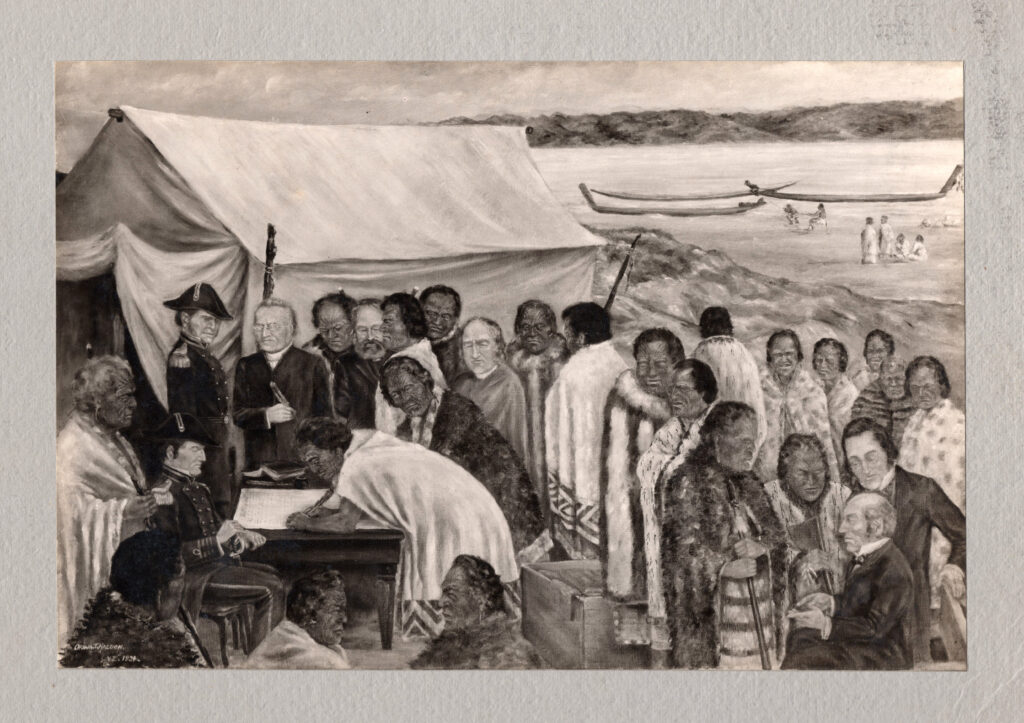
Image caption: “The Signing of the Treaty of Waitangi”, Ōriwa Haddon, from Archives New Zealand via Flickr, CC BY 2.0.