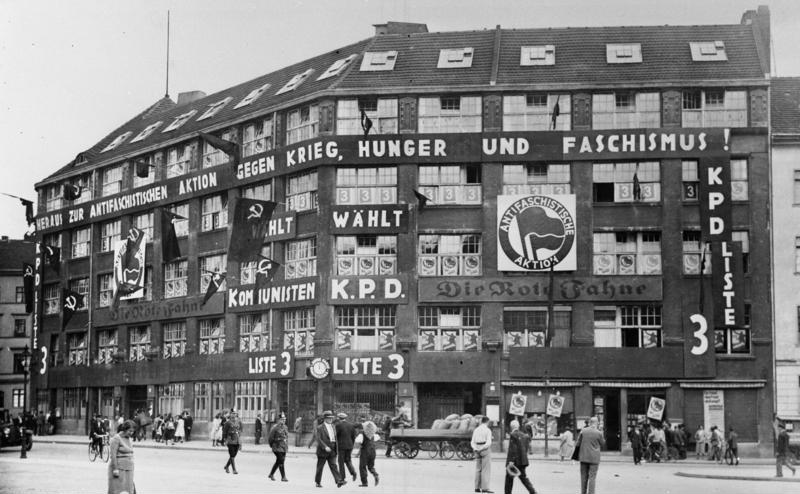
We are in challenging political times. Wins for workers have been few and far between, disillusionment in bourgeois politics is high, and we are seeing growing support for far-right and even fascist organisations. It is important in these moments to look to the past, when we have seen similar conditions, and draw lessons from history. Common are pleas for “lest we forget” in reference to the horrors borne out of fascism, but less common are appeals for a considered analytical approach to the events, ideas, and arguments of the past that are needed to help us truly understand the threat of fascism and what can be done to stop it.
Some of the most helpful Marxist analysis around fascism is provided by Leon Trotsky in Fascism: What It Is and How to Fight It. Written while Trotsky was in exile and relying on correspondence for political news, the work is a collection of articles focusing on the development of fascism in both Italy and Germany, and on its threat as a political current across Europe. It gives a clear and detailed account of the development of fascism and serves as a desperate warning to Trotsky’s comrades about the need to fight it.
The Middle-Class Roots of Fascism
Trotsky identifies fascism as a spontaneous movement of a disempowered middle class that was co-opted by the ruling class in an attempt to squash a threateningly powerful workers’ movement.
Fascism can be understood as having its ideological roots in the middle class. In times of capitalist crises, the class interests of the middle class can become unstuck. Economic turmoil drives smaller businesses into bankruptcy and leads to cost-cutting measures, driving many higher-earning officials and middle management types out of their jobs. This relegates them to the same conditions as the working class while simultaneously holding an even greater personal hostility to this fate, driven by comparison to their previous conditions. Fascism also drew from the long-term unemployed ex-soldiers of the First World War, who had not reintegrated into society. The people fascism attracted were marginalised, angry, and hungering for change.
Trotsky describes how fascism thrives on a sense of disillusionment and the feeling that nothing can be done: “If the communist Party is the party of revolutionary hope, then fascism, as a mass movement, is the party of counter-revolutionary despair.”
This alignment with the same desire to threaten the present system can be seen in fascism’s co-option of revolutionary language in its early stages of development. It even explains the name “national socialists,” which, rather than reflecting any genuine socialist politics, instead reflects the popularity of socialist politics in Germany in the first few decades of the twentieth century, as well as its clear identity as the alternative to the current barbaric system. If there had been a strong working-class movement offering leadership, it is possible this disenfranchised middle class could have been won over to the ideas of revolutionary socialism; instead, the major socialist parties at the time were either too weak or too politically confused to offer this challenge.
The Ruling Class Intervenes
Ruling-class support was also integral to the development of fascism, although there was not a clear and universal perspective through which the ruling class viewed fascism. On the one hand, in terms of its political content, fascism was a force that aimed at disrupting and attacking big business’s hold on power; but on the other hand, it was a politically expedient tool for crushing working-class organisations. During the time of early fascist development, the ruling class faced an even bigger threat: the workers were getting organised. In Germany, the Communist Party (KPD) was a huge political force. The recent revolution in Russia had shown that the workers were capable of overthrowing the capitalist ruling class, and attempts at revolution had already been made in Germany. The traditional tools with which the ruling class was able to manage dissent, such as the police and arbitration courts, had begun to fail due to the strength of the movement. Fascism offered a political alternative to revolutionary politics and was able to mobilise armed groups to smash strikes and attack workers. The ruling classes pumped money into fascist parties, leading to their rise and influencing their political line to be even more anti-worker.
A United Front
In response to the rising threat of fascism and its success in Italy, Trotsky outlined a clear plan of opposition. His approach was a united front. He urged all revolutionary communist parties to take the threat of fascism seriously and mobilise against it as fiercely as possible. To do this, he advocated for formations of alliances with reformist social democrats. He made clear this was a strictly defensive strategy and stressed the importance of maintaining an independent political line, but advocated conscious shared strategy and mutual protection, stating:
Communist workers must say to their Social Democratic counterparts: ‘The policies of our parties are irreconcilably opposed; but if the fascists come tonight to wreck your organisation’s hall, we will come running, arms in hand, to help you. Will you promise us that if our organisation is threatened you will rush to our aid?’
Trotsky also advocated for the development of armed self-defensive groups of workers who would prevent fascist forces from attacking trade union meetings, printing presses, and social clubs, even taking offensive action if necessary to prevent the spread of growing fascist violence.
A Historic Tragedy
Despite his astute political analysis, Trotsky was in a politically weak position and was unable to influence the bulk of the left to adopt this approach. Instead, the dominant political forces available to oppose fascism were Stalinism and social democracy, and they both did dismally. The dominant political perspective endorsed by Stalin at the time was one of “Social Fascism,” which viewed reformist social democrats as a qualitatively similar political current to fascists. It saw fascism as merely the most recent horrible presentation of the evils of capitalism, and social democracy as supporting the same rotten system and therefore part of the same political project. This meant not only could communists not unite their forces with social democrats against fascism, but also that in many cases they spent their energy attacking social democratic leadership while ignoring the looming threat of growing fascist groups.
The social democrats were equally unable to pose a significant opposition to fascism. They were too trusting of the stability and goodness of the capitalist state. They put their confidence in the police to deal with mounting fascist violence despite evidence that the police were largely sympathetic to fascism and likely to ignore unruly behaviour. There was also a general belief in the power of the goodness of democracy to prevent any real danger posed by fascism, and a preoccupation with preventing the growth of revolutionary power within the working class. They openly opposed mobilising workers against fascist forces out of fear this would instil within them a knowledge of their own ability to challenge state power.
The weakness of these political alternatives led to their failure, and thus a triumphant victory for fascism in Germany and the devastation that followed. It was also a blow from which the German working class would never recover, essentially ending the KPD and its hopes for revolution.
The Case Today
Present conditions are far from those of early twentieth-century Germany. The far right has distinct qualities that must be accounted for, and even if we were to subscribe to Trotsky’s analysis completely, we do not have the mass socialist parties with which to counter fascist forces. We are not in a position to wage a winning war against fascism. It is important, however, to take the learnings of this history on board. We must note how the failure of political clarity can lead to the absolute capitulation of a political movement. We can use this example as a demand on us to build a politically coherent fighting left capable of resisting the far right and attacking capitalism itself.
Banner Image: Karl-Liebknecht-Haus, the KPD’s headquarters from 1926 to 1933. The Antifaschistische Aktion (abbr. “Antifa”) logo can be seen prominently displayed on the front of the building. License: CC.