When the US and Israel began airstrikes on Iran in February, our government’s cookie-cutter response was to applaud the aggressors for protecting “international peace and security” – copying the exact words used by Canadian prime minister Mark Carney and Australian prime minister Anthony Albanese in their statements.
This language of security captures almost every part of our current crisis: foreign policy is either “international security” or “national security”, national safety is “border security”, ICE enforces “homeland security”, captured territories are “security zones”, pandemic management is “biosecurity”, deliberate starvation is “food insecurity”, and fuel supply is “energy security.” The term is so pervasive that Trump has used it to justify building his US$400 million White House ballroom, and even opposing windfarm construction.
Clearly this fixation arises in the context of a deep insecurity within the capitalist system. But given that it appears in policy platforms across the parliamentary spectrum, it’s worth asking: what work does this language perform, and what does it reveal about those who use it?
A useful term here is interpellation, the process by which we are brought into a social order and internalise its principles. The word evokes being legally summoned, called to account for your conduct, or given an obligation: in other words, it requires something of you. Under capitalism, interpellation occurs when a police officer comes to your kindergarten to teach you about road rules, or shows up to solve crimes on TV – implicitly asking you to accept the premise that cops exist to look out for your safety. We are taught to respect the police long before we encounter the threat of the baton or prison cell through these assumptions weaved throughout everyday life. Interpellation, then, helps to explain why people choose to support or represent a system even when it harms them.
Framing problems in terms of security is a remarkably effective vehicle for interpellation because it capitalises on real fears of danger and precarity – feeling unsafe in our homes or losing our jobs – to stabilise the instruments of capital in crisis. “Energy security” gestures at the pressure at the pump or power bill, but channels that attention toward supply chains and “commercially rational investments” (per Nicola Willis and Simon Watts). “National security” pins our safety on the success of our borders and military, which only endangers those outside our borders, and polices those inside. As usual, black and brown bodies are placed most at risk.
Security is a fundamentally conservative idea, always about defence, discipline, preservation, and containment. It is useful for those who want to protect the status quo. But for those of us who experience the status quo as unacceptable or unlivable, we might want to consider what social forces are constrained by this concept, what security prevents us from achieving: freedom of movement without borders, democratic control over our resources, and alternative forms of governance. As the editors of Parapraxis magazine put the question: “am I secure, or am I being secured?”
One way of answering this question is to observe who gets permission to act in the name of security. States often invoke this word to legitimise using discretionary powers, but there is no allowance for citizens to claim security against the state. Palestinian and Lebanese communities are never protected in Israel’s “security zones” or given the right to defend themselves.
Although the idea of security may be compromised and unstable, we can’t abandon it completely. Insurgent movements and revolutions may need to defend their gains against militarised opposition, and strikers may need to protect their picket lines from scabs. But these examples also point us in a more fruitful direction. We can and must imagine safety beyond the conservative frame – as a promise, rather than a limitation, of our collective flourishing.
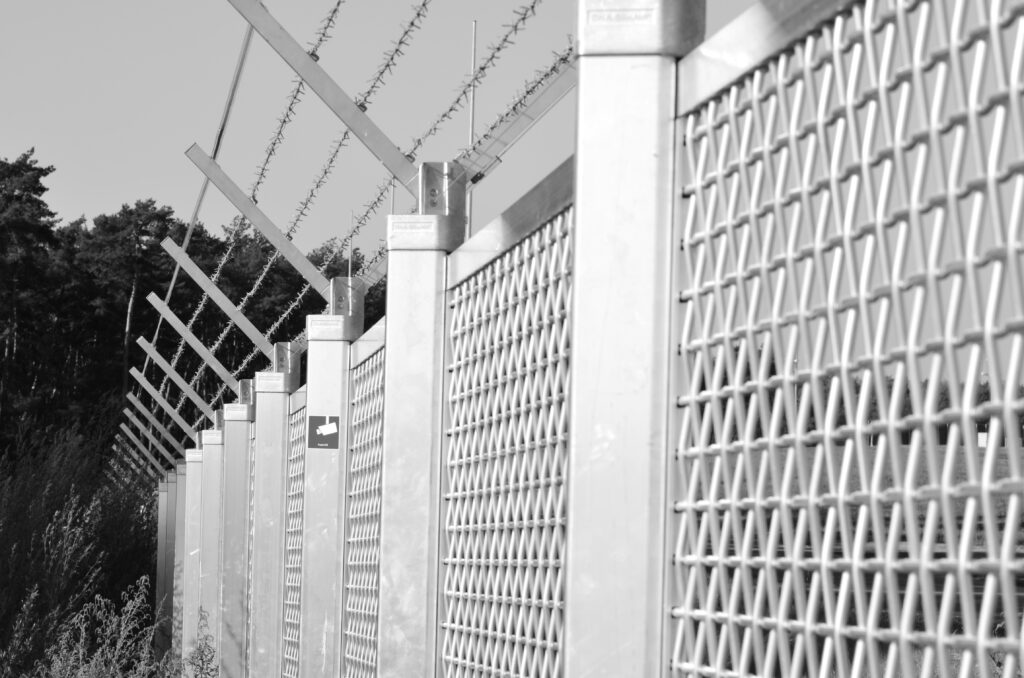
Banner Image: Barbed wire fence at Frankfurt Airport. Photo credit: Norbert Nagel.