The story of the Russian Revolution should be a heartwarming, rousing tale for all socialists. Revolution can often seem mystical, like everything just explodes into a ball of fire and the world is changed. This makes it seem like revolution is impossible and will never happen, but by studying history, we can demystify revolution and learn from its successes and mistakes. The Russian Revolution shows us history does not just happen; it is made by the efforts of people. It shows us that, in a relatively short space of time, anger and dislocation can change into something with the potential to change the world.
Revolutionary Conditions
Revolutions occur repeatedly across the globe and throughout history, but they do not occur at random. Revolutionary upheaval typically occurs at times of great political, economic, and/or social rupture. It also occurs after long periods of escalating struggle where people learn that hopes for reform are futile and that they are capable of fighting and winning. In early 20th-century Russia, these were the exact conditions. A humiliating defeat in the Crimean War and the rapid industrialisation of the rest of Europe left Russia struggling to hold face on the global stage. This led to changes in legislation, pushing newly freed serfs and peasants into the cities as cheap labourers. Successive tsars were wildly unpopular and regularly threatened by assassination. Poor peasants were regularly rising up against the large landlords, and the new working class in the cities was highly politicised, with wave after wave of strike action over both economic and political demands. The ruling class was at breaking point. Russia’s entry into World War I further worsened economic conditions and intensified these kinds of political struggles. This upheaval allowed for the rapid growth of class consciousness and revolutionary sentiment amongst the working class that was crucial for the revolution to take place.
The Revolutionary Party
Another core element that allowed for a successful revolution in Russia was the presence of a mass revolutionary party. The Bolsheviks were a party with hundreds of thousands of workers and activists who were experienced in leading strikes and clarifying political arguments. They were able to apply the ideas of Marxist theory to their conditions and advocate the right political choices at the right junctures. They were also able to communicate these politics to the working class, proving themselves as the best fighters for change and, by the time revolution was possible, as the leaders of the only real alternative to the status quo. Without the party, there would have been no call for socialist revolution when the working class had amassed enough power and class consciousness to lead a new society, and resistance would have been smashed. Nor would there have been an experienced cadre to lead the insurrection itself or to establish the call for an international movement.
The February Revolution
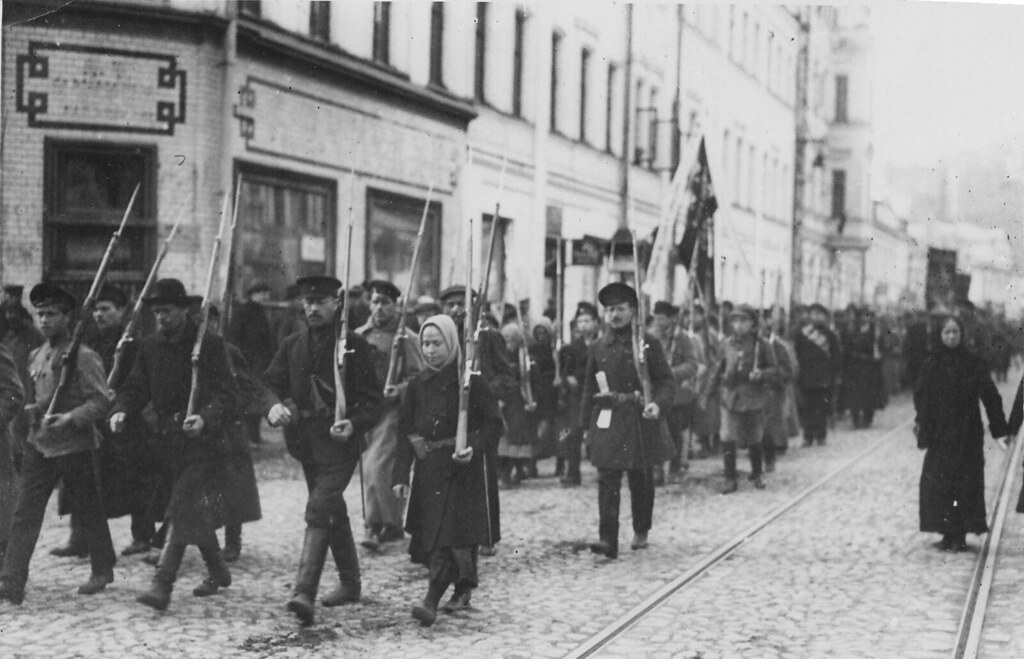
On International Working Women’s Day, 23 February 1917 (8 March on the Modern Gregorian calendar), women textile workers in several factories went out on strike, calling others onto the street to join them. This action was not initially supported by socialist parties, who feared the threat of premature revolution, but following a mass showing of the working class, the Bolshevik Party supported the action, sticking to their long-held philosophy of meeting the workers where they were at. Workers poured into the streets, marching on the Duma (the tsar’s false parliament). The strike continued into the following days with more workers joining and the street movement growing in strength. Unable to contain the strike through typical methods, the state brought in the army to squash the crowd.
However, soldiers shared working-class interests and were generally unwilling or apathetic towards firing upon the peaceful crowd. The news of this spread jubilantly throughout the crowds, encouraging even more to come onto the streets. At this point, some of the military started to mutiny, outright refusing orders and even firing upon police. By the 27th, a majority of the army had mutinied. A mass of these soldiers then turned and helped workers to take the Tauride Palace; this became the basis for the seizure of power by the working class. The tsar, acknowledging his unpopularity, voluntarily abdicated in an effort to preserve monarchical rule, but the heir, fearing for his safety, would not take up the role, and the monarchy crumbled.
The leadership of the February Revolution consisted of the Soviet of Workers’ Deputies, which had been elected in the early stages of the February uprising. They had the power to negotiate terms on behalf of the workers and call for an end to the strike. This ultimately gave them political authority over society. However, under the influence of right-wing socialist thinkers who maintained that a socialist revolution could not exist in Russia until after further development of capitalism, the leadership of the Soviet formally gave over their power to an elected bourgeois provisional government.
Dual Power
This created a precarious system of dual power. While the Provisional Government was the official leadership of Russia, they were only able to lead because the Soviet had endorsed them. The Soviet still wielded immense power by having the support of the majority of the working class. The Provisional Government was not able to force itself into sole leadership as it did not have the trust of the people. Nor was the Soviet able to or willing to take sole leadership. The workers of Russia did not have strong enough class consciousness to take power themselves, instead maintaining trust in educated bourgeois leadership to make reforms in their favour.
Dual power is an ultimately unstable state of affairs. The Provisional Government saw the Soviet as a threat to its power, and the full weight of capitalist hegemony and monopoly on force was poised to crush them. For a short time, however, the Soviet, with the full backing of the workers, existed as a viable structure to replace the state when the bourgeois government showed its true colours and failed to meet the liberatory goals of the working class. Under these conditions, the successful seizure of workers’ power is possible.
Preparing the Battleground
Once the conditions were in place for a successful workers’ revolution, there was still a need to carefully manage the exact moment and mechanism of revolutionary upheaval. A crucial factor in the success of the revolution was timing. Here, the revolutionary party played a key role. Until this point in history, it had appeared that workers’ power in Russia was a long way off, but now all the infrastructure was present for it to occur imminently; in fact, if it did not happen soon, there was a good chance the movement would be smashed. Vladimir Lenin was the first to recognise this, leading the call for “all power to the soviets”, a slogan directly demanding workers take power, upon his return to Russia in April. This line was adopted by the Bolshevik Party, but there was still work to be done before the direct seizure of power. Throughout the months that followed, leading up to October, the Party had to manage a tense political system. On the one hand, they had to educate a large number of workers whose minds had just been opened to the ideas of revolutionary socialism and on the other, they had to prevent premature action from the more advanced sections of the working class that had seen the success of the February Revolution and were ready for more. It was of utmost importance that, when insurrection came, it brought with it as large a section of the working class as possible; this was crucial in winning the day and also establishing a new leadership that could survive. Lenin was a crucial figure in this time, adapting the political line quickly as developments changed and bringing the broad masses with him.
Revolution as an Art
The kind of leadership needed to build and sustain a mass party is not necessarily the same leadership needed to stage a successful revolution. During this period of educating the masses, the cadre of the party, including Lenin, dedicated much time and resources to learning the art of revolution. To them, this meant studying the technical and military strategy of past revolutionary upheavals such as the French Revolution and trying to apply these rules to the modern context. Lenin was not particularly gifted in this arena. His vision for insurrection that was not taken up by the party would likely have resulted in much greater loss of life and potentially defeat of the whole movement. This is another reason a party is so crucial: it creates many diverse leaders with diverse skills. Leon Trotsky played the crucial role of artist of the revolution.
On 9 October, the Petrograd Soviet established a Military Revolutionary Committee and elected Trotsky to the head. This was the first attempt at trying to systematically organise armed workers for the seizure of power. Many workplaces had built up a stockpile of weapons, largely those confiscated from defected or defeated members of the military whom they had faced in violent struggle. These were distributed to the newly established Red Guards, essentially a military group made up of workers for the purpose of defence and advancement of workers’ power. This gave Trotsky authority for military command over the revolutionary workers.
He also laid out the plan for insurrection itself. Core to his plan was the role of the soviets. These elected groups still had respect and authority over the workers, and if they called to action, the workers would come. Another crucial element was how to call the workers to action. It was decided that a defensive strategy would effectively corral workers to initiate the struggle and that the rest would flow easily from there.
On 24 October, the Provisional Government launched an attack on the Bolshevik Party. It ordered the Military Revolutionary Committee to be shut down and banned its press, sending troops to seize its printing organs. In response, Trotsky ordered a small group of troops to protect the press and sent word to all military units being sent out of the city to ignore the Provisional Government orders and remain. This was an act of outright disobedience; it challenged the Provisional Government’s authority and put the full weight of an armed Petrograd behind it. The Government tried to direct troops into the city to crush the revolution but did not have command over the railways, which answered only to the soviets.
The government was completely unable to prevent the Red Guard from taking the city. The important buildings of the old order were seized, as were tactically important areas such as bridges and railway stations. On the morning of 25 October, the press announced the success of the revolution: “The Provisional Government is overthrown. The state power has passed to the hands of the Military Revolutionary Committee”. This was a bit premature as they had not yet seized the Winter Palace, but this announcement added to a mood of victory that allowed it to be easily taken by that evening. State power had been taken. Street battles occurred in Moscow and other key cities for weeks after to entrench this new order, but once Petrograd was secured, success was all but inevitable.
Workers’ Power
The Military Revolutionary Committee then officially signed over power to the Second All-Russian Congress of Soviets, which elected a new government representing the interests of the workers. In the early days of workers’ power, many decrees were passed, making good on the promises of the revolution. Immediately, the new government worked to nationalise the banks, attempting to redistribute the profits of the wealthy to the people and set about signing a peace treaty to end the suffering of the war. Many other progressive reforms were put in place. Unfortunately, the newly elected government was also forced to sustain a long period of civil war, protecting the revolution from counter-revolutionary forces. They were also economically isolated, with no support from other bourgeois nations who feared revolution in their own countries. This led to very poor conditions in Russia, and many of the best cadres of the revolution were killed. Overall, this set the stage for counter-revolution from within the Bolshevik party and the eventual shift away from true liberation, but for a time there was a better world within sight.
Lessons
The Russian Revolution provides many great lessons for socialists today. First, it can bring great hope. It shows workers can realise their power and come together to oust the capitalist class. It shows they are capable, through the struggle of building the infrastructure needed to build a new kind of society. The Russian Revolution also illustrates the importance of a revolutionary party. A core leadership of cadres experienced in struggle and with the ideas of Marxism, capable of internal debate and shared action, was absolutely crucial in the revolution’s success. The event also clearly demonstrates the importance of internationalism. Without workers’ revolutions in other parts of Europe, Russia was unable to maintain real workers’ power, which was vulnerable to threats from both outside and within.
These lessons give us our tasks as socialists today. To build and grow class consciousness by throwing ourselves into struggles against the ruling class whenever they occur. To build a strong party by diligently growing our organisation in the ones and twos. To educate our members in Marxist theory and apply it to the struggles of today, stimulating robust internal debate. To maintain an internationalist outlook, reading and learning about struggles overseas, particularly where we see other socialist organisations playing a part in politics, and sharing our own Marxist analysis of these events, tying our struggle here to all struggles of the working class. To study history and to learn our political tradition and the real meaning of the phrase, “long live the international socialist revolution!”
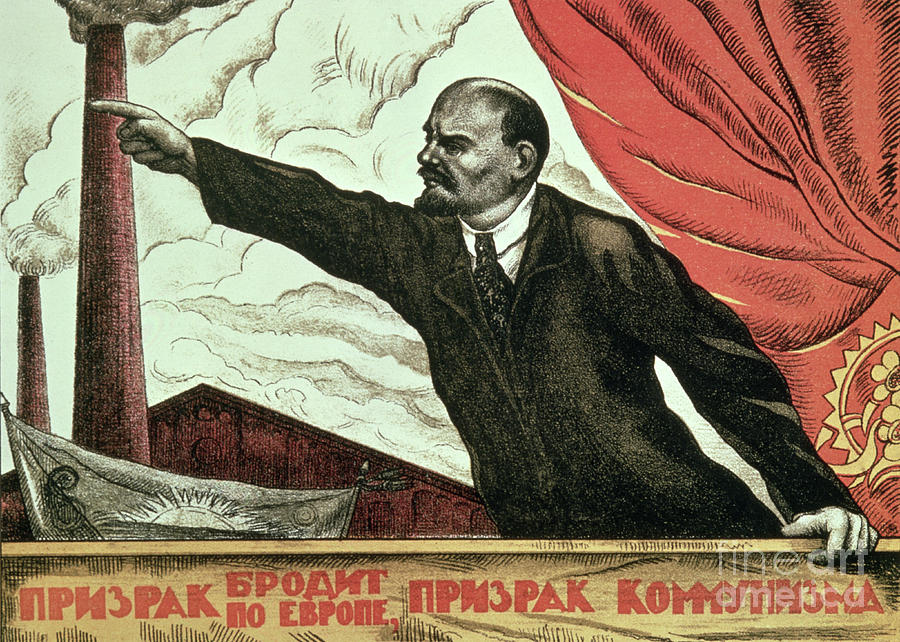
Banner Image: Russian Propaganda Depicting Lenin at the Tribune. Image credit: Public Domain