The role of bourgeois democracy under capitalism is to operate as a smokescreen for the most acute elements of oppression. Giving people the opportunity to vote every three years channels any desire for better away from grassroots organising and into appeals to capitalist state power. As ostensibly you can vote anyone into those seats of power, the mechanism for change appears to be to find someone who represents your political position, and vote for them. Ultimately, however, this system never offers opportunity for real systemic change. The bosses still own the companies and take all the profit, while the workers still do all the work and suffer the worst conditions. The bosses are also able to use the money and power they’ve accumulated to influence these electoral systems – to bribe and bully and ensure even small surface-level changes won’t get in the way of their profits.
The state also plays a crucial role in stabilising capitalism. It sets and enforces the rule of law. It upholds property rights, ensuring that capitalists feel safe accumulating as much private wealth as they want, without any threat of someone else taking it. The state can also manage the long-term goals of a capitalist system by equalising the playing field between the capitalists. It constructs legislation and regulation that suits capitalism broadly, even if this is sometimes at the expense of the short-term goals of individual capitalists. Without the crucial role of the state, capitalist crises would be more intense, and capitalists would be forced to take on greater personal risk.
Our current liberal-democratic system may be designed to placate us and to prop up a capitalist system we would much rather tear down, but this doesn’t mean we should disengage with electoral democracy entirely. Reforms made through bourgeois democracy can be good for workers. Having a more left-wing government does make our lives better. Better funding for public services like education and healthcare will improve and even save the lives of many. Worker-friendly laws around unionisation or the right to protest allow us to organise in workplaces and on the streets. They make it easier to spread revolutionary ideas and to engage in struggle, directly exposing the rot at the heart of our broken system.
The democratic rights we do have to effect (small and temporary) political change should not be taken for granted. Bourgeois democracy under capitalism is only safe as far as it is a politically expedient tool to the capitalist class. Some nations, particularly the most exploited areas of the Global South, have never had access to even the pretence of free democracy. Some of those that do hold this pretence of liberal democracy, such as Latin American nations, do so in the context of imperialist election interference. An imperialist world order has kept these nations under the thumb of the West through military might and predatory “aid”. Movements in these regions for independence or the right to even bourgeois political self-determination are violently crushed. The international working class differs only in its intensity and form of exploitation by capitalists.
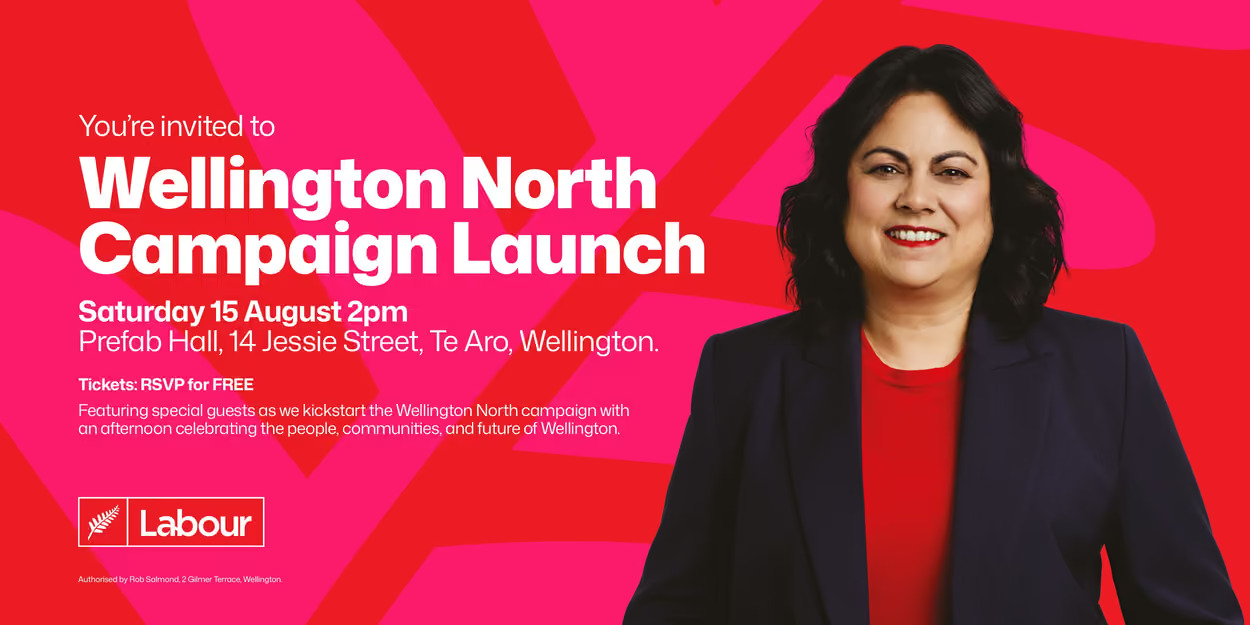
Threats to our own political rights are present in more subtle ways here in Aotearoa. In times of low political activity on the left, there is less of a need to placate. If no popular dissent is occurring, bourgeois democracy is not needed to manage that dissent. Politics instead takes on a role, no longer appealing to the masses, but as an intermediary by which big businesses manage themselves in relation to one another. This can be increasingly seen in electoral politics today. No working-class interests are even nominally represented in government. There are no reformist socialists in power, and the Labour Party has long since abandoned a working-class focus, instead aiming to win over a frustrated middle class and small business owners from the National Party, and taking workers’ support for granted. We also see this through the entrenchment of neoliberal ideology. Political parties no longer feel the need to appeal to the working class by making real improvements to our conditions, but instead can rely on the ideological dominance of “meaningful change isn’t possible” politics, and a sense of despondency about how bad things are.
This has created a culture of political apathy. Young people and poor people don’t vote at the rate of other demographics, and this is getting worse. There has been a clear decline in 18- to 24-year-olds enrolled to vote since 2011, with only 60 percent enrolled during the last election. And it’s hard to blame them – why would they vote when politicians have nothing to offer? In a political culture where there is no real grassroots alternative to electoral politics, this means the ruling class is winning.
This sense of apathy is politically expedient for the right wing. With the decline of a political fight from the working class, they are free to dominate the political field and pass as much egregious, unpopular legislation as they like. This is a political culture the ruling class is actively developing. This can be seen in Christopher Luxon’s comments on low voter turnout: “I mean, if you don’t vote then you can’t complain”. He intentionally pushes the burden of voting onto voters themselves rather than considering any structural barriers or the need for politicians to effectively appeal to voters. This fits perfectly with a narrative of young “snowflakes” who do nothing and complain about it. The right uses this narrative to obscure systemic barriers and disadvantages that are increasingly making life harder for young people.
These new voter suppression laws are intended to exploit and entrench this culture of apathy even further.
These attempts to feed disillusionment and stifle voting may not be in the long-term interests of the capitalist class, as they may invigorate a culture of mass revolutionary dissent as people realise there is nowhere else to turn. Capitalism is not very good at thinking long-term. It has a tendency to assert itself in the most extreme form possible at every turn and constructs ever-evolving crises of political legitimacy much in the same way it creates economic crises. At this current juncture, the ruling class feels safe enough to attack its pretence of “free democracy” in the interests of a small advantage in the next electoral cycle.
In December 2025, the government published a large list of amendments to the Electoral Amendment Act. Amongst these changes, there was a clear trend towards making voting more inconvenient. The changes include: moving the last day to enrol to vote from the day of the election to 13 days before; banning the provision of free food, drink, or entertainment within 100 metres of a voting place; and tightening offences around undue influence to enrol on a particular roll. They also once again removed the right to vote for prisoners serving any length of sentence, up from the previous three-year ban. Amongst the same legislation was an increase to the thresholds of undisclosed donations to electoral campaigns. It is very clear that the intent of these changes is to make it easier for the current government to stay in power, and this could be effective.
Last election, same-day enrollment was used by over 80,000 people – much larger than the margin of error under our current MMP system, where contesting electoral seats can change election outcomes. In 2023, 450,000 voters enrolled within the 12 days before the election (12 percent of the total vote). This will affect mostly young people, those with housing instability, and other minorities. According to the Regulatory Impact Statement, 33 percent of 18- to 19-year-old voters and 48 percent of Māori voters aged 18 or 19 updated their enrolment details during the 12 days before the last election. It is clear these votes from more marginalised demographics that will go uncounted are more likely to be votes for the left.
The state is refusing to measure or even acknowledge the problem. The Electoral Commission has announced they will not be counting the number of voters turned away on election day. Voters who are unsure if they are enrolled will be allowed to vote on the day, and their vote will only be counted if they were enrolled prior to the 13-day exclusion period. This number will be recorded and likely used publicly as an approximation for votes lost due to these changes, but this measure will be a severe underestimation of their real impact. Whether these new laws have changed the election outcome will be something we can never know.
It should be completely unacceptable to us that the right wing wants to restrict our democratic freedoms and pull the wool over our eyes, trying to convince us this never happened. As socialists, we have a responsibility to fight to protect and expand our democratic rights, even in their deeply flawed bourgeois context. We should be using this election as an opportunity to expose the cruelty of the current system to the working class, to encourage them to imagine a world beyond it, and engage deeply with politics both in and beyond the voting booth. The final day to enrol to vote is 25 October.
Banner image: Eclipse of the Sun, 1926, George Grosz, Public domain