Whether scrolling through a news website or a social media feed, you’re likely to encounter a variety of little windows into far-right and fascist activity, and of individual and collective efforts to counter them. It can be pretty confusing seeing this range. What’s effective? What’s inadvertently enabling? How can you contribute your time and energy productively to anti-fascist efforts? This article attempts to give an overview and brief discussion of some relevant approaches. While the article uses a degree of categorisation to aid digestibility, there is significant overlap between approaches, so it’s important to recognise that the following isn’t a “select one of the following tools and apply it exclusively” method. Bearing all that in mind, then…
Research, education, and prebunking
The Disinformation Project was an interdisciplinary group hosted by the University of Auckland, formed in 2020 to monitor “Covid-19 mis- and disinformation on social media, mainstream media, and in physical and other digital forms of information and knowledge dissemination.” In a November 2021 report, the group recorded an association between Covid-19 specific disinformation and far right ideologies. Over time, they noted a “pivot” of the use of disinformation by far-right actors to promote and stoke online misogyny, hatred of transgender people, and anti-Māori racism. Unfortunately, The Disinformation Project was discontinued due to cuts to funding: cuts which notably occurred under the present far-right New Zealand government. Their work remains online at thedisinfoproject.org, and serves as an example of the important role that patient and committed academic research can play in tracking pipelines towards fascism.
The Debunking Handbook 2020 is an online resource published by an international team of university researchers, who noted two factors relevant to educational efforts: firstly, that fact-checking can help to overcome mis- and disinformation, but that secondly, once someone has been convinced by misinformation, it is harder to dissuade them of those beliefs. The researchers explain this phenomenon by describing disinformation as “sticky.” Therefore, it’s important to deploy strategies that prevent mis- and disinformation taking hold in the first place. This includes forewarning about the existence of misinformation, as well as “prebunking” with preemptive refutation of disinformation. Pōneke Anti-Fascist Coalition used a prebunking approach in 2024, when they distributed copies of their informative zine Free Speech & Power ahead of a panel discussion hosted by Victoria University of Wellington, featuring the far-right lobby group the Free Speech Coalition.
However, tiny fascist groups struggling for relevance and desperate for notoriety can potentially stand to gain from imprudent re-sharing of their material on social media and news media. When considering educating people about a tiny fascist group’s actions, we must weigh up whether our intervention most usefully builds a counter to the fascists’ efforts (for example by generating sufficient outrage to spark real and effective action) or only serves to increase the “reach” of their message. For example, if you are spurred to create a social media commentary about a racist fascist action, it might be more useful to create a post naming the problem of racism and providing an anti-racist argument, rather than wholesale re-sharing the fascists’ imagery and messaging. One approach which balances reporting against limiting the fascists’ narrative is to blank part of their images to obscure their messages.
When an Australian neo-Nazi visited New Zealand in 2024 – a visit self-publicised on social media, on which he bragged about meeting with New Zealand neo-Nazi groups, clearly seeking to help stoke fascism within these borders – PAFC chose to acknowledge that visit with a mocking image on social media. PAFC’s accompanying commentary intentionally drew attention toward how the state’s surveillance systems, such as the SIS, GCSB, Immigration, and Police, allow the persistence of White supremacy. The post highlighted the need for grassroots organising, ending with the motivating call: “See you at the next anti-fascist rally!”
Deplatforming
When “alt-right” personalities Lauren Southern and Stefan Molyneux visited New Zealand in 2018, a wave of anti-fascist outrage and protest led the Auckland Council to cancel their venue booking, citing safety and security concerns. Southern and Molyneux then booked a music venue which, when these speakers became known to them, also cancelled their booking. ISO members wrote at the time: “Southern and Molyneux are key media figures in the alt-right movement, and their presence in Aotearoa only serves to give succor to local right wing activists who hope to spread vile ideology.” Having their speaking venues cancelled had a tangible effect in preventing the fuelling and spread of far-right ideas. This deplatforming strategy was so successful that the far right subsequently put considerable effort into creating its own countering force: immediately afterward, the neoliberal Taxpayers Union spawned the Free Speech Coalition, later renamed the Free Speech Union, to contest the Council venue cancellation in court. Today, the FSU has a budget of $1.6 million – including funding from the far-right Atlas Network – and is being deployed by the current far-right government to positions such as the Medical Council to entrench power beyond this government term. This illustrates how committed the far right is in combatting our ability to deplatform their champions.
Deplatforming can be an effective and useful tactic – the Southern/Molyneux/FSU example shows the far right has certainly recognised this usefulness and responded accordingly – but it can also have complications. One example is the events in 2019, when anti-transgender lobby group Speak Up for Women planned to hold an event at Massey University’s Wellington campus. Students organised a petition and held a rally in the campus common Pyramid area, supported by the National Council for Women and Rainbow Tick, where the petition was handed over to Massey management representatives. Subsequently, the university cancelled the group’s booking, citing “external advice on its health, safety and wellbeing obligations under the Health and Safety at Work Act 2015, and its duty of care to the University community.” This was cast by SUFW as the stifling of free speech, and the event was instead held at parliament thanks to ACT’s David Seymour. Meanwhile, Massey proceeded not long afterward to also cancel a pro-trans student celebration event, citing similar “safety” reasons. In this case, deplatforming the anti-trans event achieved some initial success, but the appeal to power ultimately also raised the university’s confidence to similarly deplatform our own side.
Unmasking
Identifying (unmasking, or “doxxing”) fascists is a time-consuming but important activity undertaken by anti-fascist researchers. By correlating available information, researchers have been able to expose the handful of members of explicitly fascist groups in New Zealand – to both mainstream media journalists and the general public – through social media campaigns. Following this strategy, Pōneke Anti-Fascist Coalition has published several social media posts exposing known fascists participating in conspiracist marches, active in neo-Nazi organising, creating neo-Nazi propaganda, and working for the New Zealand Cadet Forces.
One Aotearoa anti-fascist activist interviewed for this article shared the following insights about the strategies of countering small-scale fascist organisations, which touch on many of the points thus far discussed:
For the small groups we need to deplatform them and disrupt their ability to organise. By deplatforming, I mean not debating them, never ceding space for them to speak, and not sharing their messaging (no matter how innocuous the messages may seem). Nazi groups often use naïve progressive influencers to spread their content on social media. Disrupting is more complicated, but the most effective strategy for anonymous Nazi groups has been to publicly name them. These strategies have worked recently in Aotearoa; Creativity International in Tauranga gave up when the media stopped covering their antics, and Action Zealandia was paralysed for a year after their leadership were exposed in the media.
Mobilisation
Writing in ActionStation Aotearoa’s 2026 anti-fascist The Far-Right Playbook, Byron Clark described the ways in which we can act to stop conspiracy theorist infiltration of local governments and school boards, and FSU takeovers of Internet oversight groups:
Fighting back against the far right doesn’t always look like confrontational street protests. More often it looks like people participating in their local communities through joining and being actively involved with civil society organisations, making them less vulnerable to infiltration attempts like the examples above. Each of us can play a vital role in protecting democracy and democratic institutions.
At a community level, we can combat the far right by promoting democratic processes and combatting voter disenfranchisement. This far-right government is deploying the Steve Bannon “flood the zone with shit” technique against us, passing legislation using an “under urgency” process supposedly reserved for emergencies. This shortens timeframes for feedback and makes even timely protest challenging. The Government has restricted who can vote and has limited the period in which people can enrol to vote, all with the clear intention of disheartening and disempowering the general public. We fight this by collectively remaining active, by continuing to motivate others through efforts such as distributing this publication, by actively encouraging all eligible people to vote, and by building every possible rally in opposition to this government and their actions.
There’s a very real role for fun and play in the work of maintaining our comrades’ spirits and enthusiasm. I interviewed long-time anarchist, anti-fascist, and peace activist Val Morse, who shared the following example:
Nearly everybody is an anti-fascist – we need to celebrate anti-fascist culture and make it fun. So we did a festival stall recently with a great game of “trash the fash” that featured a basketball hoop, and a big box of photos of horrible fascists. People were invited to play like a carnival game where they could pick their three most unfavourite fash and crush the image and throw it through the hoop into a trash bin. Each time, they got an anti-fascist sticker for their efforts. What was amazing was how many kids knew who all these horrible fash were and how keen these kids were to smash them. I thought, “yep, this is a winner!”
PAFC have frequently used art and humour, through social media, protest banners, and street posters, to uplift our side and mock this present far-right government: for example, a social media post which caricatures of the party leaders as a boar, a sea cow, and weasel; or the poster and social media campaign which shared a “Resist, persist, and eat your vegetables: standing with our trans, takatāpui, and gender diverse whānau” message to stoke the pride and confidence of our own side while demonstrating to the far right and fascists that their tactics are failing.
But voting, fun, and art alone aren’t enough. To counter far right and fascist groups as they get bigger, more organised, and better resourced, we also need to mobilise large numbers of the working class: in the streets, in direct opposition. The 1995 Socialist Workers Party (UK) pamphlet Killing the Nazi Menace by Chris Bambery explains this succinctly:
What counts is activity – activity by the greatest number of people that can be mobilised. As we’ve seen, that was successful in Britain in Cable Street in 1936 and on the streets of Lewisham in 1977. Such mobilisations can only be built with open calls to smash the Nazis as a menace to all ordinary people, not just by moral appeals against racism.
In the words of the anti-fascist activist previously quoted:
When the groups get bolder they need to be physically stopped by a mass movement. This is why fascists [currently] often do their stunts at 3am or at dawn.
And, in Morse’s words:
These [fascist] groups are a bunch of cowards and we want to deny them any opportunity to spread their hate. So years ago when the National Front were actually doing public demos on “flag day” (whatever the hell that is), we would explicitly counterprotest them, showing up earlier than them, claiming space, physically confronting and shaming them. Now most of them are too scared to do much publicly, but they still try putting up posters and stickers so those should always be ripped down.
Organising street counter-protests is critical – there needs to be visible and coherent opposition to the far right to ruin their events. Never underestimate the impact of even a small group of people. Disrupting and denying them the ability to operate is what they hate. So for the past couple of years, we’ve protested against the March for Life – the anti-choice misogynists – by getting in front of their march with our own banners, placards, and sound system in order to steal their thunder, so to speak. Actions against Destiny [Church] have included direct confrontation in the way of their marches or standing alongside and harassing them as they go past.
All of these are clear examples of the huge potential for and value of unity against fascism. Bambery adds: “There is one qualification. We are for confrontation, but only through mobilising large numbers of people,” and follows with this quote from Leon Trotsky: “The task is to involve the workers in increasing numbers in the fight against fascism… adventures can only isolate a small, militant minority.” Organising small “squad”-like responses to fascists risks devolving into conspiratorial organising and elitism. Our goal, when fascists start organising in more than single-digit sideshows, is to mobilise large numbers of people from across the majority who recognise the fascist threat and who actively reject fascist ideology. To be clear, this doesn’t mean we should delay until we’re sure we can bring thousands or hundreds of thousands into the streets… but it means the ongoing goal is to show as many people as possible that they are already anti-fascist in spirit, and to convince them to commit to actual mobilisation to materially stop fascists.
Conclusion
This article has given an overview of just some of the wide range of approaches used to counter the growth of fascism. Which tactic is suitable for any given context will depend on the size, coherence, and immediate threat of the far-right forces, and on the size, coherence, and urgency for defence of our own. This article has demonstrated that there is no one-size-fits-all solution, and our strategic approach must be open-minded. We must avoid rigid thinking or adherence to a single tactic, which could be detrimental to our attempts to develop alliances and stand in solidarity with our comrades’ struggles. But in all our work, we aim to build towards the greater self-empowerment of the working class, for mass mobilisations that can defeat fascists and win all the other necessary struggles besides.
Finally: fascism and the far right are only the most glaringly obvious weapons deployed against the working class. But all other aspects of capitalism continue to oppress the working class even when there is no immediately looming fascist threat, and fascism will always rise once more as a capitalist tool of suppression in response to any building of our own strength. As long as capitalism remains, we’ll be fighting for survival. This article has merely discussed tactics to be used in individual skirmishes with fascists. To win decisively and permanently, we need to smash and replace the capitalist system itself.
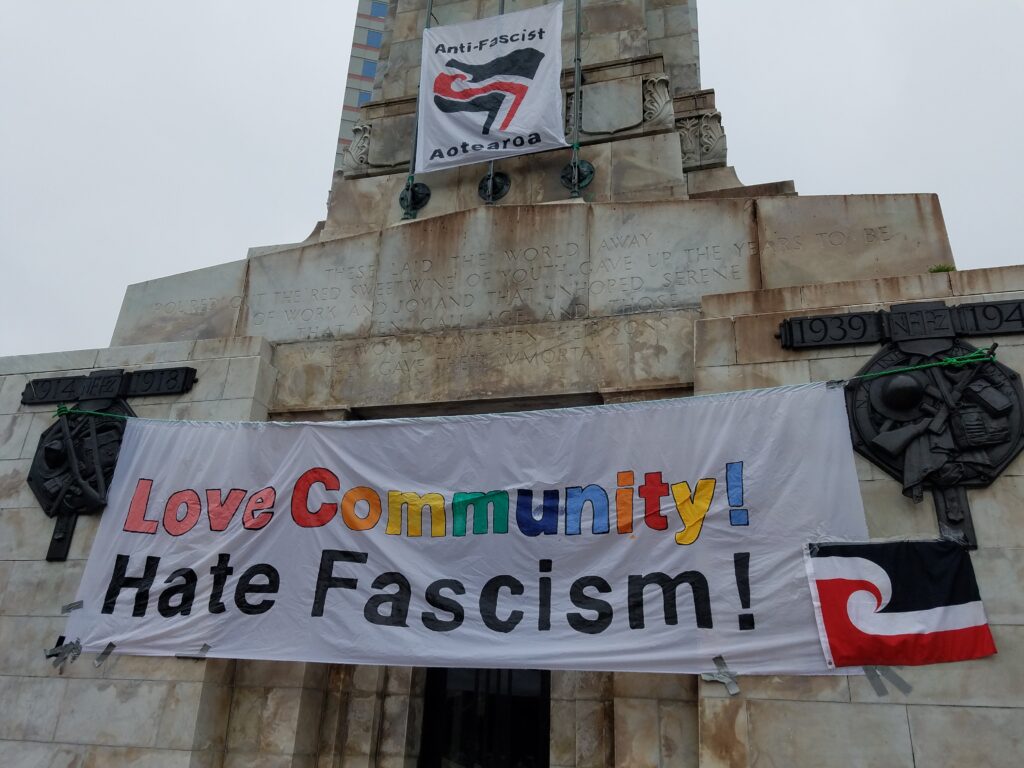
Caption: A Wellington war memorial, the site anti-fascists stood in 2022 against a street march by the far-right Destiny Church front group the (so-called) Freedom and Rights Coalition. The banners read: “Anti-Fascist Aotearoa” and “Love Community! Hate Fascism!” Photo credit: Serah Allison.