War, and consequent death of both soldiers and non-combatants, has been a miserable feature of much of human history. It’s only relatively late in our history, however, that we have faced the possibility of such conflicts bringing about our complete demise as a species. And even if anyone were to survive global war, regardless, we may well by then have devastated this paradise of a planet to a near-uninhabitable state. Herman Khan wrote in the book On Thermonuclear War:
Perhaps the most important item on the table of distinguishable states is not the numbers of dead or the number of years it takes for economic recuperation; rather, it is the question at the bottom: “Will the survivors envy the dead?” It is in some sense true that one may never recuperate from a thermonuclear war. The world may be permanently (i.e., for perhaps 10,000 years) more hostile to human life as a result of such a war.
Soviet leader Nikita Khrushchev was maligned for using the words “we will bury you” in a 1956 address. This was popularly interpreted as a warmongering threat, as captured in the lyrics to pop artist Sting’s 1985 song “Russians”: “Mr Khrushchev said ‘We will bury you’; I don’t subscribe to this point of view. It would be such an ignorant thing to do if the Russians love their children too.” The CIA’s records from around that time discuss the dual military and rhetorical nature of Khrushchev’s remark:
Krushchev and other Soviet spokesmen have in fact used the “burial of capitalism” figure a number of times. They have used it occasionally in predicting that capitalism will perish in the event of a thermonuclear war – still the official Soviet line, despite the increasing frankness with which Soviet spokesmen over the past five years have acknowledged the great damage such a war would bring to both sides. But the forecasts of capitalism’s demise, or “burial,” have most often been made in an ideological rather than a military context: The ultimate death of capitalism is pictured not as resulting from a Soviet military victory, but as a result of inevitable rejection of “a peoples” of a system (capitalism) which breeds wars in favor of a better system (socialism) which ensures peace.
Even in the most optimistic interpretation of the USSR leader’s words, Khrushchev shouldn’t be misinterpreted in any way as a pacifist. It was he who presided over the Soviet Union’s brutal suppression of the Hungarian uprising. And it was Khrushchev who matched US president John F Kennedy’s nuclear missile deployment in what was known as the “Cuban Missile Crisis,” one of the closest ever brushes with potentially full-scale nuclear war. Khrushchev presided over a USSR he claimed was “socialist” but which was in actuality inherited from Stalin’s brutal counter-revolution and was in direct capitalist competition on the world stage with the United States. The logic of capitalist competition manifests at an international level as states locked in military competition – each driven to imperialist expansion of control and influence, and necessary deterrence of the same from competitors.
Khan, quoted earlier, was a neoconservative academic. No class ally of the oppressed, he nonetheless lost his employment in the US think-tank RAND because of his expressed concern about the mass proliferation of nuclear weapons as a form of “deterrence.” Khan dubbed the path both Khrushchev and Kennedy were following “Mutual Assured Destruction,” or MAD for short: in theory each would be deterred from attacking the other through the likelihood of retaliation of a scale which could reasonably be expected to bring about mass destruction or even annihilation. In reality, as each side observed the other arming themselves with greater and greater destructive powers they were in turn motivated to continue a cycle of further escalation: thus the nuclear “arms race” of the “Cold War” period. And as the number of nuclear weapons increased, there was an ever-greater chance of nuclear war by either inadvertent accident or intentional action.
The “Cold War” is considered to be over, as the USSR’s glasnost (“openness”) and perestroika (“restructuring”) under Mikhail Gorbachev decades after Khrushchev’s leadership saw a relative decrease in Russian power and influence, and the USA was left as the sole major military superpower globally. Are we perhaps safely beyond the time of mutually assured destruction, then? Unfortunately, and unsurprisingly: no. We remain on the brink of global destruction for a variety of reasons; and at the root of all of those reasons is still the system of capitalism which persists despite our efforts thus far.
According to the International Campaign to Abolish Nuclear Weapons (ICAN), there are approximately 12,331 nuclear warheads in around 9,600 active military stockpiles of nine nuclear-armed countries as of April this year: Russia, the United States, China, France, the United Kingdom, Pakistan, India, Israel, and North Korea. The result of any of these countries launching a single one of these thousands of weapons would be devastating: ICAN estimates a single nuclear weapon detonated over New York City would cause more than half a million deaths, not to mention the horrendous injuries and health effects survivors would suffer; and just as in the “Cold War” period, the likelihood of retaliation and escalation remains.
Israel’s infamous “Hannibal Directive” is reported by Israel’s Haaretz newspaper as being an Israeli military order with “the intent of foiling kidnapping even at the expense of the lives of the kidnapped.” While Western Zionist organisations such as the Israel Institute of New Zealand attempt to claim otherwise, Haaretz and The Times of Israel report that this directive was employed by the Israeli military on 7 October 2023, almost certainly resulting in “friendly fire” deaths of Israeli soldiers and civilians. Thus, Israel has proven itself willing to accept the death of its own citizens as collateral to pursuing its military goals. The ongoing genocide against Palestinians is evidence of Israel’s willingness to murder others in pursuit of those same goals and in nominal retaliation. And Israeli prime minister Benjamin Netanyahu’s broader warmongering and vision for a “Greater Israel” represents, as aptly described in a joint Arab and Islamic statement reported by Al Jazeera: “a grave disregard for, and a blatant and dangerous violation of, the rules of international law and the foundations of stable international relations.” Israel currently possesses 90 nuclear warheads, according to ICAN, and so it represents just one of many examples of a state holding us at the threshold of widespread and violent demise.
From the Cold War to the present day, capitalist states are repeatedly bringing us to the brink of destruction. The “Doomsday Clock” is a representation of our progression toward apocalypse, imagined and updated by the Bulletin of the Atomic Scientists who on 27 January 2026 declared “It is now 85 seconds to midnight” with the following explanation:
A year ago, we warned that the world was perilously close to global disaster and that any delay in reversing course increased the probability of catastrophe. Rather than heed this warning, Russia, China, the United States, and other major countries have instead become increasingly aggressive, adversarial, and nationalistic. Hard-won global understandings are collapsing, accelerating a winner-takes-all great power competition and undermining the international cooperation critical to reducing the risks of nuclear war, climate change, the misuse of biotechnology, the potential threat of artificial intelligence, and other apocalyptic dangers. Far too many leaders have grown complacent and indifferent, in many cases adopting rhetoric and policies that accelerate rather than mitigate these existential risks.
This is not a mere theoretical risk or hollow threat of destruction. The capitalist logic of ceaseless competition at all costs assures our destruction, and if capitalism is allowed to continue the only question is when, not if, we will all be inevitably annihilated. The voices quoted in this article – Khan, some unnamed bureaucrat(s) in the CIA, and the Bulletin of the Atomic Scientists among whose founding members was J Robert Oppenheimer, “father of the atomic bomb” – are not socialist ones. Rather, they are the voices of people inexorably tied to capitalism who are forced to acknowledge that the logic of the very system they uphold assures their own destruction. In this moment there are two things we desperately need, things that give us some hope of survival against this otherwise assured destruction. I’ll describe these one after the other, but to be clear these must be undertaken simultaneously to give us any hope of survival.
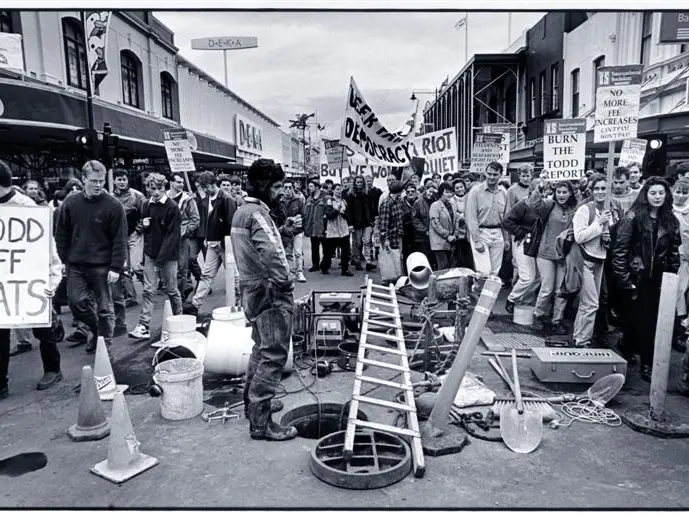
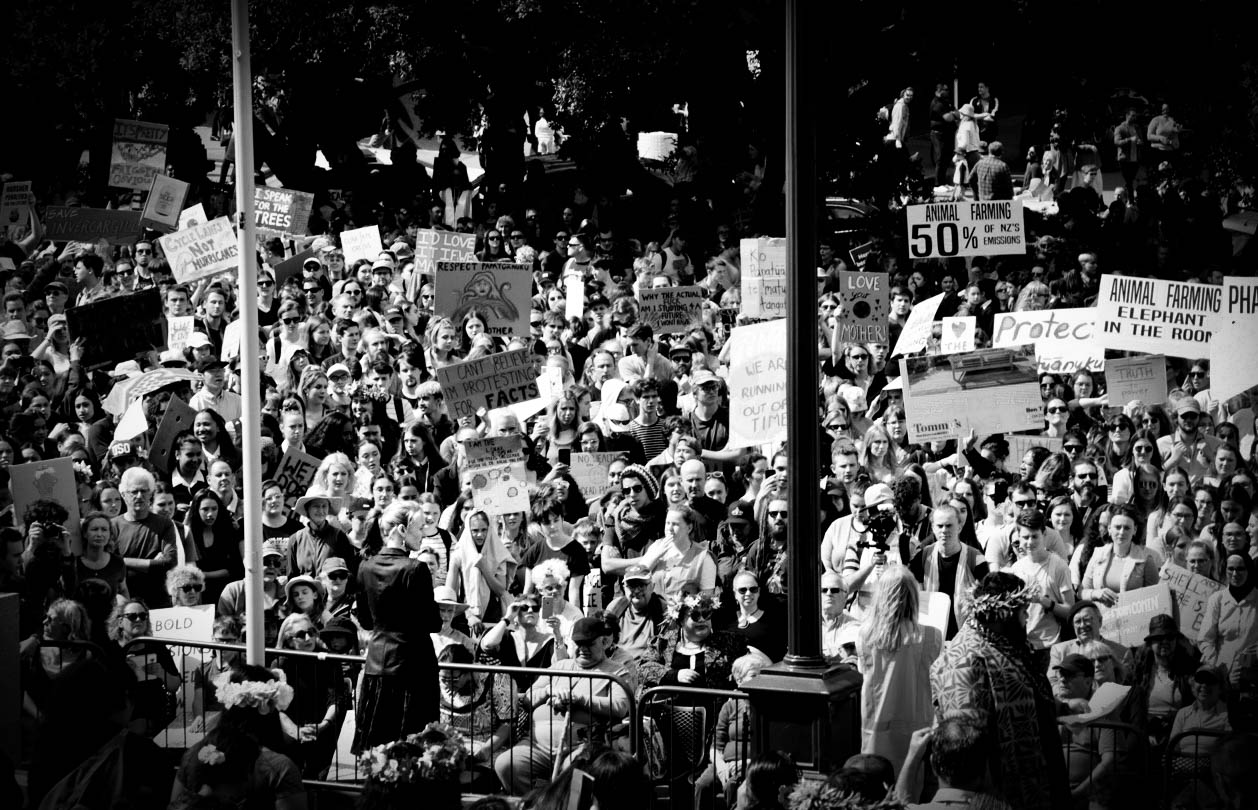
First, we need active movements against all of the weapons which capitalism wields to threaten our destruction, including street mobilisations against war and weapons companies. These movements must draw in sufficient numbers of working-class people who can be convinced to utilise collective power to stop production and strike effective blows against the capitalist machinery. It’s not enough that New Zealand adopted a “nuclear-free” stance in the 1980s, that “we” imagine “ourselves” as a “peace-loving nation” or as adhering to some nebulous “rules-based order” in false nostalgia for a non-existent peaceful and just period. We need to push for New Zealand to ban all imperial ships from our harbours, cut ties with génocidaires, end military exercises with any aggressor countries, cease involvement in spy networks, and stop launching military targeting satellites.
Second, we urgently need to build massive socialist organisations which can educate, lead, and successfully mobilise to take on the capitalist class not just in momentary demonstrations or single-issue campaigns but in sustained political challenge to the entire capitalist system. Only by building such organisations can we have any hope of decisively winning against those who have used the spoils of their exploitative activities to entrench their power and control and to build the weapons that threaten our very existence. This is why simply being an “activist” is insufficient. This is why you should join us: we must work together to overthrow this capitalist system once and for all. See our contact page for information on how to contact your nearest branch of the International Socialist Organisation of Aotearoa, and get in touch! We have a world to win, and we can’t afford to lose!
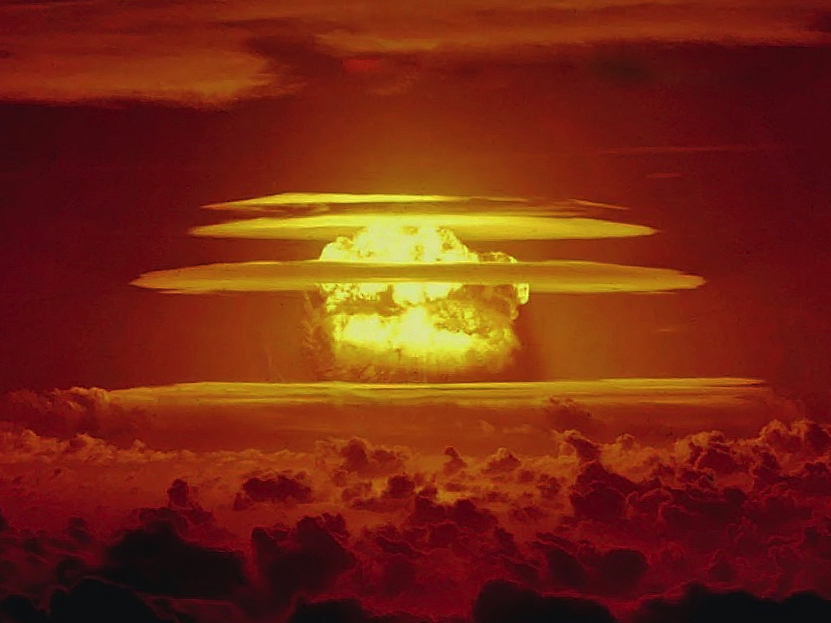
Banner Image: The “Castle Bravo nuclear test”, the detonation of the most powerful thermonuclear device ever “tested” (deployed against people of the Pacific) by the United States of America. Photo credit: United States Department of Energy – National Oceanic and Atmospheric Administration; from Wikimedia Commons; Public Domain.