The Luddites currently occupy an almost mythological presence in the cultural imagination. Now a derogatory term, to be a Luddite, we’re told, is a shameful thing: to be backwards-looking, hateful of technology and opposed to new ways of working. To be, essentially, opposed to any kind of “progress” that capitalists deem necessary, inevitable, and always, always good.
The Luddites are now remembered as a group of angry rioters who, in their fear, impotently smashed some of the new machinery that towered over them in their workshops. In reality, however, they were a network of organised workers based across England, specifically the East Midlands, East Lancashire, and West Yorkshire, with specific demands – fairer wages and better working conditions. They organised targeted attacks at mills and factories, relentlessly petitioned the Government, and gained mass public support. That is, until they were violently suppressed by the State.
The Context
In a period defined by the Napoleonic Wars and the First Industrial Revolution, the Luddites’ struggle was one of many which workers waged against the state amidst major political and economic instability.
In fact, the British government had already been suppressing political action for some time. In the 1790s, the Government passed a bill against radical writings and newspapers, and in 1799 the Combination Acts were passed, outlawing strikes and union organising. Inspired by the French Revolution, the lower classes were envisioning new ways of living. Local groups across the country were petitioning to give working people the vote, and forming their own communities. But the ruling class was reading new economic theories of their own and, sensing the growing strength of the working class, suppressed fight-back as much as possible.
In 1803, the Napoleonic Wars began and caused further political and economic instability. Political action at home was dampened by the need for soldiers abroad, and food prices were skyrocketing due to food shortages, poor harvests, and naval blockades. By 1811 – when the Luddites first took action – Britain was at the height of an economic depression. There was, at that time, still no end to the war in sight, and food riots were ongoing throughout the country. But with unions outlawed, and petitions to the Government met with silence, workers had to find a different way of organising.
The Struggle
Beginning in Britain in the mid-to-late 1700s, the first industrial revolution was changing nearly every aspect of life. With new methods of trade and mechanised forms of working, textiles – based predominantly in the North of England – became the dominant industry. Prior to the development of factory work in the early 1800s, craftspeople trained for years in their field and worked in small workshops, often in their own homes, within their local community. They had control over their working hours and could work at their own pace and rhythms, producing carefully crafted textiles. So, when, in the early 1800s, new machinery was being developed to reduce labour costs and accelerate output, it presented not only a threat to their craft, but to an entire way of life.
As Marx outlines in Volume One of Capital: “Like every other instrument for increasing the productivity of labour, machinery is intended to cheapen commodities and, by shortening the part of the working day in which the worker works for himself, to lengthen the other part, the part he gives to the capitalist for nothing. The machine is a means for producing surplus-value.” In essence, these skilled workers would now lose autonomy over their working life, and would instead be forced to work longer hours in harsher conditions without gaining the profits that this extra labour would produce. Not only would the emergence of these factories displace communities and push workers into larger cities, but the textiles produced by machinery – frequently operated by children – were of a much lower-quality to what skilled workers had been trained to craft.
It becomes clear then, that when in March 1811 a group of workers in the East Midlands set about smashing around 60 stocking frames, their anger was not directed at the machinery itself – they were skilled craftspeople and worked with technology every day – but at what the machinery represented.
After this first attack, the Luddite spirit quickly spread and soon spanned across multiple counties, each group with its own politics and approaches dependent on the specificities of their locations. The East Midlands workers were more savvy with parliamentary discourse and would petition the government alongside their attacks, while the Yorkshire bunch were much more threatening and radical in their approach, quickly realising the link between the specificity of their fight and the injustice of the system that had caused it. In Manchester, workers didn’t have the same tradition of organising as the rural towns did, but the very fact of the city’s rapid urbanisation meant there was a higher concentration of people able to organise together and tackle the factories in larger groups.
Nedd Ludd
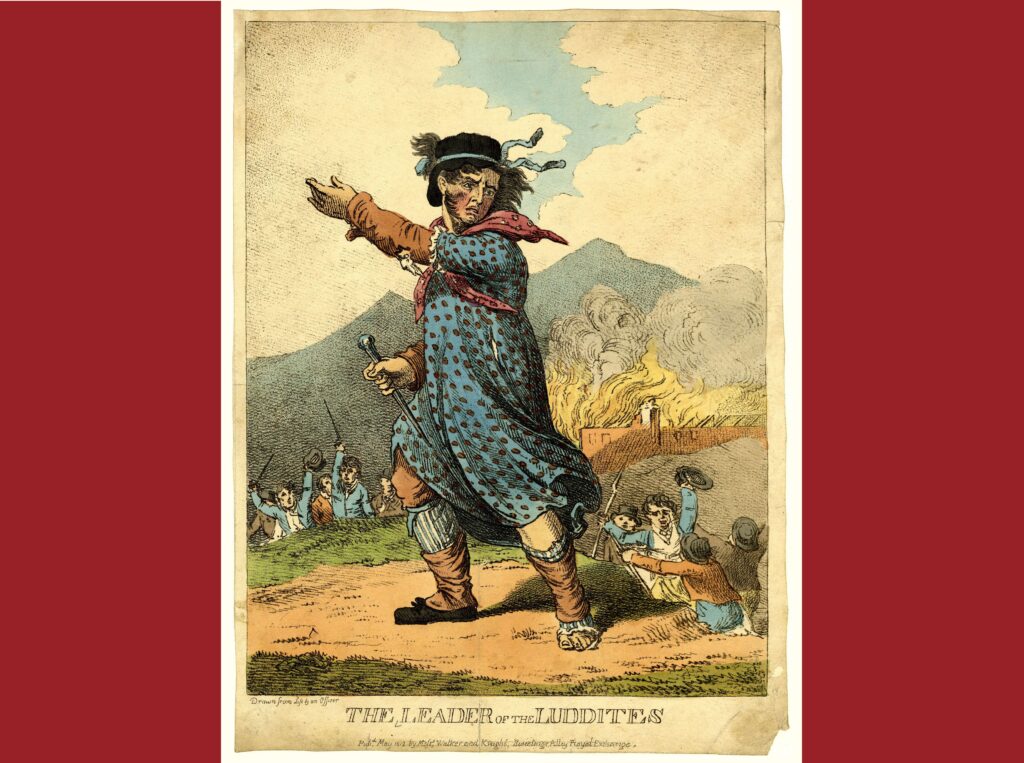
Despite their differences in approach, rhetoric, and politics, the Luddites all united under the same name: Nedd Ludd. “King Ludd,” or “General Ludd,” as he is sometimes called in Luddite protest songs, is said to have smashed some stocking frames after being criticised for his working methods. While Nedd most likely was a real person (though not a figure of authority), he existed long before the Luddite movement itself and had already become a figure of folklore akin to Robin Hood. The strategic use of this title was not representative of a singular leader then, but was a symbolic gesture, uniting a discursive network of protesters under one cause and, in turn, increasing their collective power.
It also gave them anonymity. The Luddites took a vow of secrecy never to reveal their comrades’ names to the authorities, and each letter they sent to one another, to mill-owners, or to Parliament was signed under the name Nedd or Betty Ludd. They wrote songs about “General Ludd” to purposefully create a mythos of their struggle, and would wear masks during protests to hide their identity. The costumes, the shared name, and the public attendance during protests meant that it was very hard for the authorities to know who to prosecute. In their desperation to suppress the attacks the government began planting spies into the communities, even encouraging attacks on factories, in the attempt to find out who the leaders really were.
This impressive solidarity, not only between Luddites but between the Luddites and their communities, proved successful in the short term. They won concessions to food prices, usage rights, and received raises in wages. But as the struggle progressed it became more violent. Mill owners began shooting protesters, and one – William Horsefall – wrote to encourage the magistrate to “ride up to their saddles in Luddite blood”. Eventually the government sent around 12,000 troops to the North of England as military reinforcement for the magistrate – a lot considering Britain was still fighting the Napoleonic Wars at the time.
The Government’s suppression eventually won, the movement ultimately coming to a halt in 1813 when protesters across counties were hanged. At this point in British history the common method of punishment was transportation to Australia, so the public execution of Luddites was purposeful: the Government wanted to show people what could happen if anyone attempted to challenge the status quo. Nevertheless, the Luddite sentiment resonated in many local struggles that came after them.
Remembering the Luddites
While the Luddites were defeated, their unity has lent them longevity. Theirs was not a national struggle, but the Luddites used their localities to their advantage. Their use of carnival traditions in their costuming, and of folklore in their song-writing and portrayal of a leader, was an act of defiant community. They were waging a moral fight as well as an economic one, challenging a system and a government that allowed unrestrained profit and competition no matter the toll on the environment or people’s lives.The common understanding of the Luddites today is indicative of the bourgeoisie rewriting history to suit their own needs: the needs of Capital. But the immensity of the suppression that the Luddites’ were met with demonstrates that their defeat was by no means inevitable. As Paul Murphy writes in The Case For Luddism: Taking a Hammer to the Capitalist Machine, “Their defeat marked a turning point” in the progression of capitalism. Ultimately, this history is still happening. With the rise of generative AI, technology is not only threatening our jobs but our humanity. Uniting under a common fight, the fight for a better world – a socialist world – is the only way we can hope to build a system that values human need, over endless profit.
Caption: the only known depiction of Nedd Ludd. His outfit – a polkadot dress – is a common aspect of traditional carnivals, where people dress in costumes to subvert the norms of society. Here it becomes a means of protest; it is a symbol of the masses reclaiming power over the State. Source: Wikimedia Commons