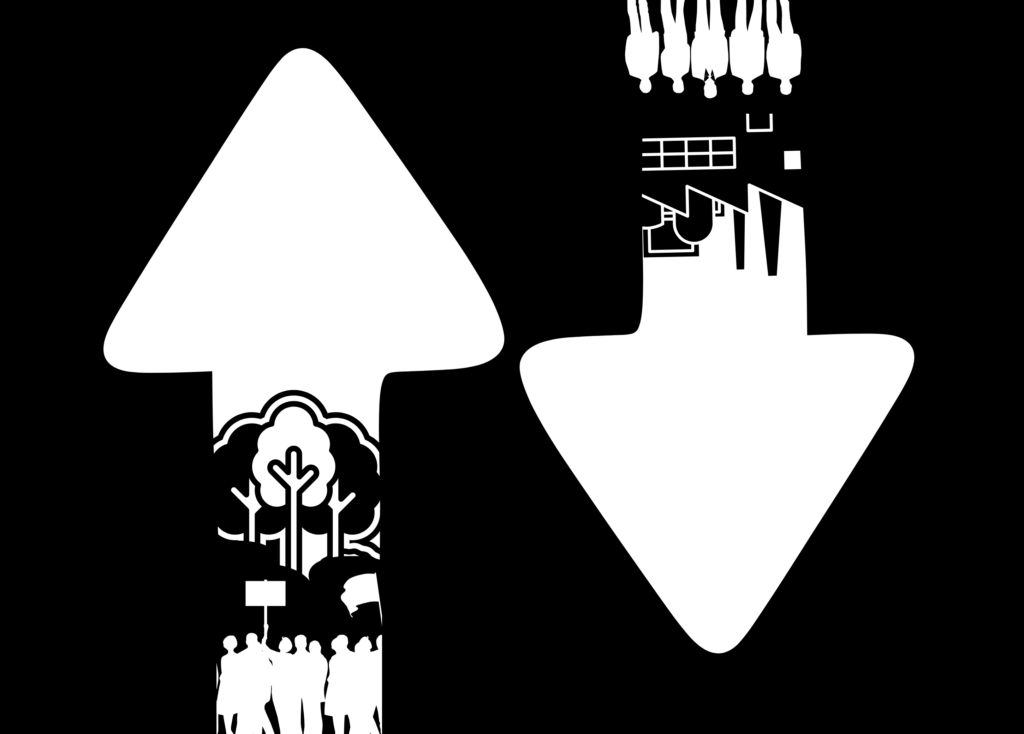
Historical Materialism is a theory of history, a way of understanding the world. It is the fundamental underpinning of Marxist analysis. As the name suggests, this is a “materialist” framework: it starts with the assumption that we live in a material world, and that human social structures can be understood as part of that material world. However, it is not a framework of crude biological determinism. Marxists recognise that this material world is not fixed and unchanging. The historical aspect of Historical Materialism tackles the question of how things change. It deals with the interactions between humans and the wider environment. It examines human societies and the way that people are both shaped by the conditions of the society they live in, and have the capacity to shape that society.
These interactions can be called “dialectical”, in the sense of a two-way process or relationship; Historical Materialism is sometimes called Dialectical Materialism. A dialectical way of examining the world involves recognising the totality of phenomena, seeing individual parts as inextricable from the whole; it posits that things are always in a state of change; and it goes beyond reductive, one-way causal narratives, seeing phenomena as being in a complex interrelationship with each other.
In describing the world, Marx starts with the relationship between humans and the wider environment. He particularly focuses on production and reproduction – how we acquire the things we need to live. One way to talk about production is to name different “modes”. Capitalism is a mode of production where human life, including our relationship with nature, is organised around the production of commodities and the accumulation of profit. Under capitalism, people are divided into classes based on their relationship to production – primarily a labouring class of Workers, and a ruling class of Capitalists who control the means of production and reap the benefits of production-for-profit.
When it comes to how people shape the world, Historical Materialists are less interested in the deeds of exceptional individuals – though they can play a role – and are more interested in collective activity and the relationship between different classes. These forces, along with the forces of nature, drive change in human societies. Marxist historians posit that a society can be radically transformed through the process of revolution. This is how capitalism arose out of the feudalism that preceded it, when the Capitalists (or Bourgeoisie) took power from the Aristocracy. Such revolutions happen when the material conditions have been created for a new type of society to emerge, and when crisis gives a class of people the opportunity to take advantage of these developments.
Workers, as a class, are in a dialectical relationship with the Capitalists. A dialectical relationship doesn’t imply an equilibrium that sustains itself over time. Rather, these are unstable relationships – they have the tendency to generate new possibilities that push beyond the existing relations. As Workers, our lives are shaped by the needs of Capital. However, life under capitalism is contradictory. Capitalist workplaces throw us together and facilitate mass-scale cooperation. The technologies used to oppress us also give us the capacity to communicate and create in unprecedented ways. While we are disempowered in our day-to-day lives, our place at the centre of production gives us immense potential power. All this creates the possibility for resistance, especially when we come up against the obvious failings and injustices of capitalism.
Seen through a Historical Materialist framework, the failures and injustices of capitalism are not incidental, they are contradictions inherent to the system. Capitalists need workers for their companies and buyers for their products, but in their drive to maximally exploit us they are constantly threatening our ability to sustain ourselves, to keep working and consuming. Capitalism generates technological innovation, but then must suppress the potential of this technology to meet human need and undermine profit-making. Capitalism ruthlessly exploits the natural world, and then is forced to contend with ecological disasters that threaten their profits and very existence. The result: recurrent and worsening crises.
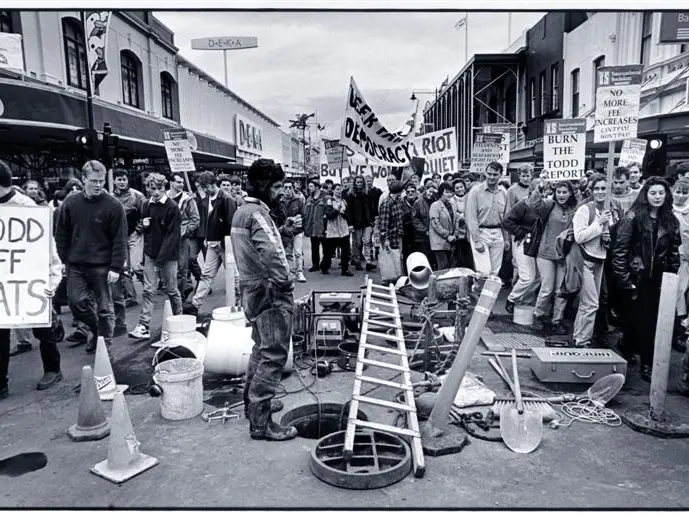
It is easy to feel that the logic of capitalism is inescapable, as those who have the ability to control material conditions also have the ability to shape consciousness. However, workers can shape material conditions too, and when we fight back – going on strike, for example, or occupying a city square – we interrupt the logic of capitalism and make other possibilities imaginable. Historical Materialism is not a deterministic theory that robs us of our free will, but a way of seeing the world that affirms that we have agency, even if it is in conditions not of our own choosing. Within the society around us, there are the seeds of other possible societies – and massive potential which can be realised through collective action.
Caption: Graphic design illustrating the relationship shaping material conditions between the Workers from below and the Capitalists from above. Image credit: Romany Tasker-Poland.