What is Nationalism, and why do socialists oppose it?
While often presented as timeless, the nation-state is a relatively new phenomenon. The evolution of modern nation-states in Europe in the 19th century is tied to the rise of capitalism. Nation-builders instituted new forms of governance and territoriality to fit the changing dynamics of capitalist society, in the process marginalising other collective identities and relationships to places. The borders of modern nations subsume other collective formations – the hapū of Aotearoa, for example, are now formally encompassed within the nation of New Zealand, while fighting to maintain their unique identities in practice.
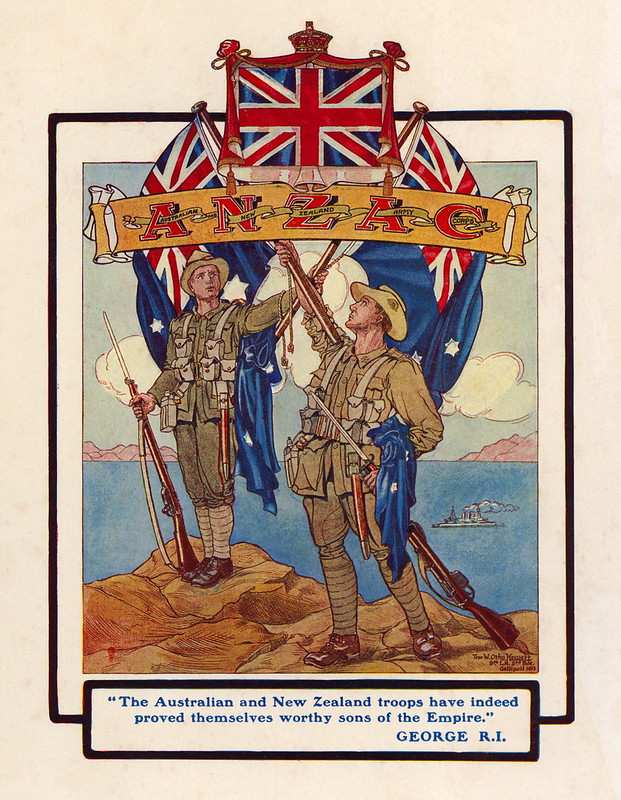
National borders also cut through communities. In America, a continent cut up through conquest and colonialism, Mexican and Indigenous peoples express this with the slogan “We didn’t cross the border, the border crossed us.” WWI was another exercise in this arbitrary carving up of territory, as the real legacy of the ANZACs reminds us. During this conflict, European powers fought over the possession of colonies and carved new borders, particularly in the Middle East, without regard for the wishes of the inhabitants. The devastating legacy of this is still felt today. For New Zealand’s part, the ANZAC troops’ attempt to invade Turkey was part of this wider project. Closer to home, the New Zealand military invaded an already-partitioned Samoa, taking over the part of the country then-ruled by Germany.
When discussing “the nation,” we are often essentially discussing the state. As covered in previous columns, the state is an instrument which enables the rule of capitalists over the working class within a nation, and facilitates competition between capitalists across nations. Nationalism is the ideology that naturalises this arrangement, tying it to specific national territory. It discourages other forms of collective identity which may run counter to the interests of the ruling class, especially class consciousness. Nationalism encourages workers within a country to identify with their “own” ruling class, and discourages them from identifying with workers internationally – fostering xenophobia and racism. Nationalism enables war-making and is at the root of anti-migrant violence. As we see with the example of WWI, nationalism can justify the idea that one’s “own” nation is entitled to rule others.
While opposing nationalism, socialists have a long-standing tradition of support for national liberation struggles. This support is rooted in opposition to imperialism and colonialism, and solidarity with international workers in their fight against these injustices. We welcome blows against the imperial system which harms us all, and recognise the right of workers to freedom from imperial and colonial domination.
National liberation movements are complex. They foster political awareness in workers and the oppressed, often raising aspirations that go beyond formal national independence to questions of exploitation and political power. They can, paradoxically, encourage internationalism, as workers across the world recognise commonalities in their struggles. However, class fighters within national liberation movements often find themselves in a difficult position. They can face pressure to fall in behind their local bourgeoisie politically – putting aside their own demands and interests – or to turn on workers of other national or ethnic groups. This is why socialists, while supporting national liberation movements, retain our loyalty to the working class elements within these movements in the final instance. We advocate for independent working class political organisation, and support workers of all countries in struggle against their “own” ruling class.
This gives us a picture of the alternative to nationalism, which is internationalism – the radical idea that workers of all countries have more interests in common with each other than with their “own” ruling class. This is not to say that we advocate cultural homogeneity. We envisage a world where people are restored to an unaliented relationship with their land, where diverse histories and languages are protected as taonga, and where a multitude of collective identities and practices can flourish unhindered by the repressive edicts of nationalism.
In fact, internationalism is not just a moral consideration but a practical one. Capitalism is a global system, and it will take international efforts to dismantle it. It stands to reason that a society built in its place would also be globally connected. If our goal is to right the injustices left in capitalism’s wake, heal the damage wrought on the environment, and create a society based on human need, then borders will only pose a barrier to this.
Banner Image: “The Australian and New Zealand troops have indeed proved themselves worthy sons of the Empire”. From the “Anzac Book”, 1916. Archives New Zealand, Reference: ACGR 8481, PUTTICK9, (R21124691)