Today, people commonly talk about “classes” in society through the notion of a spectrum of wealth: those with very little money are “lower class,” while the filthy rich belong to the “upper class.” Those of the ambiguous “middle class” aspire to climb this class ladder, while they fear sinking into the lower classes. Clearly, the wealth disparity between the rich and poor is bordering on absurd, as the rich buy their way into political power while the very poor are considered cheap labour. But this conception of class obscures a deeper understanding behind a smokescreen of supposed meritocracy, and fails to conceive of the ways that broader economic systems of structured inequality and exploitation operate and sustain themselves. Also, perhaps most critically, this view of class-based society fails to take into account the ways in which these classes interact with one another.
Class Society
Throughout history, class society has shifted through many forms, but broadly we can categorise the people within those societies into two categories: producers, and non-producers. Producers are people who work to create any sort of good or service which is used by people in society. The non-producers, in contrast, do not participate in this process directly, and are able to build a livelihood using what others produce. In feudal society for example, producers include serfs: peasants who were legally bound to a plot of land and who worked this land, grew crops, maintained buildings, and so forth. The non-producers in this form of society were the land-owning lords, who lived off of the work of those serfs in exchange for protection. The form of these classes differs today under modern capitalism, while the broad producer/non-producer category remains. Today for example, a producer may be a customer service worker who sells their time to a call centre, or a teacher who sells their time to the state or a private school, while a non-producer may be a landlord who lives on rental income in exchange for allowing workers to legally live on multiple plots of land and houses that they own.
In class society, whether this is slavery-based ancient production, feudalism, or capitalism (these different forms are called “modes of production”), the non-producing class organises the work of the producing class. This can only be achieved when that non-producing class (lords, kings, capitalists, and so forth) owns and controls the natural resources, tools and machines, and infrastructure that is used to actually create things. We call this category the “means of production.” Understanding a class’ control over the means of production and its use as a point of relation between classes is fundamental for all class analysis. It enables us to answer the questions: Who controls what is produced? What elements of society control people’s ability to fulfil their needs, from housing to food to the pursuit of art and fulfillment of one’s life? And critically, if control over the means of production enables one class to hold power over another, how does that controlling class take what is produced for its own benefit?
Surplus Labour and Value
To answer that last question, we need to understand the demarcation between “necessary labour” and “surplus labour.” Necessary labour is undertaken by the producing class to generate the requirements for subsistence. Surplus labour is the work done to create products over and above the level of social subsistence (in other words: making more than is necessary to meet the needs of the status quo). The form that this surplus takes differs across modes of production, but the function is the same in essence: the producing class has enough to reproduce its own social existence, while the non-producing class seizes the surplus for itself to create a more materially-enriched existence for itself than the class which laboured to create that wealth.
In some forms of feudalism, this demarcation was clear: a serf would spend some of their workweek on the lord’s estate, and some on their own holding. In other forms, this distinction was muddier, as lords extracted rents in the form of money or commodities, such as food produced by the peasants. In capitalism however, the distinction between necessary and surplus labour is hidden from plain view. Necessary labour is a proportion of labour time that a worker spends producing the value required to generate their own means of subsistence, while surplus labour is everything beyond that.
By being paid for our time, we obscure the real value of what we produce, and cannot clearly separate how much work is needed to keep society running from what is beyond that necessity. That surplus does exist because workers, whose labour is ever-more productive due to technological improvements, create more value than what they are paid for. To articulate this from another angle: producers (the working class) within capitalism work longer days than necessary, because this creates surplus value to be extracted by the non-producing (capitalist) class. This is the economic exploitation at the root of today’s dominant global mode of production: capitalism.
Control of the Means of Production
Capitalism’s distinctive feature as a mode of production is the ownership of the means of production by private capital: the transformation of the means of production into business-owned private property. Capital, at its simplest, is money which is used to buy something to sell again for a profit. Capital is owned by private capitalists, and used to purchase means of production: resources, land, machinery, and factories, as well as purchasing labour time from workers.
Behind this formal ownership sits an interlocking system of legislation, police, and military – state enforcement of class control of the means of production. And if members of the working class refuse to engage in this exploitation, they effectively choose to languish in poverty. Alternatively, if groups of workers attempted to directly control production and claim the surplus value for themselves, this would be labelled as criminal activity and would see the police (or in extreme cases, the military) violently repress and detain them. Under capitalism, the forces of the market tend to ensure that surplus value is extracted long before the more direct violence of the ruling capitalist class is necessary. So our class, the working class, is kept separated from the means of production by an ever-present threat of violence and impoverishment, while capitalist market forces ensure that we continue to be indefinitely exploited.
Capitalism’s “Middle Class”
The phrase “middle class” is often used to refer to those who, in capitalist societies, hold comfortable levels of income while being neither the “working poor” nor “independently wealthy.” Marxists conceptualise this differently. While most class relations within capitalist class society fit broadly into either the working class or the capitalist class, the “middle class” umbrella covers a range of sub-classes and contradictory class positions. For example, small business owners (or “petite bourgeoisie”) own their means of production, but due to the dominance of large companies may be forced into a social existence that looks much more like a worker’s than a capitalist’s. Land-owning farmers hire and exploit wage labourers, while also undertaking productive labour on their land to maintain their livelihood. Some white-collar workers are promoted to high-salaried positions that bring them into the social orbit of the bosses and are effectively paid to represent the class interests of the bosses, while still occupying a working-class position in relation to production.
The class interests of these middle class groupings are highly varied and mobile, and any analysis as to their class sympathies and revolutionary potential must be explored in context of the material conditions of the day. In one moment, a small business may be flourishing under positive market conditions, and may pay their workers generously out of a sense of shared community and philanthropy. The next moment, an economic downturn may lead to their lobbying for legal conditions whereby they can brutally exploit their workers, in order to maintain their class position and avoid losing their capital and becoming a worker themself.
Conclusion
Understanding how classes have been arranged, changed, and exploited throughout history is a crucial step towards understanding how and why entire modes of production have collapsed and given rise to their successors. Our task then is not only to understand and describe the history of class society, but to orient ourselves within it – and to engage in class struggle in the interest of our producing class: the working class of the world.
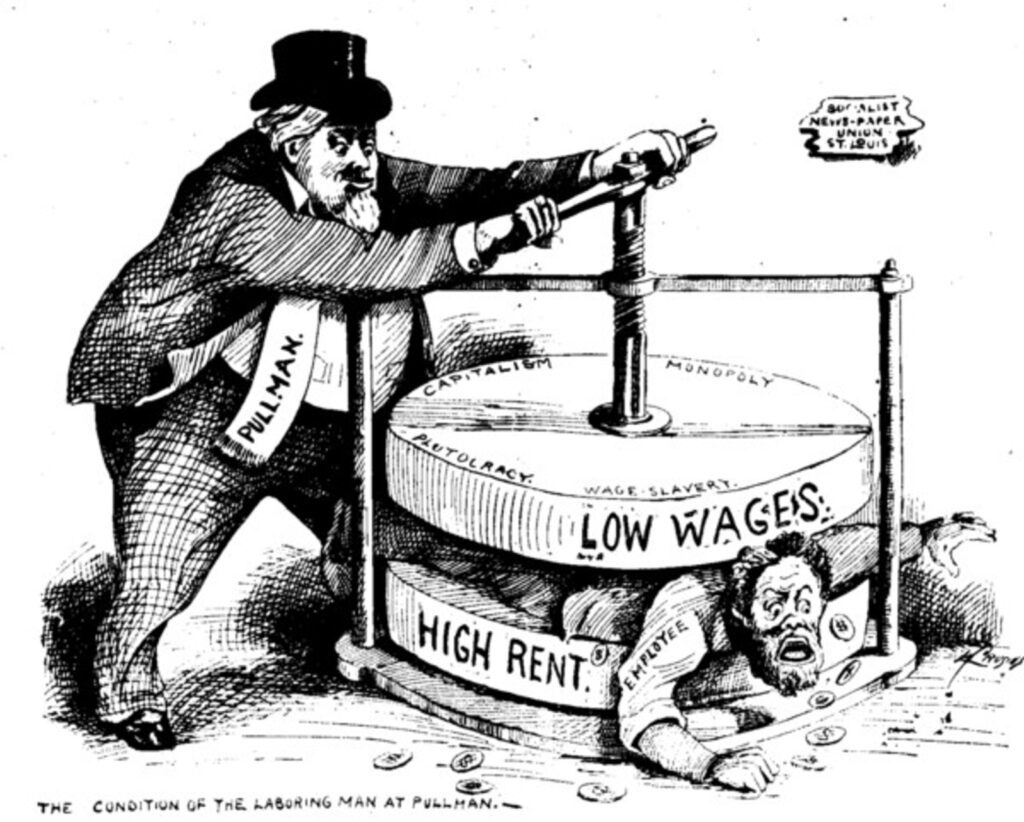
Banner Image: The Condition of the Laboring Man at Pullman (1894) – Public Domain