Though only 22 years old, Te Pāti Māori (TPM) has evolved significantly since its founding in 2004. The Māori Party originated from a Māori MP, Tariana Turia, splitting from the Labour Party in protest against the state-sponsored raupatu (confiscation) of the takutai moana (foreshore and seabed). It has transitioned from its nine-year alliance with the National Party and loudly moved into the current iteration of promoting extra-parliamentary action towards decolonisation. All the while, Te Pāti is plagued by internal fractures. We ask the pertinent question: what does this mean for socialists engaging with the only self-proclaimed electoral force for fighting for tino rangatiratanga (self-determination) in the modern anti-Māori, capitalist landscape?
Foreshore and Seabed (2004)
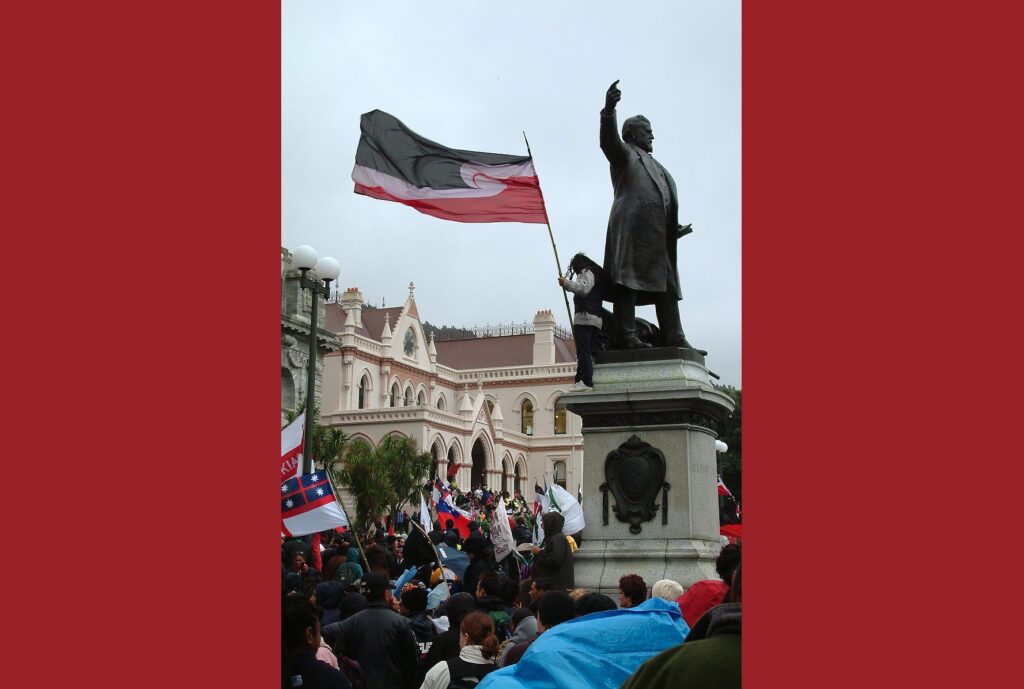
Te Pāti Māori must be understood within the context of its emergence as a protest by te Ao Māori. The Labour government created the Foreshore and Seabed Act 2004 to forcibly vest the ocean and tidal area around the entirety of Aotearoa to the Crown, from the tip of high tide to the end of New Zealand’s domain 12 nautical miles from land. Fierce protests erupted, with a 15,000-strong hīkoi from Te Rerenga Wairua (Cape Reinga) to Parliament in Te Whanganui-a-Tara. In parliament, Labour MP Tariana Turia (Ngāti Apa, Ngā Rauru, Tūwharetoa) voted against the Act. Māori academic Pita Sharples joined Turia to form the Māori Party in 2004 amidst this surge, dedicated to the kaupapa of mana motuhake. By contesting Māori electorates, the party swept four seats in the 2005 election, explicitly fighting against the Act and the Labour Party that made it.
National Party (2008)
Mass protest politics fell to the wayside following the 2008 general election; the Māori Party added its five electorate votes to John Key’s National government in a confidence and supply agreement (agreeing to vote for National’s budget), including ministerial roles outside of cabinet (to allow them to be nominally independent) including Sharples’ Minister of Māori affairs position, as well as the repeal of the much hated Foreshore and Seabed Act. They also secured substantial funding for cultural and socio-educational interests, laying the foundations for Mātauranga Māori in mainstream settings and entrenching the importance of Te Reo Māori, supporting Kura Kaupapa and Kōhanga Reo.
The Māori Party of the time found it preferable to work with the conservative government for piecemeal reforms, rather than to create and work with the very mass base from which they originated. A naïve analysis may be that the Māori Party found it better to work with the right-wing party in order to replace the Foreshore and Seabed Act with the watered-down Marine and Coastal Area (Takutai Moana) Act 2011 which leaves the land rights of specific areas up to legal debate (a far cry from tino rangatiratanga). This analysis is all the more tempting specifically because they were in parliamentary opposition to Labour, the creators of the 2004 raupatu. That answer however, obscures the class interests of the Māori Party themselves.
To go through the Treaty settlement process, iwi usually require a trust or holdings company entity to receive redress – usually reparations as large cash or credit sums, forestry, land usage, and aquatic rights. This requires the iwi to go through a long negotiation process with lawyers and financial managers just to receive 1 to 2 percent of the value of what was taken during colonisation. To maintain and expand this pittance in a capitalist economy, these boards are compelled to invest and tie themselves to the global markets – their interests are inexorably tied to the capitalist class because of their reliance on capital investments. This specific layer of Māori would be increasingly relied upon as their complicity in the National coalition austerity campaign dwindled their working-class base.
Mana Party Split (2011)
The pro-working-class faction broke off in 2011 when Māori Party MP Hone Harawira split from the party, creating the left-wing Mana Party (later called Mana Movement), which summarised neoliberalism being “mirrored in the corporate developments arising from Treaty of Waitangi Settlements” and “creating huge disharmony and factionalism in Te Ao Maori so while our corporate warriors play capital markets and investment strategies the peoples wellbeing deteriorates more and more…” This article is not about the rise of the Mana Party (and the subsequent downfall of the Internet Mana party). Rather, the Mana Party split is presented as an example of the continual tension between the proletariat voting base and the cynical bourgeois nationalism of the corporate boards connected with Te Pāti.
Post 2020 Radical Orientation
The dam burst in the 2017 election: the Māori Party lost every single Māori electorate to Labour, and it recovered only one in the following 2020 election. The party had to change. Within a year, both co-leaders, the party president, and a spate of senior executive board members resigned, clearing the way with a series of nationwide community hui.
Thus Te Pāti Māori was reborn, renamed from the Māori Party, with new co-leaders Rawiri Waititi and Debbie Ngarewa-Packer – explicitly abandoning their previous compromise strategy, and looking towards Matike Mai Aotearoa and an enshrining of Te Tiriti o Waitangi as the basis of both resistance to racist government policies and the guide towards their political programme. Bolstering some of the most progressive tax, welfare, environmental, and constitutional reforms seen in Aotearoa’s neoliberal era, including abolishing the police by 2040, they won six of the seven Māori electorates in the 2023 election. One such seat was won by the youngest MP in over 170 years, Hana-Rawhiti Maipi-Clarke – a signal of Te Pāti Māori also shifting appeal towards urban rangatahi and working class Māori.
The National-NZ First-ACT coalition government came into power in 2023, and began rushing racist and anti-worker bills in quick succession through “urgency” (a process which reduces the amount of time for debate in and out of parliament). In response, Te Pāti Māori has become a staple of protest within Parliament (most notably the ripping of the Treaty Principles Bill as part of a haka) as well as outside of it; galvanising several activations of grassroots protests including working with Toitū te Tiriti in the enormous protests against the ACT party’s not-so-subtle attempt to rewrite Te Tiriti o Waitangi: the Treaty Principles Bill (because of the hīkoi, the Bill became such political poison not even National voted for it).
One may think that Te Pāti Māori have learned from their past failures of corporate complicity, moving back towards extra-parliamentary politics as the lungs and breath of the party, instilling new life with every picket and hīkoi. In this respect, Te Pāti Māori is one of the few remaining reformist parties that understand politics doesn’t just happen in parliament, or one day every three years, but that politics is a continued process to be nurtured and learnt from consistently.
However, the contradictions between their working-class protest and electoral base and the Māori capitalists within and adjacent to the party (as well as between competing capitalists) do not give the populist sections the purchase to act in the long-term interests of movements. October 2025 ended with TPM Te Tai Tokerau MP Mariameno Kapa-Kingi leaving the party, after a public spat in which she and Te Tai Tonga MP Tākuta Ferris were expelled for bringing the party into disrepute (in the wake of Tākuta questioning why non-Māori communities were supporting the election of Labour’s Māori electorate candidate), with Mariameno also being accused of misusing party funds (she appealed and was reinstated). Eru Kapa-Kingi, her son, former TPM list MP, former TPM vice-president, and the face of Toitū te Tiriti (as well as being the target of the alleged misattributed funds by way of Mariameno hiring him) left in March, and later announced that Toitū Te Tiriti would also sever its relations with Te Pāti Māori, citing a “dictatorship model” of the party leaders.
The paradox of reformism rears its ugly head: a reformist electoral party relies on grassroots mobilisation to build connections between groups, expand membership, garner support for the election, and maintain a movement beyond the three-year election cycle. However, the movement cannot go beyond what Te Pāti is willing to offer; party president John Tamihere has no interest in having “regular national council meetings” (as the Te Pāti Māori constitution demands), nor holding AGMs in which the expelled candidates can vote on no-confidence motions against him as Ferris attempted. This is not the result of a rogue individual taking control of a party; it is the logic of reformist parties that results in a purging of the radical sections of the party.
What’s more important than whether an electoral party says they will institute a specific policy is whether they actually have the capability or willingness to do so if they get into power. As Luxemburg said: “Since the social reforms can only offer an empty promise, the logical consequence of such a program must necessarily be disillusionment.”
This is Te Pāti Māori as voters experience them; a third of their electoral candidates left to contest their electorates individually, and Te Pāti have shifted to a Māori electorate-vote-only strategy, focussing on staying in parliament to oppose the racist National coalition.
But revolutionary socialists should critically engage. Te Pāti Māori as it exists now will never be capable of achieving tino rangatiratanga whilst embedded within and economically dependent on capitalism. However, Te Pāti still represent a section of te Ao Māori both as a pole of resistance within parliament, and, more importantly, with their “activations” on the street. As Eru Kapa-Kingi correctly states, “Parliament does not hold the mana. The mana is in our communities, on the ground.” It is in the street mobilisations that we can usefully help build revolutionary and grassroots politics amongst the Te Pāti Māori supporters whilst standing in solidarity against the anti-Māori racism of whichever government gets into power next.
Photo caption: Protesters flying the Tino Rangatiratanga (self-determination) and Te Kara (United Tribes) flags, protesting the Foreshore and Seabed Act 2004. Photo credit: Armon on WikiMedia, GFDL.