
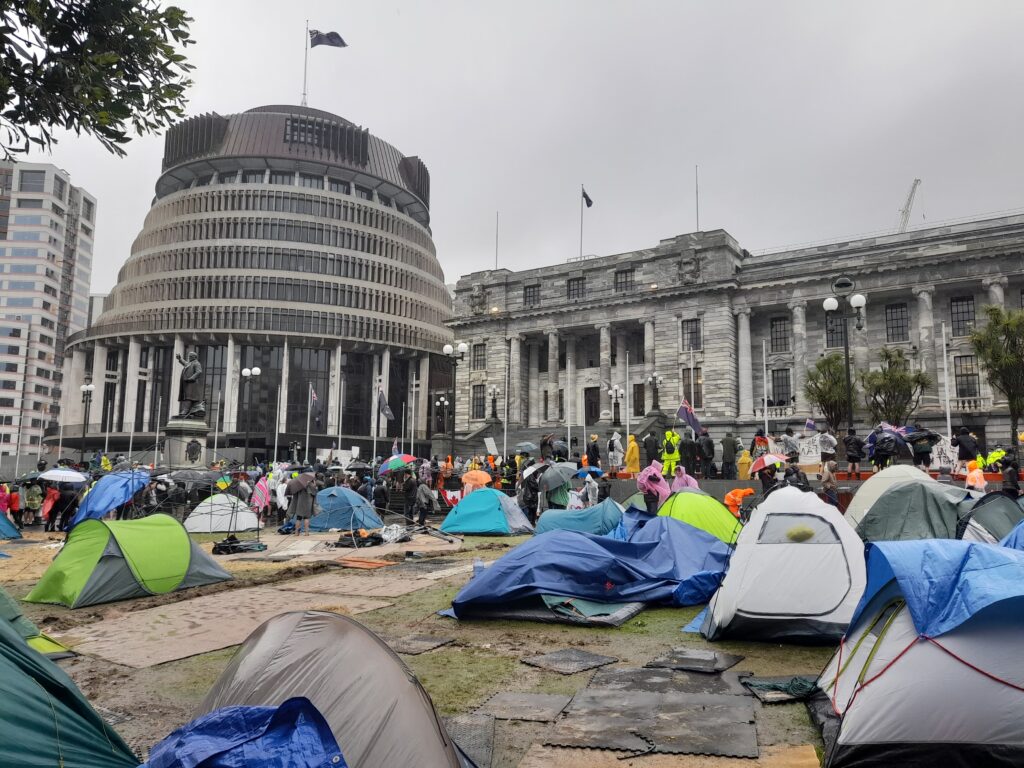
The massacre at Al Noor mosque in 2019 was, for many New Zealanders, their first close encounter with violent right-wing extremism. The Parliament Occupation of 2022, in turn, revealed the breadth and diversity of the paranoid fringe of New Zealand politics. For Byron Clark, researcher of the far right, these events provided the impetus behind his book Fear: New Zealand’s hostile underworld of extremists.
Since the publication of Fear, far-right currents in New Zealand have only become more prominent, as Clark himself has noted in subsequent writing. Drawing on Clark’s coverage, we aim to give a picture of the far-right landscape in New Zealand politics today. For further reading, Clark’s writing can be found on the Substack Feijoa Dispatch. Fear is available from bookstores, and as an e-book. Warm thanks to Clark for his diligent reporting on these issues.
Far-Right Ideologies
Given the colonial history of New Zealand, it is no surprise that white supremacy is a common theme in far-right politics here. After all, White New Zealand was official government policy before it motivated farmers in Pukekohe to form the first White New Zealand leagues in the 1920s. Colonial nostalgia is a feature of white supremacist politics in New Zealand, with modern-day proponents presenting redress for colonial crimes (paradoxically) as a conspiracy to enshrine Māori supremacy. In the lead-up to the 2023 election, initiatives such as co-governance and Three Waters were the subject of these conspiracy theories. Anti-Māori lobby group Hobson’s Pledge donated $283,000 to influence the outcome of the election that brought this coalition to power. If ringleaders of these panics, such as Julian Batchelor, have receded into irrelevance, it is probably because the government is carrying out many of their wishes.
The flipside of fantasies of White Supremacy are fantasies of White Genocide. The gunman who killed 51 and wounded 89 at Al Noor mosque in 2019 espoused a then-popular conspiracy theory about a UN compact on migration. According to this theory, the compact was intended to facilitate the “Great Replacement” of White people with other races. To their eternal shame, both ACT and National boosted this conspiracy by opposing the compact. As Clark notes in Feijoa Dispatch, National dropped this position after it was revealed that the Christchurch gunman had “here’s your migration compact” written on one of his weapons. Yet six years later, mainstream politicians are openly dog-whistling the Great Replacement conspiracy. On 18 August, NZ First politician Shane Jones tweeted “don’t let these Green dreams drive us into poverty and drive all our young people away to Australia, only for new migrants coming from the third world to replace our own children and grandchildren.”
Far-right actors in New Zealand entertain a range of other fixations, from COVID conspiracism to climate change denial. While the specifics vary, there is a consistent foundation of conspiracism and scapegoating, which directs attention away from society’s observable power structures and towards a more obscure enemy. While scratching the surface of these conspiracies often (unsurprisingly) reveals anti-semitism, the usefulness of these politics is that the targets are largely interchangeable. For reactionary demagogues like Winston Peters, “woke” has become a useful catch-all to designate enemies. He is currently directing ire towards trans and gender nonconforming people with the gender definition bill – continuing another long-running far-right tradition of opposing gender and sexual freedoms.
Far-Right Activities
The Christchurch massacre and the unruly scenes at the Parliament occupation raised widespread concern about far-right violence. There have long been fringe groups in New Zealand who celebrate and promote violence. According to Clark, Action Zealandia was the most active of these in 2019 before they fragmented into small autonomous local groups such as Southwind in Wellington and the Canterbury Legion. While he rates the influence of these groups as fairly insignificant at present, and researchers infiltrating their communications in 2023 found them “mostly incompetent,” their existence nonetheless increases the threat of right-wing violence. Many current and former members have a history of violence, both personal and political – Clark references a former AZ member, for example, who recently assaulted two people with his car.
Perhaps the most credible threat of violence at present comes from Destiny Church and its various offshoots; their attack on a drag event at an Auckland library last year, which saw one teen concussed, marking a definite escalation. Their “Man Up” group has physically disrupted more Pride events since then. The anti-migrant “True Patriots of New Zealand,” which Clark identifies as another Destiny Church front, disrupted a Sikh parade in Auckland in January with a banner that read “this is New Zealand not India.”
Another threat to contend with is the coordinated campaigns of harassment that have become a standard tactic used against critics of the far right. Female journalists are a frequent target and, according to Clark, this “mob censorship” acts as a deterrent, raising the cost of speaking out. Clark himself was the target of such a campaign and so, he argues, was Benjamin Doyle, the country’s first openly non-binary member of parliament who was effectively hounded out of this office.
Along with these thuggish elements, Clark’s writings reveal a convoluted milieu of political groups and actors, engaged in a variety of activities from standing electoral candidates to orchestrating astro-turfing campaigns. Among these are the Christian nationalist New Zeal, the rural populist Groundswell, and the conspiracist Voices for Freedom. Many of these groups have associated “alternative media.” By Clark’s account, Voices for Freedom’s Reality Check Radio (RCR) is the most popular of these at present, broadcasting “7 hours of original content a day [in 2025], promoting everything from misinformation about puberty blockers, to climate change denial, to the ‘great replacement’ conspiracy theory.” The threat from these hubs of disinformation will only increase as the wider media landscape of Aotearoa declines; the “youth-oriented” RE: News is the latest in a series of news outlet casualties.
The Far Right and Electoral Politics
Discussing the “alternative media” landscape of New Zealand in Feijoa Dispatch, Clark goes on to write:
It was on RCR that New Zealand First launched their 2023 election campaign, and various MPs including government ministers appear as guests, now that association with a platform where the ‘great replacement’ conspiracy theory is discussed as fact is no longer something that harms one’s political career.
He is pointing to a disturbing trend wherein far-right, conspiracist elements are exerting an increasing influence on media and policy. This tendency can be seen internationally and is a direct result of a system in crisis.
In New Zealand, the years since the Parliament Occupation have seen an active courtship between the far-right milieu and more “mainstream” political parties. New Zealand First is, clearly, the strongest example of this. As Clark writes in the Dispatch, they got into parliament in 2023 in part by “courting the freedom movement” and “cannibalising the vote of other [far-right] extra-parliamentary parties.” He writes:
Now, New Zeal has deregistered with the electoral commission, and their former leader is standing for New Zealand First. The party has built a coalition of anti-vaxxers, transphobes, and Christian nationalists (admittedly, that’s an overlapping Venn diagram) and they are ‘surging’ in the polls, recently surpassing the Greens as the third most popular party. This trend mirrors not just Reform in the UK, but also One Nation in Australia.
The three years we have just endured begin to show us the impact of these far-right elements entering “mainstream” politics. It is not just ACT and New Zealand First to blame, either; National can also demonstrate an overtly reactionary edge (circa 2023 party members tastefully referred to hard-right elements within the party as the “Taliban”). In the current coalition, National can cast itself as more moderate against its partners. However, by entertaining their more outrageous culture-war policies, National ensures that these politics remain relevant. Centre-left parties like Labour are also subject to this “race to the right,” goaded to prove that they can be just as “tough” on immigration, for example. This is a losing game for the centre-left, electorally, but it is, as always, the working class that has the most to lose.
The stakes are high for the 2026 election; a small number of votes could make a significant difference in terms of the far-right presence in parliament. But when it comes to the wider political moment, the stakes are too high for us to be focused exclusively on parliament. Grassroots organising is needed to counter the threat from the right in the streets, and in the long term the only way to counter the spread of far-right politics is to offer a credible socialist alternative.
Banner image: The Parliament Occupation of 2022, a far-right and conspiracist protest against the government’s COVID response. Photo credit: Kiwichris on Wikimedia Commons, CC BY-SA 4.0.




.jpg)