Lenin teaches us that “we have all that is necessary for the building of a complete Socialist society.”
Hence we can and must, by our own efforts, overcome our bourgeoisie and build a Socialist society.
– On the Final Victory of Socialism in the USSR, Joseph Stalin, 12 February, 1938.
Socialism in One Country is an argument from the Soviet Union, an assertion that the USSR had achieved socialism following the Russian Revolution, or the 1936 Constitution, depending on who you’ve read. Defending the Soviet Union, said the Soviet Union, was the priority of the workers of the world and Stalin’s government, in order to protect socialism established by the revolution against the encirclement of capitalist imperialist powers.
Socialism in One Country is the expansion of state power said to be done in the name of the workers, for the workers of the world, but by one country in particular. That country was, at the time, the USSR, held up as a bastion of communism that had to focus on developing socialism locally while under siege.
The claim to socialism in the USSR was the 1917 October Revolution that saw the Bolsheviks defeat competing socialists, reactionaries, tsarists, and liberals in the Russian Civil War. The Bolsheviks emerged as victors, defeating both the Russian aristocracy and the fresh-faced capitalists of Russia. The Soviet State apparatus may have bested the Russian aristocracy and nascent bourgeoisie, but it did not ultimately abolish capitalist relations.
During the Revolution, the policy of “war communism” barracked labour, subjugating the peasants and workers to Soviet military administration and strategic needs to defend the gains of the Revolution. After the Civil War, the New Economic Policy (NEP) moved to allow rural capitalist development to assert overt control of the state by building local aligned capitalists to develop local capital. This was a desperate measure in response to the massive economic crisis brought on by the civil war. Lenin himself acknowledged that NEP was a “strategic retreat”, having sustained a “severe defeat” on the matter of socialist economics in the former Russian Empire.
Lenin, Trotsky, and the Bolsheviks’ struggle for socialism and workers’ power was revolutionary for its time and aspirational in character. They, and the organised working class of Russia, did not go into the October Revolution thinking that socialism could exist in Russia alone. Rather, they believed revolution and support from developed capitalist nations were needed. From the October Revolution and throughout the civil war, the policy of Lenin and the Communists was to aid in the construction and development of mass communist parties that could push for successful revolution throughout the world. The adoption of Socialism in One Country was an abandonment of this policy and led to the subordination of international workers’ movements to the Soviet state and bureaucracy.
Ultimately, international and domestic pressures were too great, and a new ruling class took shape in isolated Russia. A monstrous bureaucracy headed by Stalin, made up of former tsarist officials and Stalinist loyalists, solidified the state as a means of oppression and exploitation of workers. Remaining proletarians worked for wages to develop capital under the control of the Soviet state, that is, State Capitalism. By 1935, a course on Soviet Economic Law went so far as to say that “One-man management is the most important principle of the organisation of socialist production.”
Engels clarifies in Socialism: Utopian and Scientific that:
the modern state … is only the organisation that bourgeois society takes on in order to support the general external conditions of the capitalist mode of production against the encroachments as well of the workers as of individual capitalists.
The Soviet Union, despite coming into existence as a workers’ state, could not overcome the limited economic development in the relative poverty of the former Russian Empire. Tony Cliff clarifies that the Soviet Union’s relationship with global capitalism ultimately linked it to the global capitalist market, and so the pressures and priorities of the capitalist system. Engels goes on further to say that:
The modern state, no matter what its form, is essentially a capitalist machine, the state of the capitalists, the ideal personification of the total national capital. The more it proceeds to the taking over of productive forces, the more does it actually become the national capitalist, the more citizens does it exploit. The workers remain wage-workers — proletarians. The capitalist relation is not done away with.
Capitalist relations were not done away with across any of these periods, despite the struggles against capitalists within the Soviet Union and against the Imperialist states attacking the Soviets. The USSR could not break out of capitalist relations on its own. Though capitalism on a world scale had laid the material basis, industry and techno-social revolutions, for the development of world socialism and classless society, this was not done consistently around the world. The concentration of capital saw the concentration of development, and so Russia, despite having communal practices widespread in the form of the peasant communes, needed world revolution and international socialism to have any hope of abolishing capitalist social relations. International worldwide struggle is the only way for socialism to survive locally; it cannot do otherwise. The emancipation of the workers is not a local, nor a national, but an international issue.
The Soviet Union ultimately collapsed against the weight of the global capitalist system leaning against it; Soviet state capitalism was only able to compete so far on its own with its puppets in Eastern Europe. China today bent around to accelerate capitalist development within the country in the interests of the Communist Party of China, doing so in the name of the Chinese proletariat; yet again, it reneges on internationalism, following in the self-oriented steps of the collapsed Soviet Union, going so far as to renege on socialism as well.
Ultimately, the strategy of Socialism in One Country does not represent socialism; in fact, it was a symptom of counter-revolution in the USSR and was an abandonment of international socialism. The aspirations and goals of the Russian Revolution inspired workers the world over. The adoption of Socialism in One Country represented a nail in the coffin of that revolution and actually crushed the prospect of socialism in the 20th century. It is important for socialists today to understand the nature of this policy and the forces that pushed it, so that we can argue with all our might for a genuine socialist perspective in the 21st century.
Sources:
Tony Cliff: Russia – A Marxist Analysis Chapter 4, Chapter 5
Lenin: The New Economic Policy And The Tasks Of The Political Education Departments Chapter 3
Evgeny Pashukanis: Course on Soviet Economic Law 1 (1935)
State Capitalism in Russia
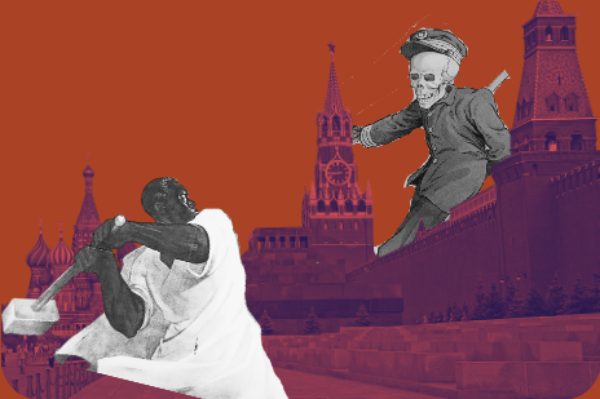
Banner image: Composite image based on Red Square in Moscow by W Bulach CC BY 4.0 and public domain images