In a crowded Union Hall at the Otago University Students’ Association Leaders Debate on Wednesday 11 August, Opportunity deputy leader Daniel Eb made a compelling case for the party’s recent rise in the polls. The debate was a raucous affair. Jeers and snide remarks came from the crowd and party candidates alike. Candidates from National, ACT, and New Zealand First hardly got a word in without interruption from the audience or the candidates to their left. Chlöe Swarbrick was one of only two leaders in attendance, alongside the Alliance’s Victor Billot. Swarbrick well and truly won the day, while ex-farmer and entrepreneur Eb came out as a quiet second place. He sat centre stage as insults were flung from either side of him, remarking that, unlike his peers, he could “respect the rules of the debate.” When he finally got the mic, he declared that New Zealand “politics is broken, and I think you can see that abundantly on this stage.”
For many, Opportunity appears as a welcome alternative to a polarised political landscape, underscored by escalating crises, which neither major party has an answer for. Eb’s routine was well-rehearsed and reflects the party’s strategy going into this election. Their landing page opens with the tagline, “Expect better. Let’s fix politics” – a bold mission. But it begs the question: what is wrong with politics? For Opportunity, the answer is not an increasingly far-right conservative bloc whose only competition is a centre-right Labour Party and two nominally left minor parties, capitulation to Trump, the collapse of the social Keynesian consensus and the rise of neoliberal finance capitalism, or the normalisation of anti-immigrant sentiment. No. For Opportunity, the answer is so-called political extremism, typified by the Greens’ “activist mindset.” Under this notion of politics, the Greens’ socially-conscious environmentalism represents the extreme-left, opposite the vile racism, queerphobia, and sexism of NZ First and ACT on the extreme-right – an absurd claim when talking about the Greens, who, for all their left-wing rhetoric, are still committed to the maintenance of capitalism.
This rhetoric is not new, however. New Zealand politics has seen several so-called centrist parties come and go. Indeed, for a time, Opportunity’s signature teal referred to a rumoured alliance between the Greens and National. Marxists in particular are no stranger to such ideas. During the long economic boom that followed WWII, Daniel Bell proclaimed in his book of the same name the “end of ideology”. In his view, the economic gains of the post-war years and the absorption of the labour movement into parliamentary politics had dealt a resounding death blow to revolutionary politics. History had proved Marx wrong. As Bell put it, “politics today is not a reflection of any class division.” Instead, the state had risen to a point where it could relieve all class antagonisms through managed competition and social welfare. Bell’s legacy survives through the post-politics rhetoric of parties like Opportunity, when Wong says things like “unions came out of a time in our history when it was… the business owner versus the workers.”
Some prominent Marxists came to positions similar to Bell’s, but were ultimately proven wrong. The long boom ended in the 1973 oil crisis. Since then, capitalism has seen several global crises, and Keynesianism has failed to deliver the economic and social prosperity it promised. Today, workers in New Zealand have no guarantee of full-time employment, let alone wages that match inflation. Opportunity gives lip service to these problems. Indeed, their messaging under Wong has increasingly shifted leftward. In her State of the Nation address, she called out “the failure of successive governments to address our creaking systems” by presenting timid solutions like free dental visits. At face value, their policy seems to match this leftward shift. Their proposed land value tax (LVT) promises to deliver more tax revenue than any other party’s tax plan, and targets the existing tax incentive to treat housing as a commodity. Their plan to “clean up politics” will find many fans among the left. The party’s proposed universal basic income (UBI), citizens’ assemblies, and commitment to restoring references to Te Tiriti in legislation all sit comfortably on the political left. The major parties recognise this too. Christopher Luxon has ruled out working with the party, stating “it looks like they just want to increase taxes – that’s not what we want to do,” while Chris Hipkins has “opened the door”.
Fundamentally, though, Opportunity is committed to capitalism, and neoliberal capitalism at that. Their leftward posturing elides a strong commitment to market-based solutions. Wong has described former Green Party leader James Shaw as a political inspiration. As climate minister, Shaw was a strong proponent of market solutions to climate change like the Emissions Trading Scheme. Wong recently spoke against restoring opt-out union membership, stating it is not the government’s role to mandate it. Innovation is one of Opportunity’s three key pillars. In her State of the Nation address, Wong described her vision for a future capitalist utopia where “innovation… drives the economy,” and New Zealand is “the world’s high-tech lab.” The LVT reflects an intent to shift investment away from property toward startups and entrepreneurs. Wong said as much when she opined that future young people will think more about “what businesses they might build, what technologies they might pioneer, and what problems they might solve” than the value of their home. She has also said that Opportunity does not want to “punish” successful individuals with a wealth tax. This language finds a closer bedfellow in ACT than any other party, which, as some other commentators have pointed out, is rarely the subject of Opportunity’s criticism. Even the choice of a UBI over universal basic services (i.e. a strengthened welfare state that guarantees the provision of services like housing, healthcare, dental, etc.) reflects a preference for market-based solutions over state intervention. And that is to say nothing of their millionaire founder or corporate donors.
All this, however, is window dressing. The coalition is the furthest right government New Zealand has seen in several decades. Opportunity poses a serious challenge to changing the government. The party has promised to work with either major party, and they are yet to release any coalition bottom lines. Recent polling has consistently placed Opportunity above the 5 percent margin, with multiple polls putting them above 8 percent. The most recent Reid Research and Verian polls show neither bloc would have enough seats to form a government without Opportunity’s help. While polls only show the likely results of an election, were it to be held at the time of publishing, the trend of recent polls shows Opportunity is likely to enter parliament in November with considerable leverage. Therein lies the danger of a post-politics outlook in a profoundly reactionary political climate.
A recent analysis of New Zealand Election Study data by Paul Kennedy Gunsen offers a troubling narrative about where these votes are coming from. He found that (1) Opportunity voters between 2017 and 2023 had shifted from previously voting blue-green to overwhelmingly centre-left; (2) Opportunity voters found National increasingly less desirable as a coalition partner; and (3) Opportunity voters’ political self-identification had shifted markedly towards “centre-left” by 2023. The data shows that Opportunity voters are increasingly coming from the left with the impression that their vote will go towards a centre-left coalition. However, as Opportunity’s posturing has shifted further left, its commitment to playing both sides has stayed fixed. This only weakens the electoral left as it haemorrhages votes to a party that could go either way, strengthening the right, which, despite ruling out Opportunity, will do what is necessary to stay in government. The picture is muddied only slightly by poll data from this year: Two of the latest Talbot Mills polls (10–19 July and 1–10 June) included questions on who respondents voted for in 2023. From the small number of Opportunity voters (only 107), National was first, ahead of Opportunity, then Labour, showing a rise in voters pulled from further right.
Opportunity’s rise in popularity confirms what socialists have been saying for a long time: working people are disillusioned by decades of tinkering at the edges of the neoliberal system and want an alternative. Unfortunately for voters, Opportunity can not deliver such an alternative. The ruling powers want us to believe that politics is about good people making difficult decisions – and that capitalism, while flawed, only requires the right balance of forces, acting in our best interest, to find the best answers. The party’s mantra to “keep Labour honest on the economy” and “National honest on the environment” reflects the “common-sense” nonsense that follows a post-politics conclusion. But the economy did better under Labour, and neither party has any clue about what to do about the climate crisis. There is no third way around capitalist crises, except out of capitalism.
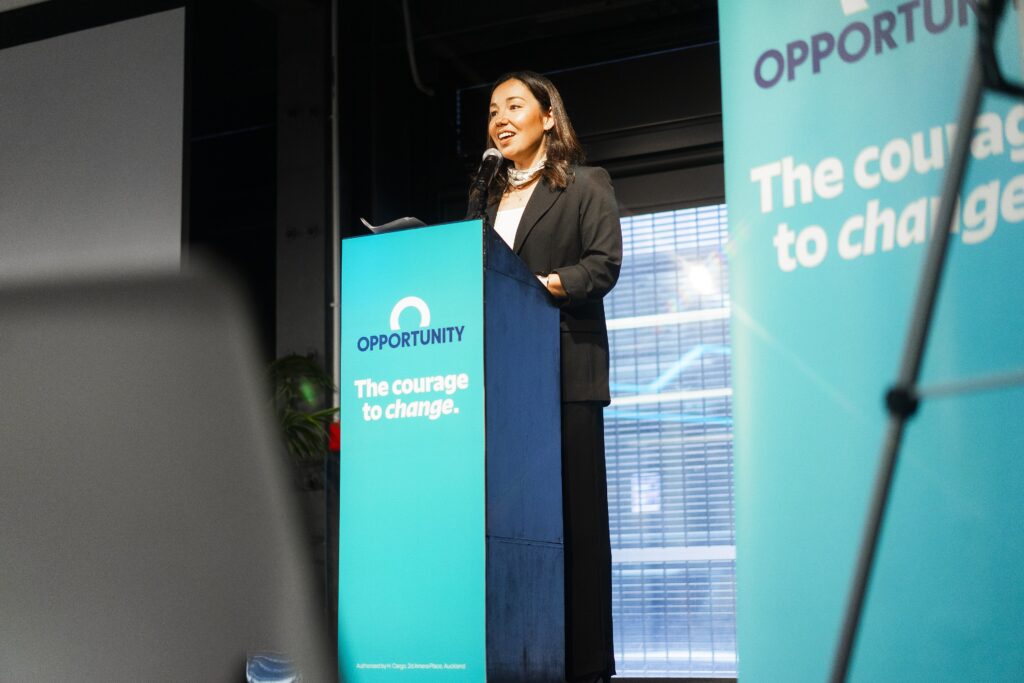
Banner Image: Opportunity Party leader Qiulae Wong speaks at a podium. Image credit: Wikimedia Commons, CC-BY 4.0.