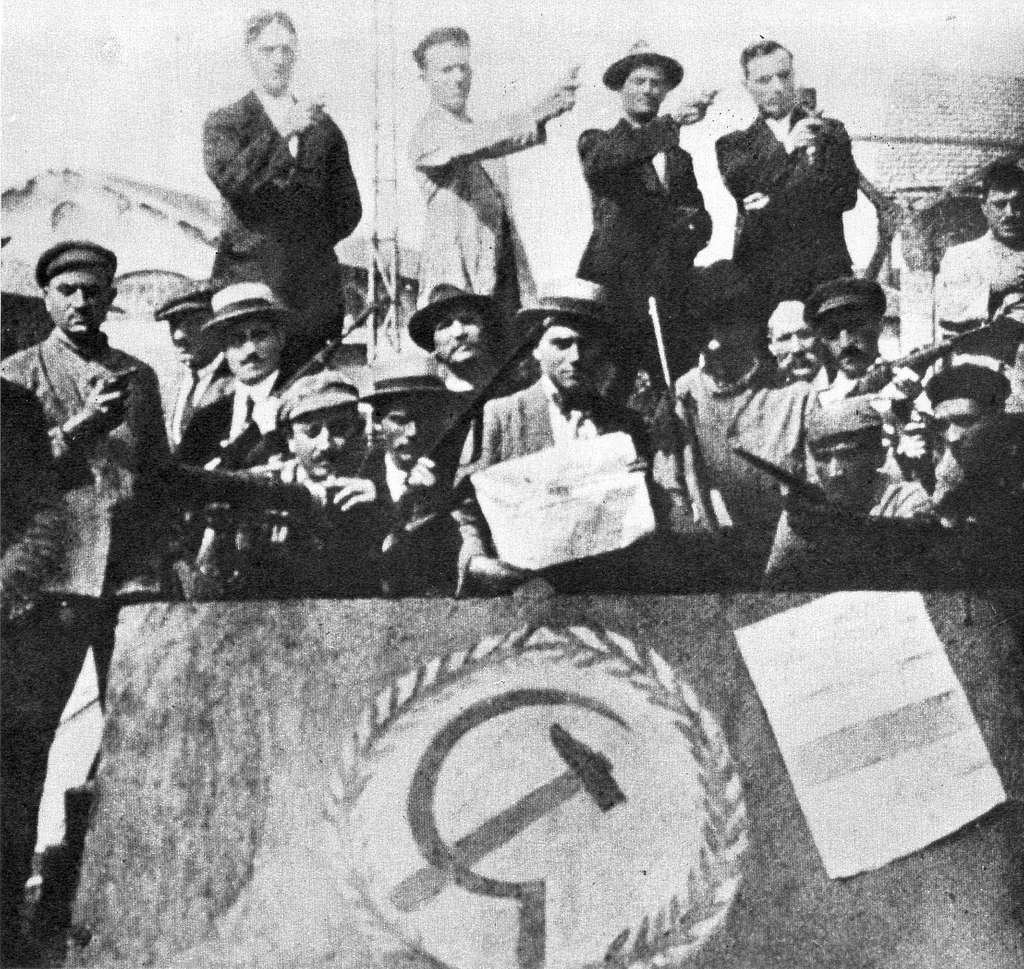
In 1919–1920, Italy saw a great upheaval of the working class. This period was called the “Biennio Rosso”, the Two Red Years. Italy was struggling after years of war and wartime industrialisation, which doubled the number of factory workers. Inspired by the Bolshevik revolution in 1917, workers rose up, forming factory councils, taking over their factories, and staging revolutionary upheaval in Turin.
However, as in all class struggles, every victory brought with it new challenges. Workers had taken economic power, but had not yet taken political power. Industry and the government conspired to suppress workers’ struggles. Factory bosses employed some of the first fascist organisations to attack workers.
In the Italian Socialist Party (PSI), debate raged about what to do. Class antagonism was growing. Many expected a civil war. The Turin party section appealed to the PSI leadership to help spread the council movement. Instead, the party leaders attacked the movement. Under Filippo Turati, the reformists refused to support the call for a general strike across the country, fearing the factory councils would challenge trade union bureaucracy and parliamentarian leadership. Another section to the left of the party rallied under Amadeo Bordiga, disavowing the councils. He based his hostility to the movement on the idea that workers’ control of production was a reformist illusion so long as the capitalist state prevailed.
Turin was surrounded by machine guns, cannons, and 50,000 troops – but in the end, the ruling class did not need to resort to open warfare. Isolated and demoralised, the strikers returned to work after a month. A compromise was reached in which unions would participate in factory management. By 1921, an industrial crisis led to massive layoffs and wage cuts. Over that same period, fascist violence exploded across Italy, targeting both the PSI and the Italian Communist Party (created in disgust at the reformism of the PSI). By 1922, Benito Mussolini had taken power after the fascist march on Rome.
Concerned at this appalling concession, and lack of action against fascist takeover, Bordiga led the PCdI (Communist Party of Italy) to split from the PSI. He argued that the most important task was for revolutionaries to maintain a “pure” political line, avoid involvement in day-to-day struggles, and hold faith that the future revolution would sweep revolutionaries like himself into the leadership of the workers’ movement. He had no interest in winning over workers who hadn’t broken completely with a reformist strategy. He shaped the party’s early direction with a rigid, uncompromising stance, refusing to form any tactical alliances with moderate socialists or bourgeois liberals to fight the rising fascist threat.
This was a sectarian approach to revolutionary politics. Rather than attempting to convince masses of workers of the necessity of revolution by fighting alongside them, he believed it was necessary to build a party of the “pure and hard” that strictly separated itself from every other institution and waited patiently for the masses to join it. Under legal pressure from the state and targeting by Fascist groups, the PCdl went underground.
In contrast, the PSI clung to the idea that “legality” would save them, and signed a disgusting “peace pact” with Mussolini. Ultimately, the tragedy of Mussolini’s rise is not only that the working class was defeated, but that it was beaten without a real fight. There was no lack of will to confront the fascists, but workers were misled by their leaders.
This lesson from history still applies today. Bordiga was a strict “abstentionist.” He argued that communists should completely boycott bourgeois democratic elections. In his view, participating in elections legitimised the capitalist state, corrupted communist politicians, and gave workers the illusion they could vote their way to socialism. This perspective meant socialists did not unite with moderate forces to crush fascism.
We are in a very different political context, but the lesson remains. We must participate in electoral politics not just because reforms have real effects, but also because it spreads the ideas of revolutionary socialism.
It helps us to argue for economic power in the workplace through union struggle. It also helps to argue for political power, broadening workers’ struggles to take on all of the battles of the oppressed. It connects and enmeshes socialists into the class we fight for. Participating in an election becomes even more important as the traditional left continues its lurch rightward. Electoral politics becomes a crucial stage on which to fight apathy and to advocate for a socialist alternative.
We have to grab every crumb of democracy that we can, and that means arguing that voting is essential.
Banner Image: Biennio Rosso, Italy – Factories manned by the Red Guards in 1920. Photo credit: From Storia de Fascismo by Enzo Biagi, photo via Wikimedia, public domain.