The working class of Aotearoa has been faced with attacks on all sides by a hostile reactionary government. Living standards are slipping as unemployment rises, wages fall behind, and public services are cut back. In these circumstances fatalism – that nothing can be done – is an affliction that can take hold. The antidote to gloom and doom is to celebrate, nurture and extend every forward step by the working class. Such a forward step is brewing in Wellington. A ‘Wellington Works’ campaign by Unions Wellington has every possibility of winning gains for our class and thereby contributing to socialists’ much-vaunted aim of rebuilding the Left, in its broad sense of union and working-class political organisation.
Wellington Works is a campaign by Unions Wellington to get the City Council to take back contracted-out services and run them in-house. This would be done piecemeal as existing contracts come to the end of their terms. Wellington has a high level of private sector-run services, including: electricity, rubbish collection, landfill, cleaning, security, professional services, transport services and elections. The result: public money pouring into private companies’ coffers, poor performance, and bad conditions for workers.
On 6 May I attended a public forum called by Wellington Works. There were about 200 people present. Journalist and researcher Max Rashbrooke was one of the speakers. After the speeches the mayor and councillors present were permitted a couple of minutes each to state their positions. Nine of them affirmed their support for insourcing, three had given their apologies, and four right-wingers did not reply to the invitation.
So far nothing has been achieved in practical outcome; we only have the promises of a majority on the City Council to support the reversal of privatisations. However, there is no place for cynicism. There is background to the current campaign that gives cause for optimism.
In 2024 Unions Wellington fought a campaign against the City Council selling off its 34 percent share in Wellington Airport. The Council was then headed by Green Party mayor Tory Whanau and it had a left majority. A 66 percent share in the airport was held by global infrastructure conglomerate Infratil, who had bought it from the Jenny Shipley National Party government in 1998. For the full story of how the privatisation was prevented see the informative three part series by Oliver Neas posted 27, 28 and 29 November 2024 on the Spinoff website:
Privatisation lost: How the Wellington Airport saga split the left
Privatisation lost: the Green Party vs the Green Party
Privatisation Lost: inside the final vote for the future of Wellington Airport
The initiators of the campaign against full privatisation of the airport were young Unions Wellington activists Finn Cordwell, Sabina Rizos-Shaw and Ashok Jacob. Oliver Neas describes the first action of the Unions Wellington campaign.
“On a sunny Saturday in early March, the ‘Keep The Airport Ours’ campaign was launched at the annual Newtown Festival. A team of volunteers talked to festival goers, collecting signatures and encouraging people to pose for photos with signs the team had made: ‘Stop privatization,’ ‘I support public ownership,’ and ‘I didn’t vote Green to sell our assets.’”
At this time the left majority on the City Council comprised the Green Party mayor, 6 current and two former Green members, and 4 Labour members.
As Neas tells the story the proposed airport sell-off was being pushed by the mayor and “had so far been supported by all councillors except the four Labour members. … The Union Wellington crew hoped to win over the Greens, but there were no guarantees.”
“Throughout March and April, the three unionists – Cordwell, Rizos-Shaw and Jacob – hurried between cafés and meeting rooms, meeting as many councillors as possible to talk them through the issue and invite them to a public forum they had planned, where they would get them to commit publicly to a position.”
Mayor Tory Whanau declined to attend the public forum organised by Unions Wellington, held on 17 April 2024. Instead a statement to be read out to the forum was provided. About 150 people crammed into Thistle Hall. At the forum eight councillors committed to opposing the airport sale: three Labour members, three Greens and an independent. In addition, a Labour member who could not attend the meeting was known to oppose the sale. The upshot was that one more vote to oppose the sell-off was needed to obtain a tie on the City Council long-term plan committee. The Labour chair would then have a casting vote to prevent the sell-off.
The City Council committee met on 20 May. The proposed sale was passed 11 votes to eight. Senior City Council staff had put pressure on councillors, telling them in a private briefing that if the airport share was not sold there would be a $450m hole in Council budgets, and therefore cuts in services. These claims were bogus. The Chief Executive said the staff advice rested on reports by KPMG. These were only provided to council members after the 20 May meeting and they did not mention a $450m hole. “In fact”, says Neas, “the reports made it clear that keeping the shares would have no effect on rates, debt or levels of service.” The KPMG reports were not the only component of dirty tricks. Councillors were told that if they did not support the airport sale they may be personally liable. And then under a new code of conduct council members would only be provided with information when it related to an upcoming decision.
In June 2024 council members passed its 10-year long-term plan, airport sale included. However, by then the majority support for the airport sale had evaporated. To cut a long story short, a motion to revoke the May and June decisions went to the full council on 10 October.
Neas says:
Sabina Rizos-Shaw, Ashok Jacob and Finn Cordwell could claim some responsibility for what was unfolding. They had collected signatures, met with councillors, written letters and op-eds, made phone calls, surveyed residents, given media interviews, prepared submissions, and made signs, badges and T-shirts. Most importantly, they got people to show up. Back in April, more than 150 had turned out to the public forum on a Wednesday night. Dozens had shown up to submit against the sale and to attend key council meetings in May and June. The crowd that now packed the public gallery and a separate overflow room was the biggest the council had seen since the 1990s. There were another 2,500 people watching on the livestream.
These mobilisations weren’t purely symbolic. Their purpose was to show decision-makers that this issue was deeply felt, to hold them accountable to their election promises, and to give them confidence that the public backed them to oppose the sale.
The motion to revoke the sell-off decisions went through by nine votes to seven. The Unions Wellington campaign had won.
The Wellington Works campaign flows from the successful airport campaign. But whereas the airport campaign was defensive – keeping what we have in public ownership – the present campaign is offensive – reversing privatisation. The leaders of the campaign are the same personalities. The campaign’s methods are similar: winning public support, and using it to gain commitments from candidates and elected officials.
The current campaign started with the local body elections last year when candidates were asked to commit to the insourcing of services. The effectiveness of this work was demonstrated at the 6 May meeting when the mayor and eight councillors attended and reiterated their support for insourcing services. The event was similar to the public forum on the airport sale in 2024. Both events were well-attended and had the same vibe (I attended both). That the campaign is undeniably political, yet supported by the unions, is important.
After decades of experience of woeful privatised services, the idea of taking them back in-house is a popular one. Wellington Works is well worth supporting. The airport campaign shows what can be achieved. It also shows the forces that have to be overcome, such as political backsliding by elected officials and dirty tricks by unelected council bureaucrats.
If I have a quibble, it is about a touch of left-nationalism. The Wellington Works leaflet distributed at the public forum starts with the words, “Overseas companies own our infrastructure, and they run our services for profit.” What difference does it make if the bloodsuckers are foreign or domestic?
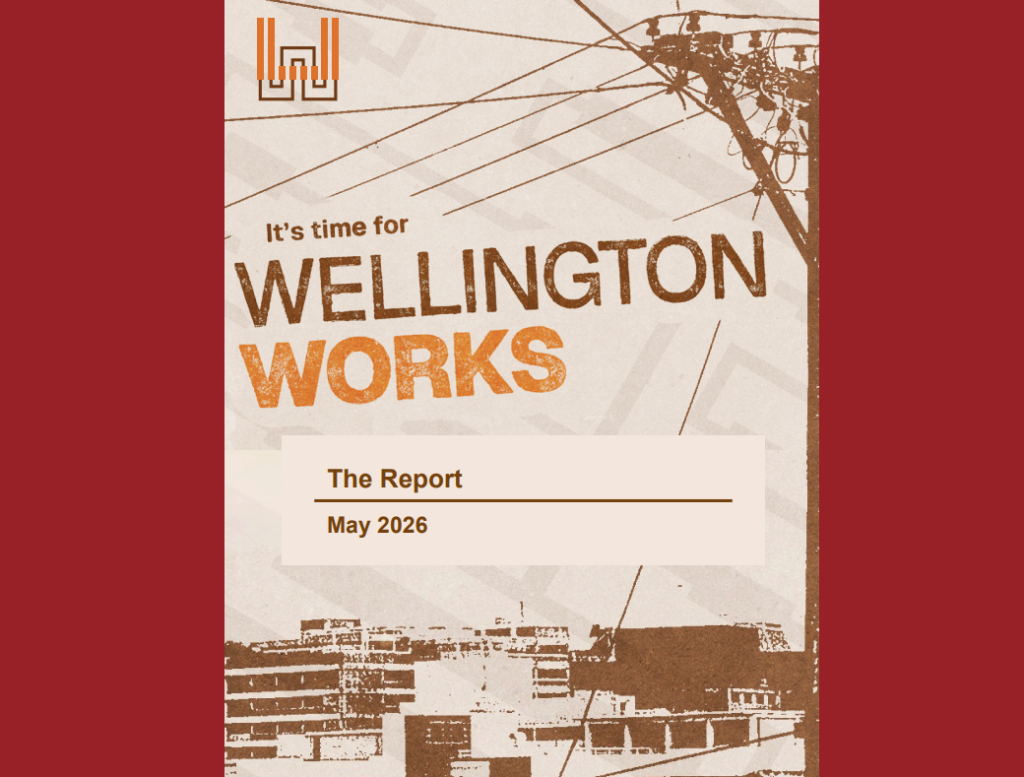
Wellington Works have produced a report that exposes the relative true costs of privatised and in-house services that is well-worth reading: