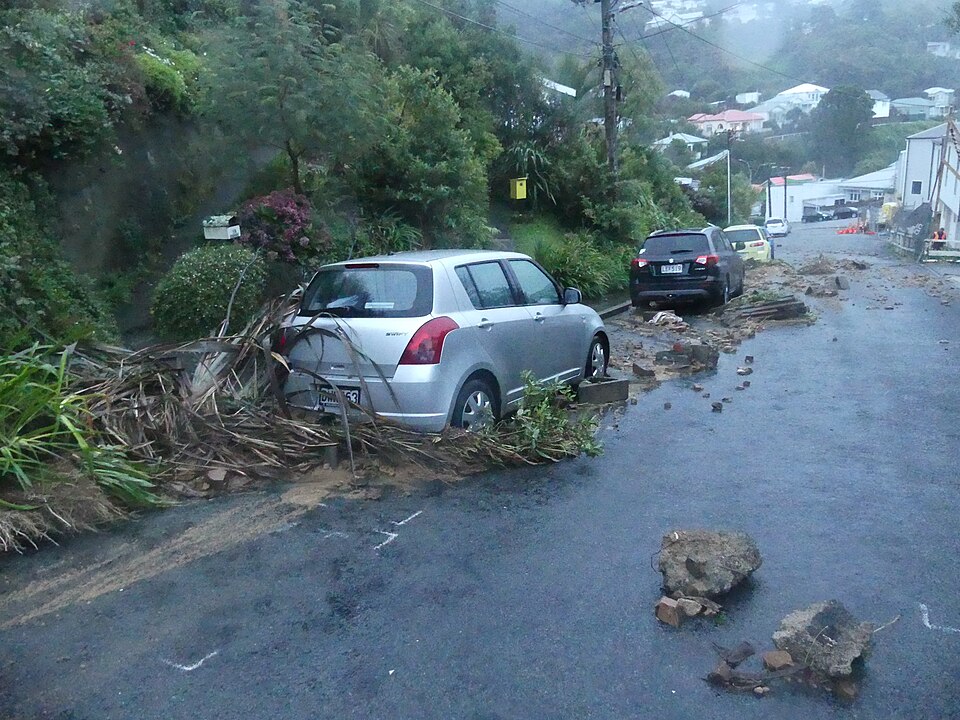
Over the last week we’ve seen in Te Whanganui-a-Tara Wellington multiple waves of extreme rainfall, which have led to flooding, landslides, damage to homes and public infrastructure, and the disappearance of at least one person. Events like these are becoming more frequent, and more severe. Numerous places in Aotearoa have experienced similar events every few months for years. The most severe of which occurred in 2023 with Cyclone Gabrielle, killing 19 people, from which communities are still recovering.
We have to be clear – this trend is caused by climate change. Climate change is the result of a competitive system of profit. Through competition, capitalists are forced to reduce the price of labour, by increasing energy inputs into production. Fossil fuels have provided this energy, and have released carbon into the atmosphere, causing climate change. All large-scale efforts to stem the tide of climate change have failed – because they fail to fundamentally challenge this system of profit. As socialists we believe that another world is possible – one where real efforts to reduce emissions and sequester carbon are undertaken, and where societies are planned in order to minimise risks to lives and livelihoods (rather than profits and private property).
The Class Dimension of Flooding
These recent emergencies reveal that a capitalist economy is unable to respond to the crisis it has unleashed.
As climate change has increased, the volume of rainfall and sea levels have risen, and the risk of flooding has increased in previously safe areas. This is no fault of working people, who have no say over how economies are run.
The impacts of flooding have a clear class dimension. Homes in flood-prone areas are typically the cheapest, because they are hard to insure. The result is that the poorest of our communities are forced into them, but are left at higher risk of losing everything in a disaster. This is as true for homeowners as it is for renters, who are even less likely to be compensated if they lose their belongings.
Climate Adaptation
The response we need is climate adaptation. This should look like identifying the highest risk areas, and helping people to move away from them. The result is better for everyone, with emergencies becoming less damaging, disruptive, and dangerous to lives and livelihoods. What we’ve actually seen has been quite different.
So far, the deliberate removal of people from flood-prone areas (often called “managed retreat”) has only occurred in a handful of places. Typically, retreat has been chaotic rather than managed, being organised after damage has already occurred – such as in the red-zones of Christchurch following liquefaction after the 2011 earthquakes, in Hawke’s Bay following Cyclone Gabrielle, and in Matatā after flooding. This is despite the fact that many flood-prone areas are well-known. Managing these risks now would save vast amounts of resources, and prevent losses in the event of weather hazards.
Flood protection has also been poorly financed. During the last government, some $340 million was spent over three years (equating to around 0.08 percent of the budget at the time). Since then, the National-led government has reduced spending to $200 million over three years. Where this money is spent raises even more concerns: of 32 projects, the vast majority were stopbank and drainage upgrades to protect low-lying dairy farms. Thus, the response to increased risks from climate change has been to ensure that our most emissions-heavy industry can continue for the foreseeable future. The majority of production in this industry is geared at producing primary commodities to be exported in their raw form, producing few jobs and supplying us with expensive butter and milk, and in several cities, carcinogenic drinking water.
The National Party recently released their climate adaptation plan late last year, finally settling who would pay when people lose their homes. Their answer is that it isn’t fair for the Government – and therefore taxpayers – to pay. The National Party’s climate adaptation strategy is two-fold: adaptation will only be paid for if it benefits the rich; and when disaster strikes, the poor will pay with their lives and livelihoods. The National Party cannot be made to care, because their class (the capitalist class) is unaffected – they have the resources to live in low-risk areas or replace their lost property. Even worse, if capitalists refuse to exploit nature or sacrifice profits for lower emissions, they risk losing their position of wealth, falling into the same situation as the rest of us. Where they are impacted – namely, the rich dairy farmers of high producing low-lying regions – they can rely on their mates in the councils and government to bail them out. The rest of us do not have this luxury.
What we need is a programme of class struggle – a working-class campaign that fights for reforms granting adaptation to at-risk communities, while drawing out the truth: that in order to fully adapt to climate change, we require revolutionary changes to our society. That is, we need to ensure that workers are not made to pay for a crisis they did not create. Using all of the resources currently hoarded by capitalists, a workers’ state could point the way forward: moving people out of risk-prone areas into healthy homes, and facilitating a transition towards a society that works with nature, not against it. Capitalists will not willingly pay for the crisis they created, nor will they willingly pay for the impacts of it. The working class and poor are the worst impacted by climate change (and all other capitalist crises), and as such are the only class that can be relied upon to fix it.
Image: Wellington flood aftermath, 20 Apr 2026, by Alan Tennyson on Wikimedia Commons, CC BY-SA 4.0