This piece is one in a series of profiles of electoral parties in the lead up to the 2026 General Election.
From attacks on the public service and pay equity to the farcical Treaty Principles Bill, the ACT Party has done much to throw us further to the grinding gears of capitalism. Their role in the past few years has been to peddle the Government’s most radical neoliberal line, acting as a scapegoat for a hand-wringing National Party. ACT’s first significant term in government has had a severe impact on Aotearoa’s political landscape. To understand this we must look at ACT’s deep commitment to capital as related to our historical conditions.
Formally named the Association of Consumers and Taxpayers, ACT upholds the tenets of right-libertarianism: free trade, “small government”, and so-called equality before the law. In effect, they champion the interests of petty-bourgeois idealists and assert the control of big capital over state affairs. This is made immediately obvious when looking at their voter base and especially at their donor list, which consists of business people and financiers of various flavours.
Historically, the National Party has been the mainstay representative of New Zealand’s capitalist class. So why now is ACT taking on more of that role?
When the post-war boom started to peter out and as struggles throughout the Global South rapidly changed the world, New Zealand was faced with reduced returns in global trade and massive amounts of inflation. The 1970s were especially uncertain, and by the 1980s, the New Right had barged their way onto the scene. They argued that any stability previously afforded by protectionism came at the cost of innovation and that, therefore, there needed to be a relinquishing of control to the market to reinvigorate the economy.
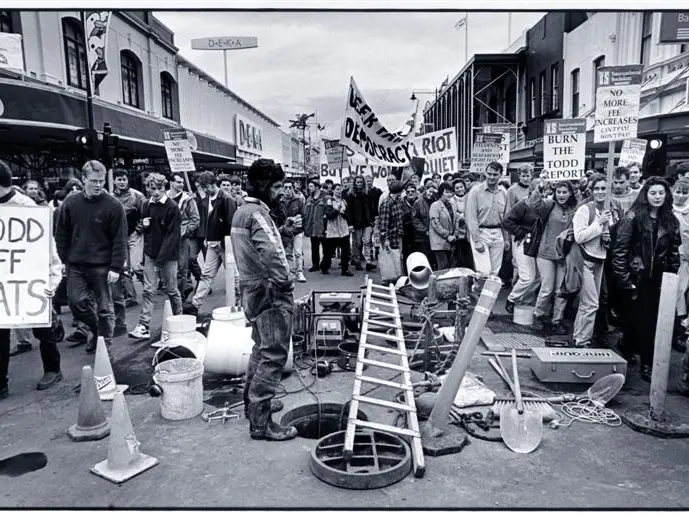
It was this idea – that markets and the money supply are the main things to look at – that shaped the policy actioned by Roger Douglas and the Fourth Labour Government. The “Rogernomics” era (1984–1990) stripped back protectionist market interventions, privatised social security and public services, and shifted the flow of capital dramatically away from primary industry, towards finance. If it weren’t for public protest and widespread outrage, these changes would have been far more encompassing and significantly more debilitating. The outrage at the change was reflected in the polling of Labour and then National (who had continued with the controversial shift), with both losing significant voter share as a result. In response to public opinion and a rapid economic crash, Labour and National pared back to more incrementalist platforms.
In an effort to continue advocating for the policies of the Rogernomics era, Douglas and former National MP Derek Quigley founded the ACT party in 1994 due to their dissatisfaction with New Zealand’s level of neoliberalisation. The ideas of the period, defined by privatisation and corporatisation, set the foundation for ACT policy today. Indeed, ACT consistently advertises themselves as a step beyond National’s liberal-conservative populism, pushing for aggressive deregulation, tax reform, and law-and-order rhetoric. These ideas, set into action, firmly shape the realities we face today.
Today, we once again face massive inflationary pressures resulting from market shocks caused by war, pandemic, and the boom-bust cycles inherent to the capitalist system. Once again, staunch advocates of capital, such as the ACT party, furiously harp on about so-called economic mismanagement by this or that government. While National remains unable to make any clear decisions, ACT are more than happy to push their coalition partners as far down their preferred path as possible.
With the National, ACT, and NZ First government’s rise to power, the consequences of their corrosive ideology are clear for the rights of the marginalised. Among other attacks, ACT, emboldened by the onslaught on Māori wards and Te Reo Māori pushed for the deeply unpopular Treaty Principles Bill. They enthusiastically teamed up with their coalition partners to repeal pay equity and slash the public sector. And the coalition continues to erode workers’ power, as demonstrated by the shutting down of fair pay agreements and the return of 90-day trials.
National, firm in their liberal-conservative reformism and too afraid to repel the middling swing-voter, don’t have the wherewithal to set about the radical change demanded of them by Capital’s greediest profiteers. NZ First, on the other hand, sitting comfortably as kingmaker, continues to appeal to those conservatives who ask but for the protection of New Zealand’s more long-standing industries.
ACT is a renewed and stronger proponent for the dominance of capital in a world that is struggling under the weight of capitalism’s cyclical stagnation. For radical capitalists, ACT is the obvious choice. ACT is the birthchild of neoliberal ideologues and the boldest adherents to private capitalist interests.
Banner Image: Former ACT leader Jamie Whyte and current ACT leader David Seymour at a press conference in 2014 with dollar sign-shaped sunglasses superimposed. Source: Wikimedia Commons