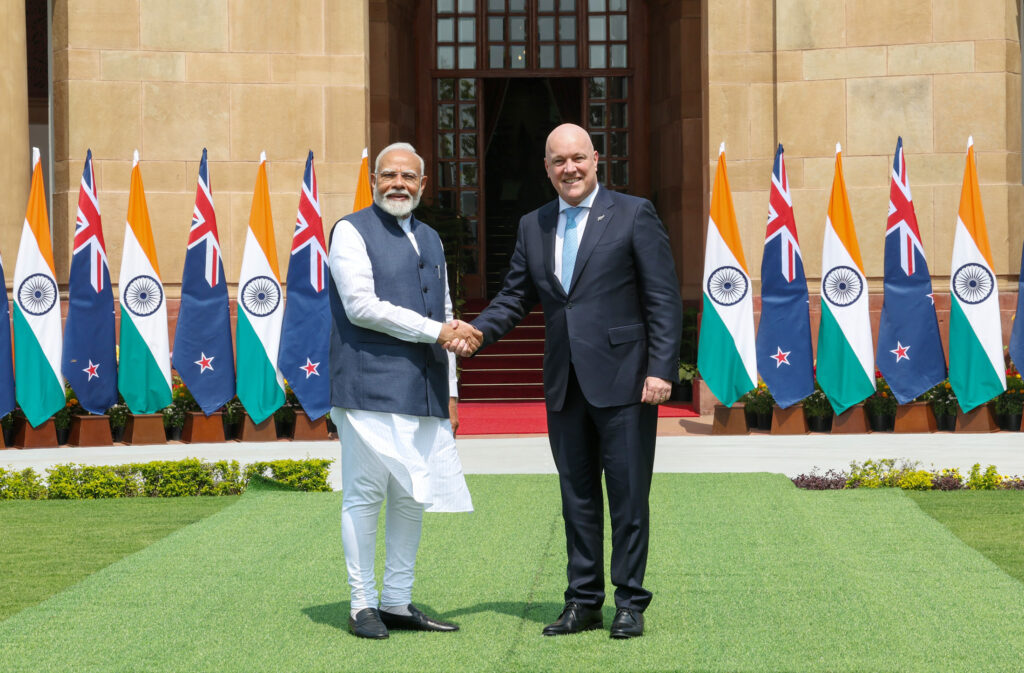
In July 2026, prime minister of India Narendra Modi stepped onto the red carpet at Auckland’s Government House to the ceremonial embrace of New Zealand prime minister Christopher Luxon and other corporate executives at the Tāmaki Makaurau Spark Arena. Modi was met with cheers of tens of thousands of people whose motivations range from Hindutva (Hindu Nationalist) ideology to a desire to simply meet with the Indian prime minister, since it has been 40 years since his predecessor’s visit. New Zealand media framed the 24-hour state visit as a milestone of diplomatic partnership and free trade, celebrating expanded market access to 1.4 billion consumers, supply chain integration, and military co-operation. Beneath the diplomatic handshakes and corporate photos, the capitalist world order reveals itself: how global trade networks seamlessly welcome a political leader with a documented history of ethnic and religious violence, domestic repression, and far-right authoritarianism. The basis for such oppression being the economic exploits it opens up for the opportunist elites not just in India but also for New Zealand.
When India gained independence from British colonial rule in 1947, it did not gain independence from the socio-economic system of capitalism and the structures of imperialism around it; capitalism and fascist “divide and rule” dogmas had already taken root. Instead of destroying the Angrez (English) imperialist class, the domestic Indian capitalist class replaced it. The Adani-Ambani, the richest men in India, do not fundamentally differ from the East India Company. But the question now is, why and how did the Indian bourgeoisie turn to fascism, with its representation in Narendra Modi? And we need to discuss how resistance in India and abroad through mass action is the only solution.
Hindu Fascism: The Bharatiya Janta Party
Modi’s political foundation was formed within the Rashtriya Swayamsevak Sangh (RSS), a paramilitary organisation founded in 1925 to establish a Hindu-supremacist nation (Hindu Rashtra). Early Hindutva theorists like V.D. Savarkar and B.S. Moonje borrowed organisational forms and concepts from interwar European fascisms, particularly the Nazis (as noted in Marzia Casolari’s 2020 book In the Shadow of the Swastika: The Relationships Between Indian Radical Nationalism, Italian Fascism and Nazism). The primary functional purpose of Hindutva in modern India is to construct religious and ethnic minorities as permanent civilisational “others” to consolidate control and subordinate class conflict to simply interfaith and interethnic conflict. The exact same techniques used by the British Raj to conquer and exploit India are utilised all over again.
This ideology manifested in state-sanctioned violence when Modi served as chief minister of Gujarat in 2002. Between 1,000 and 2,000 people, overwhelmingly Muslims, were murdered, and over 200,000 were displaced. Independent inquiries and leaked diplomatic documents revealed that police were instructed not to intervene, establishing a climate of impunity. The scale of the violence earned Modi the moniker “the Butcher of Gujarat,” despite his insistence on his non-involvement.
However, it must not be forgotten that in the three terms of Modi’s government there have been constant revolts against him. Since before he was prime minister of India and ever since 2014, communities and peoples have risen up: the 2019 Citizenship Amendment Act protests, the Aravalli Bachao Andolan, and the 2022 farmer protests have not just accepted this oppression but have actively fought against it every step of the way. Any time people are oppressed, there will always be people resisting their oppression.
The Students: The Cockroach Janta Party
The student movement, popularly known as the Cockroach Janta Party (CJP) protests, was one such example of students and the wider society recognising the socio-economic exploitation and oppression of their class.
In May, the chief justice of India, the pinnacle of the Indian Judiciary, called the youth and the unemployed “cockroaches,” which gave Abhijeet Dipke the initial spark of the Cockroach Janta Party as a name for an Instagram account. Within weeks the account garnered millions of followers and people agitated, backing the name. This act was just lighting a match to a growing dissatisfaction and recent issues developing between the people, especially the younger Indians and the government. The youth has recently in India faced an increasingly hostile situation that has gotten worse over the decades. The neoliberal austerity programme closed 93,000 public schools over ten years and has underfunded the schools which still exist, leading to the diminished possibility of lower-class students to even attempt university entrance. This is then compounded with rising tuition costs, and caste and religious discrimination, all leading into a 40 percent graduate unemployment rate, a high cost of living, environmental degradation, and economic inequality worse than even the British colonial times. A powder keg waiting to blow.
But the catalyst for the development of the movement to become so much bigger than even the Modi government with its plethora of PR firms would have expected, was exams. For New Zealand youth, the issue of these “exams” is difficult to understand. The whole of the Indian education system is developed on the hoax “merit based” admissions to universities for higher education, especially in advanced fields like medicine and engineering. The admission to top universities is a mode of exponential class mobility: it is the only way for many families and young students to alleviate the worst forms of oppression impacting themselves and their communities. A recurrent issue has been “exam paper leaks,” a euphemism used to obscure how exam questions put to millions of students every year are leaked to the elite few who can bribe corrupt officials to get an upper hand. When the general public learns of these leaks, the papers become void and must be taken again the next year by millions of students. One such exam is the NEET (National Eligibility-cum-Entrance Test), the medical university entrance exam taken by more than two million (22.7 lakh) students, which was leaked for the second time in two years and later cancelled by the National Testing Agency (NTA) on 12 May 2026.
This isn’t a simple matter of re-examination – this is about the millions of rupees that are spent by the parents and the students just to take this examination. UGC NET, SSC, CLAT, and many more exams get leaked as well, and these are the only ways to get into public universities. Private universities are already monetarily out of reach for the vast majority of people, so many students are forced to either give up or spend even more money for re-examination next year. The economic and psychological stress combined with the integral role in socio-economic upper mobility leads many to commit suicide; the CJP and parents link at least 21 suicides to the 2026 NEET leak alone.
The CJP started out as just a meme with the vaguest impressions of demands, but because the community that developed were mostly youth, the protests – like other international protests – were deemed “Gen Z protests;” the issues of students and the material conditions of the youth were their core demands. Around 22 June, the protests at Jantar Mantar, which has historically been a key place for protests and movements, garnered widespread support. Sonam Wangchuk, a popular scientist-activist from Ladakh, soon joined the protest. He, along with students from AISA (All India Students Association, a left-wing student organisation affiliated with the Communist Party of India) went on a hunger strike demanding the resignation of Dharmendra Pradhan, the minister of education. Tens of thousands came out onto the streets until 25 July, when the government negotiated with the protest organisers and ceded to their demands. Pradhan was removed.
The protests did not only garner support because it was a student-led movement, but also because of the sheer brutality of the oppressive state apparatus being unleashed on a crowd that was mostly urban and educated youth. In the so-called world’s largest democracy, police personnel with no identification, wearing plain clothes and covering their faces, were sanctioned by the state despite these actions contravening the law. Officers then attacked the students and their supporters with pellet guns, fiberglass sticks, and tear gas. After the protests ended, large numbers of women and Muslims were targeted, stalked, and threatened: this is the reality of the patriarchal and ethno-fascist society of India.
The protests, while limited, still achieved what they set out for – a key result being the dismantling of fascist ideology in the minds of many, with communities from different ethno-religious communities standing together and recognising each other as humans and as people developing class consciousness via mass struggle itself.
But this is not the end of the protests broadly. Indian communities are still protesting, some for their Indigenous lands, others for their basic rights. Our role here in Aotearoa is to stand in solidarity with the masses of people, including in their actions beyond this one protest; the active resistance from people below cracked Modi’s armour, and with it, the fascists and the capitalists here and abroad trembled.
Educate. Agitate. Organize.
– BR Ambedkar.
Photo caption: India prime minister Narendra Modi shaking hands with New Zealand prime minister Chris Luxon in New Delhi in 2025. Image credit: India prime minister’s Office on WikiMedia, used under free licence.