An attack on democracy in the local government sphere is underway. The government is attempting to force local councils to amalgamate, form regional unitary authorities, and abolish the City and District Council tier of local government. Existing District, City, and Regional Councils must either submit their own plans for amalgamation to central government by 9 August or have the government impose amalgamations upon them.
Councils opting to volunteer their own dissolution have only had notice since 5 May of the voluntary amalgamation scheme, which the government calls “Head Start.” Little time is being allowed for councils to negotiate amalgamations with other councils, and the timescale is unrealistic for meaningful public consultation. Government-imposed structures are slated to come into effect with the next round of local body elections in 2028.
The push for amalgamations is part of the neoliberal enterprise to weaken local democracy. Amalgamations sit alongside the present government’s programme to reform the Resource Management Act, which is the primary legislative instrument for controlling land use and development. The main issues are that central government will be able to override local councils’ planning decisions and enforce changes upon councils’ district plans. The objective is to give developers a freer rein.
Another attack on local democracy came in the shape of direct intervention by central government into running local councils to the extent of sacking the councillors and installing Crown commissioners. Such action was taken against Canterbury Regional Council in 2010, which only reverted to democratic control with the October 2019 local body elections.
And before that, a raft of undemocratic changes was made with the passing of the Local Government Act 2002, which strengthened the powers of mayors at the expense of the rights of councillors. Previously, all members of the local council elected the deputy mayor and elected committees. Since 2002 mayors have had the power to appoint the deputy mayor, appoint committees and their chairpersons, and they have automatic membership on all committees.
However, this briefing will not cover the whole gamut of neoliberal attacks on local democracy. It will be confined solely to the issue of the day – local council amalgamations.
The government plans to abolish the existing two-tier structure of local government. At present there are 78 local authorities comprising:
- 66 City and District Councils.
- 11 Regional Councils.
- Auckland Council, which came into being in 2010 as a result of the amalgamation of eight councils, is excluded from the current programme.
Among the 78 there are six unitary authorities, including Auckland Council, that have the combined powers of the City or District Council and Regional Councils.
The effect of amalgamations would be to drastically dilute the number of elected councillors amongst the general population. Wards will be huge, especially if they are multi-member wards. These large wards will make it prohibitively expensive for ordinary people to run for election, and they will be impractical to canvas door-to-door. The ultimate effect of amalgamations is to make those fewer councillors remote from the people they are supposed to represent, making a mockery of genuine local democracy. But local democracy is inimical to the neoliberal project. The neoliberal ideal for local government functions is to have structures that are immune from the demands of the general population and exist primarily to dispense contracts to the private sector.
Throughout the neoliberal era the number of local councils and councillors has declined while the population has increased. Prior to 1989, there were 850 authorities at various levels with varying powers and responsibilities. Now there are 78 bodies. Aotearoa already has a particularly low ratio of local government representatives to population size. By rights, as the population increases, we should have more elected representatives, not less.
A socialist approach to the government’s abolition of local councils in favour of unitary regional bodies would be to oppose the project politically and demand that the “left” parliamentary parties make council amalgamations a general election issue. The “left” must commit to stopping the amalgamations process if they are elected to power.
Unfortunately, existing councils are capitulating to central government. In the Wellington and Wairarapa regions all nine councils are working together to submit an amalgamation proposal. If successful, under present law, the maximum number of members of such a giant council would be only 30. This would mean just one elected representative per 18,000 population.
A brief survey shows that the civic leaders of the major cities are capitulating to the government.
The current campaign for amalgamations is the third in recent times. The first saw the formation of the Auckland “super-city” in 2010.
The second campaign began in 2013, but the amalgamation proposals were abandoned in 2015 when it became clear that polls in the Wellington and Wairarapa regions, and elsewhere, would reject amalgamations. In Hawke’s Bay electors voted overwhelmingly to reject amalgamation.
The National government of the day had changed the law to make resistance to amalgamations trickier. Previously, council amalgamations required a majority vote in favour by the electors in each local council area concerned. National imposed a hurdle to getting a vote at all. First, a petition had to be signed by 10 percent of electors in one of the areas. And if there was to be a vote, for an amalgamation to succeed, it would only take an overall majority across all the areas concerned instead of majorities in all areas.
The defeat of amalgamations in 2013–2015, even despite the hurdles the government of the time put in place, demonstrates that local democracy can be defended successfully. Today, however, there is no question of the public being allowed a vote. The project is anti-democratic from beginning to end.
For an account of the 2013–15 campaign see: https://iso.org.nz/2015/06/24/public-opinion-sinks-super-city/
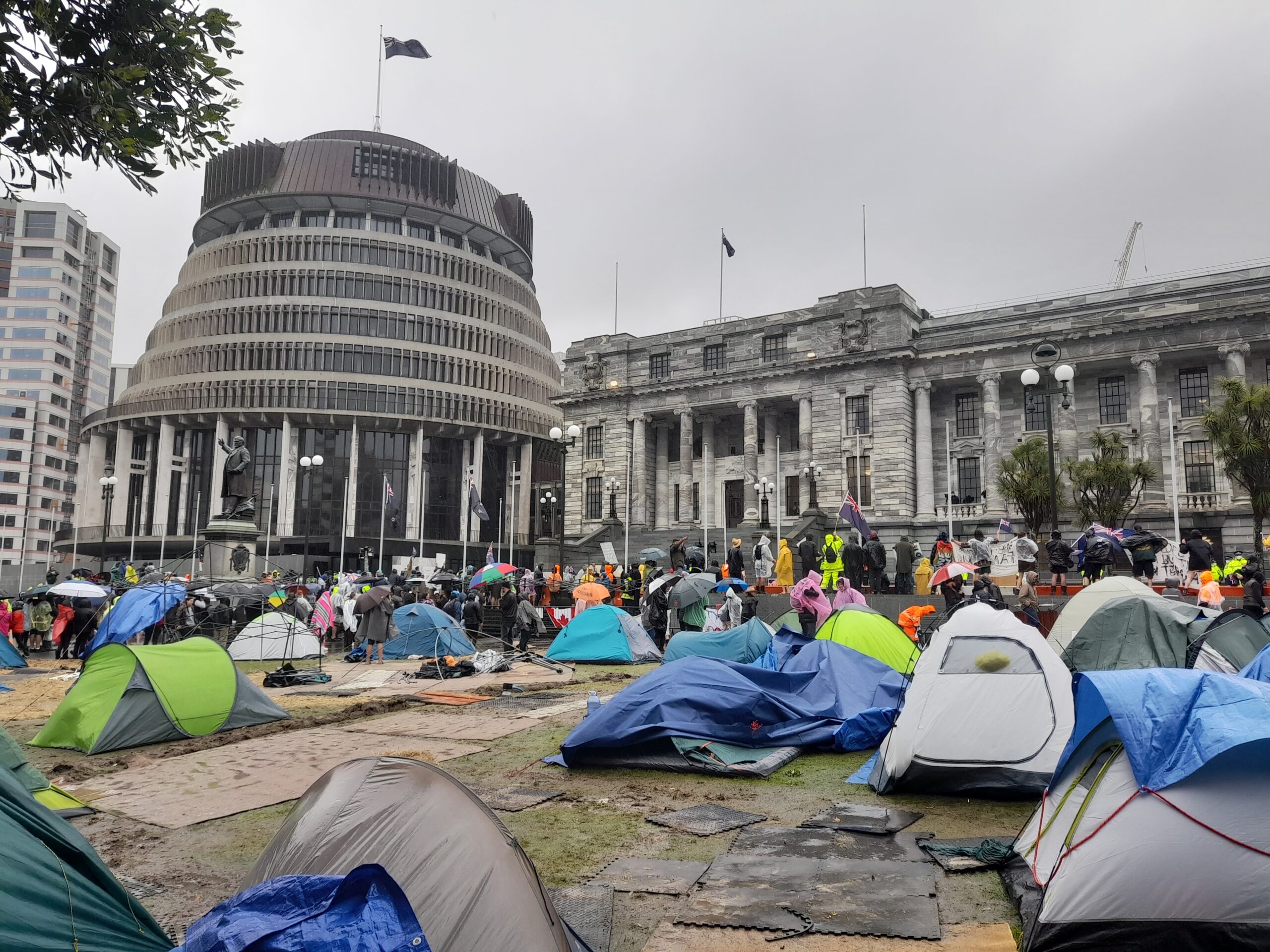
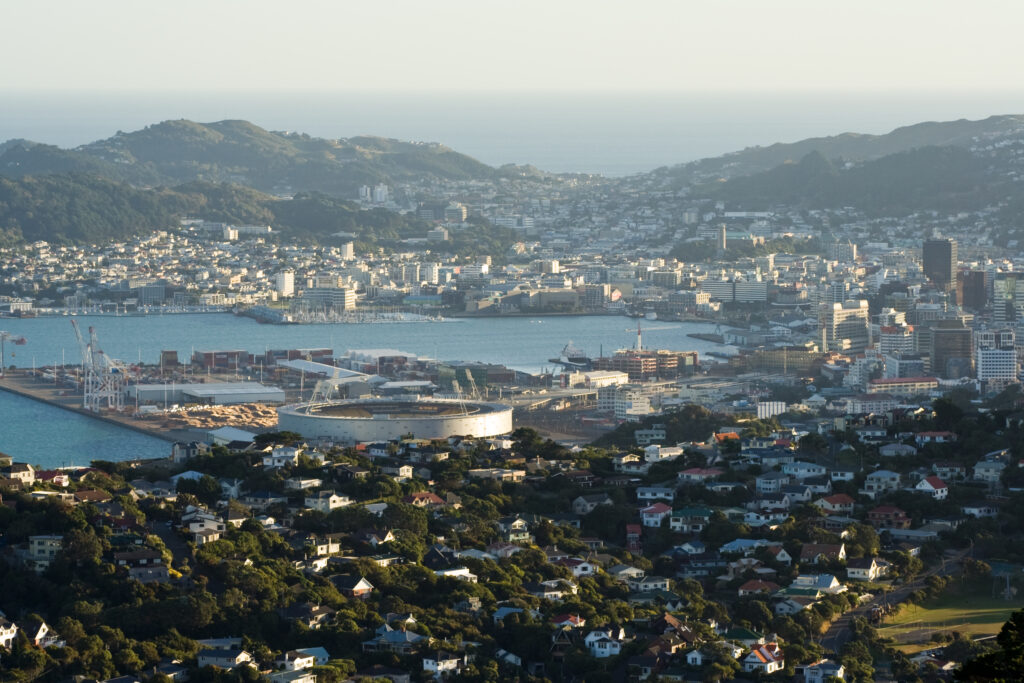
Photo caption: Wellington city. Photo credit: Aidan on Wikimedia Commons, CC BY 2.0.