On 20 May 2026, political student groups received an email from the University of Otago proctor Dave Scott, requesting that students only poster in allowed places, threatening legal action and financial compensation if billsticking continued. While seemingly an innocuous request for students to respect the Proctor Office’s Code of Conduct, Scott’s email betrays the thorough corporate transformation of New Zealand universities over the last 30 years. It comes at a time when the University of Otago is under significant public scrutiny for partnering with US/Israeli cyberwarfare, and student politics face a potential upturn following cuts to fees-free tuition. We must view this as a thinly-veiled attack on student politics: part of a continued process of managing and moderating student dissent through university policy and the enclosing of student spaces.
The role of organisations like the ISO is to carry the lessons of past movements forward – kia whakatōmuri te haere whakamua. So, let us turn to some previous flashpoints in student politics to help understand the present.
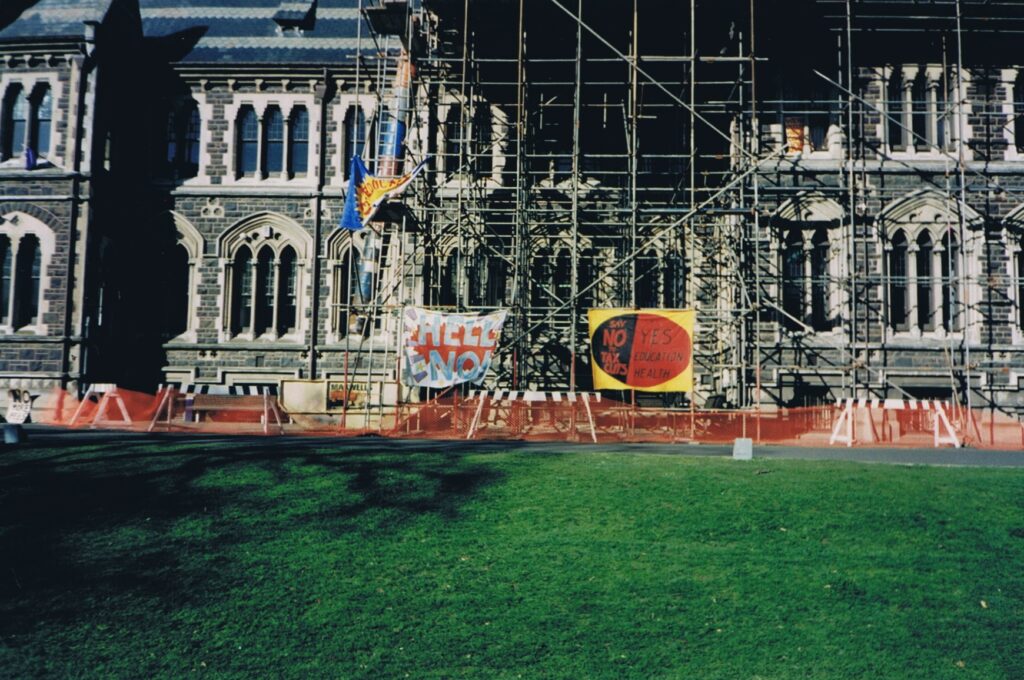
The neoliberal turn to a corporate model of tertiary education in New Zealand has been discussed at length in The Socialist and elsewhere, but of importance here is the transition to a user-pays system of university funding, coupled with decreased public spending, and the crushing of student unions through Voluntary Student Membership (VSM). This had several consequences for student politics, some immediate, some latent. First, the threat of a substantial increase in tuition fees and the introduction of a student loan scheme prompted massive waves of student dissent. 1989 saw protests numbering 20,000, and the 1990s saw continued demonstrations. At Otago, broad, left-coalitions of students (Education Action Groups) formed, instituting campus bans on sitting politicians, and occupying the Clocktower (registry building) in 1993 and 1996.
Early on, we see the recognition of space as political and a terrain for struggle. ISO member and University of Otago associate professor Brian Roper recalls the importance of occupations and campus bans in asserting student power. Trade unionist and Otago Socialist Society (OSS) member Andrew Tait, a student at the time, describes the Main Common Room (MCR) of the 1990s as the hub of student activity, both political and cultural. Built in 1960, in collaboration between the Otago University Students Association (OUSA) and the University, the University Union building (commonly known as “the Union”) was host to the MCR and the cafeteria. Upgrades in 1969 and the 1980s saw the addition of a second floor and OUSA offices to the north, respectively. In Roper’s telling, the building was what you would expect from a union space, with bollards covered in posters advertising gigs, club events, protests, and more – a far cry from the sterile, corporate space we know today. Posters, flyers, and stalls advertised protests. Saturation of department noticeboards and across the Union was crucial. “Before the internet,” Tait describes, “noticeboards were like Trademe,” and all surfaces were fair game. Unspoken rules meant you didn’t cover up other posters, and despite only being Blu-Tacked, they stayed up.
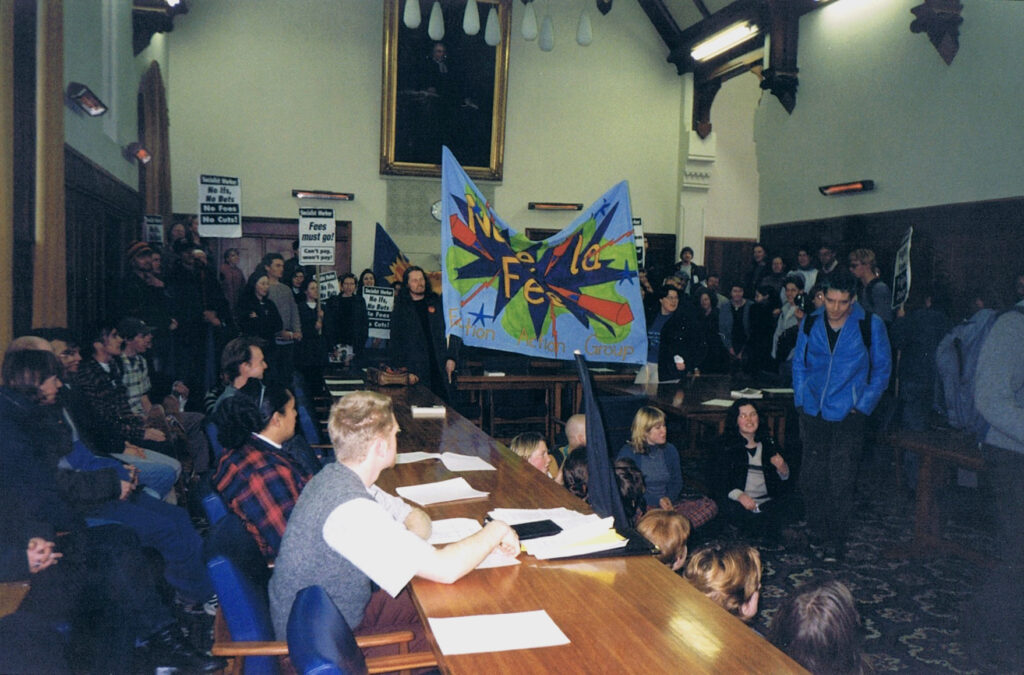
Caption: “The University Council meeting abandoned, Otago students occupy the Registry Building, 13.8.96” by SocialistWorkerNZ, CC BY-NC-SA 2.0.
The Union today is a pale comparison. Otago markets the space for venue hire, advertising “in-house catering.” It hosts a Visitors’ Centre and a Gift Shop, and bollards are swiftly cleaned of unapproved posters. Approved posters, licensed by the University, are consistently AI-generated slop. A recent scandal saw pro-Palestine posters taken down from noticeboards by University staff for allegedly “inciting violence.” While denied by management, the provided explanation is no better, citing a “misunderstanding” over posters on tables in St David Cafe. Poles in the Central Library are rented out for posters advertising horse racing. In the last couple of years, Phantom Billstickers frames were installed outside the OUSA Clubs and Societies Building, displacing sanctioned postering to two concrete bollards. Before this year’s Open Day, the University removed all posters from campus notice boards. The concrete posts that litter the Union and the surrounding campus are strictly for OUSA and paid advertisers, a result of OUSA’s desperate search for independent funding. No wonder students resort to billsticking, when all other avenues for postering are either monopolised by corporate interest or confined so far as to be useless.
OUSA no longer co-owns the Union, having been bought out by the University as a result of VSM. But OUSA, too, is a shell of its former self. In 2011, VSM was rolled out across New Zealand polytechnics and universities, via the Education (Freedom of Association) Amendment Act 2011. Student unions were crippled, virtually overnight. The Otago administration extended an olive branch in 2012 by signing a service level funding agreement (SLA) with OUSA. While avoiding major losses to student services and maintaining high membership via an opt-out system, the SLA stifled OUSA’s student advocacy. As one OUSA president put it, OUSA executives became “increasingly reluctant to bite the hand that feeds them.” Hollowed of their political character, OUSA remains little more than the student outreach and services arm of the University. Despite any radical leanings of OUSA executive members, the threat of reduced funding and the consequent loss to essential student services looms over the political ambitions of the executive. The SLA is a brazenly coercive arrangement, used to cajole student radicals, placing their elected role of student advocacy in direct conflict with an imposed responsibility to maintain student services – that is to say nothing of the vast commercial activities of OUSA.
The corporate transformation of the Union and OUSA is mirrored by the transformation of University management. The University Council only hosts three elected positions: one academic, one professional staff member, and the OUSA president, alongside an amalgam of ex-politicians, lawyers, and business leaders. To make clear the role of University management, in 2025, Otago codified its position on institutional neutrality (IN), amid calls for the University to endorse the Boycott, Divestment and Sanctions Movement (BDS). It defined IN as the requirement for “university leaders [not to] communicate institutional positions on controversial political topics except where such issues directly impact the University’s role or functions.” Similar to earlier understandings of IN, Otago states IN does not apply to the university community, resting the “political” role of “critic and conscience” on students, staff, and alumni. Under this view, university administration becomes the supposed guarantor of free debate, “the home and sponsor of critics.” Were they to forsake this responsibility by taking political positions, the University warns of potential reputational and financial harm.
The University’s 2024 Statement on Free Speech exposes what is really meant by this role. It claims to protect the University community from infringements on “debate or deliberation simply because the ideas put forth are thought by some to be offensive, unwise, immoral, or wrong-headed,” so long as such expression does not violate the law or impede “the ordinary activities of the University” (i.e. billsticking, disruptive protest, occupations). But the statement privileges certain speech above others, asserting a “corollary responsibility” on members of the University community to “not obstruct, disrupt, or otherwise interfere with the [free speech] of others.” What is considered speech here is specifically the liberal notion of polite, respectful debate. Say a fascist was invited to speak on campus, under such liberal values, the socialists who show up to deplatform and disrupt the speaker are the miscreants endangering free speech, no matter the vile, hateful rhetoric spewed by the fascist. All is fair, Otago says, in the marketplace of ideas.
As materialists, Marxists argue that ideas cannot be separated from the societies that give rise to them. In the above scenario, we understand that fascist speech has dangerous, real consequences for the groups towards whom their hate is directed, and must be opposed absolutely. ISO comrade Serah Allison argues that disrupting fascists is not infringing free speech, but exercising our own. This use of free speech is directly excluded from Otago’s policy. It would seem guaranteeing the right to freedom of speech comes with a corollary responsibility of managing dissent – freedom of what to say, not how to say it.
For as much as the University lauds free speech, academic freedom and its role as “critic and conscience,” it is also the first to suppress the free expression of its community. The removal of political posters reflects this siloing of unacceptable speech, but is just one example of a longer track record. In 2024, it was the proctor, alongside Campus Watch officers, who forcibly obstructed pro-Palestine student activists from entering the registry building, resulting in one student falling through a glass door. In a video released by Otago Students for Justice in Palestine, you can hear the proctor repeating “this is a place of business” as he jams students between a wooden door.
Campus Watch was launched in 2007 amid a minor reputational crisis for the University over student conduct around North Dunedin flats. They were marketed as “walking information booths.” At the time, student services director David Richardson assured that Campus Watch was “not security” – not long after, they took over the security team. Then OUSA president Simon Wilson stated in 2008:
They were sold to students, and the media, as pastoral but actually they do take more of a role in enforcement. I don’t really think you can do both. Either you look out for students or you’re out to control students.
This increasingly overreaching role taken on by so-called pastoral services culminated in 2018 when the proctor stole three bongs from a student flat, prompting hundreds of students to protest outside his office, and then again in the aforementioned reaction to pro-Palestine protestors in 2024. While Campus Watch officers often serve important custodial roles, it is in moments when student wellbeing comes into conflict with University interests, that the underlying corporate logic of these structures are exposed. It is the same logic that leads to riot squads being called on pro-Palestine student encampments, or student activists being landed with $10,000 fines for damages to a room scheduled for renovation. The University remains the home of criticism, so long as that criticism doesn’t dare to effect material change.

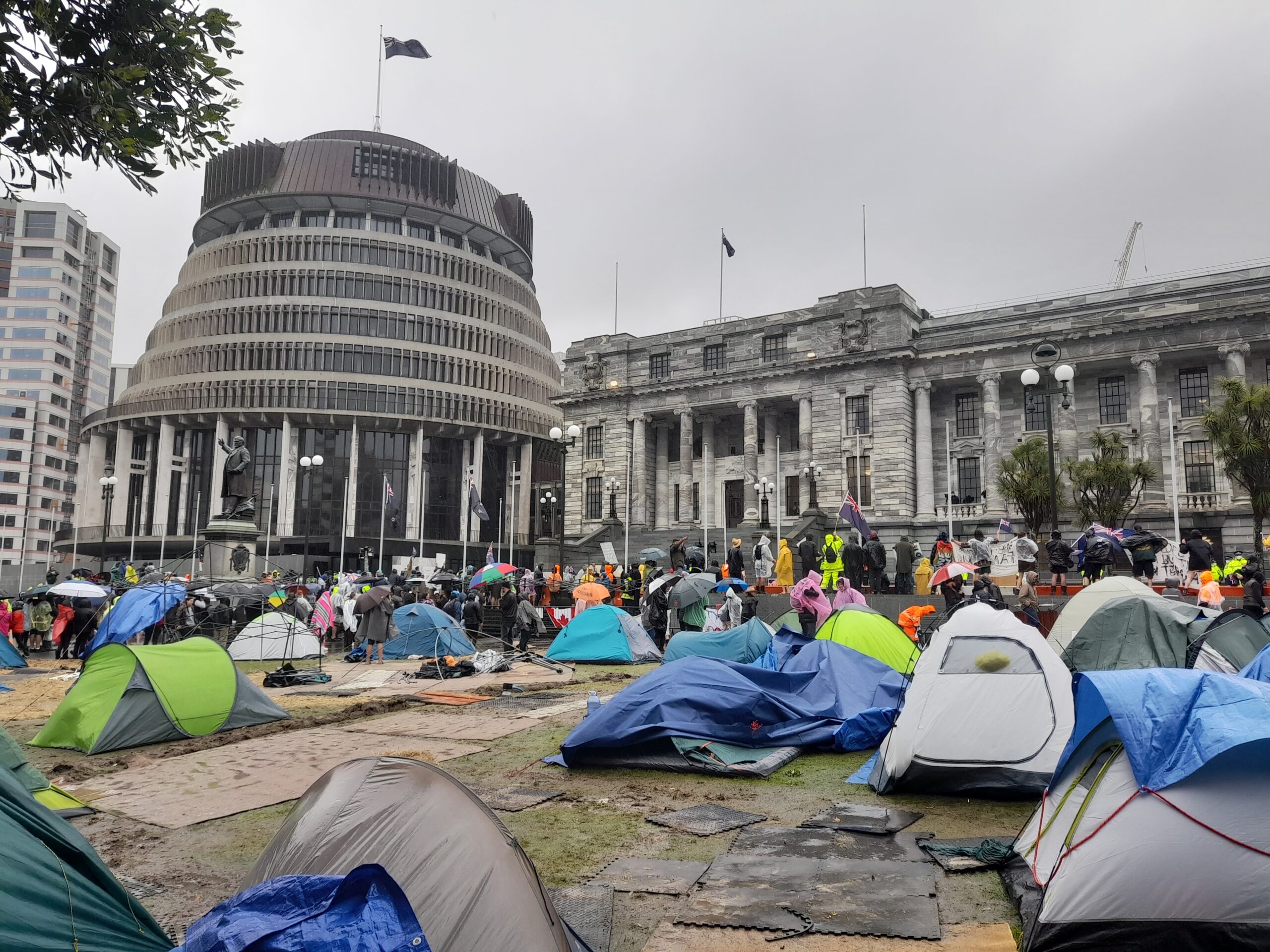
Caption: Chris Hipkins on campus defending cuts to the tertiary sector, Otago (2023). Accessed 01/06/2026, https://iso.org.nz/2023/06/18/355-million-for-tertiary-sector-reappropriated/
Time and again, the University’s fragile self-image takes precedent over its role as critic and conscience. The email referenced in this article’s introduction appeals to Otago’s status as “one of the most beautiful university campuses in the world” as a final plea against billsticking. Student activists are wise to not incur unnecessary legal or financial consequences for the ancillary task of advertising events, but that doesn’t mean conceding the contested terrain of public space to the corporate university. As we approach semester two, off the back of cuts to fees-free and subsequent protests across campuses, it is crucial that we as students recognise the opportunities that claiming public space as ours presents. That means occupations, campus bans, and teach-ins, as well as postering where strategic. We must assert our right to politicise campus, and refuse liberal appeals to the supposed “right way of doing things.” We must champion what Moten and Harney call the “first right” of refusal, “the refusal of the choices as offered.” We must exercise our right to free speech and engage in disruptive acts of resistance. We must be tactical, but at no point should we consider “respectability.”
Banner Image: “Signs of the occupied Registry Building at Otago University, 15.8.96” by SocialistWorkerNZ, CC BY-NC-SA 2.0.