Under new laws, immigration officers will be able to demand identification from suspected overstayers at their homes and workplaces. These out-of-hours compliance visits harken back to policies of the Dawn Raids era of the 1970s, in which Pacific peoples were forcefully targeted as “overstayers” despite only constituting one-third of migrants staying past the expiration of their visas. The raids occurred in an era marked by racial discrimination against Pacific peoples, hyper-surveillance, and state violence. Pacific peoples (and Māori) were racially profiled in public spaces, as well as at work and church, and endured traumatic home raids conducted at random hours by police officers with dogs.
Unfortunately, these “out-of-hours visits” are part of a much more extensive hardline stance on immigration. Legislation like this is being rushed through, blaming migrants to win votes. Migrants can be deported for engaging in criminal offending even if not convicted, or if they supply “misleading information” during immigration processes; they risk the perpetual threat of deportation until they have lived here for 20 years. Alarmingly, legislation is also targeting migrants deemed to be acting in “bad faith,” by “deliberately engag[ing] in proactive political activity.” Immigration minister Erica Stanford justifies this on the grounds of migrants who falsely claim refugee status. The state is then greatly empowered to scrutinise the sincerity of a migrant’s political beliefs, actions, and motivations.
Hyper-surveillance and oppressive legislation are appropriately timed for the election year, where migrants are being used as scapegoats. ACT’s 2026 proposed immigration election policy is a clear example. Put simply, this policy would establish an “overstayer enforcement unit” within Immigration New Zealand, which is presumably based on the ruthless US agency, Immigration and Customs Enforcement unit (ICE). Among other things, the plan includes charging temporary work visa holders six dollars per day, setting up additional barriers for immigrants to access social welfare benefits, and increasing the difficulty of the English language requirements. These attacks will have profound effects on all migrants travelling to New Zealand, and especially on communities who have been historically targeted.
In 2021, the Government gave a formal apology for the Dawn Raids, and yet we continue to witness the same patterns of politicians mobilising fear, stirring up racial tensions, and cracking down on Pacific communities as scapegoats. Tongan community leader, Pakilau Manase Lua, who lived through the Dawn Raids as a child, said that recent Government actions are going to be “disproportionately targeting our people again.”
In the context of new laws giving immigration officers increased powers, Stanford hyperbolised, “We have a big overstayer problem. Tens of thousands more than we suspected.” After facing backlash for this dramatically incorrect statement, Stanford later apologised, announcing that she “misspoke.” But misspeaking by tens of thousands is a substantial error. Hyperbolic statements, like this one, which stir up the threat of migrants are habitually asserted by politicians in times of crisis. Manese Lua, having already experienced the shortcomings of the 2021 apology, expressed discontent on Government treatment of Pacific communities: “Time and time again, we become political footballs during an election year, and this quacks like a duck, walks like a duck.”
Only five years ago, Lua attended the Labour Government’s apology ceremony, and two years later, there was a dawn raid targeting a Pasifika man, showing that New Zealand isn’t finished with this shameful chapter of history. Instead of creating more substantial pathways for Pasifika peoples to gain residency, Immigration New Zealand admitted that between July 2022 and April 2023, about 19 home visits were conducted “outside of hours,” exposing that the “formal” end of the Dawn Raids does not mean guaranteed protection of our Pacific communities.
Normalised state violence, hyper-surveillance, and increased militarisation are tactics that the ruling class use to control and repress the masses. Timed conveniently with the election year, the scapegoating of migrants is yet another populist strategy to divide the working class and win votes. Anti-immigration legislation directly harms immigrant and migrant communities, while also legitimising the increased exploitation and surveillance of the entire working class.
Capital moves across borders with ease, yet workers – human beings – are violently restricted and monitored. As of this year, capitalists who invest $5 million into New Zealand can migrate here with ease, bypassing the intense scrutiny imposed on migrant workers. Pacific communities resisted the racist state violence of the Dawn Raids era, as they continue to do today. The Government’s unceasing attacks on migrants are part of a much broader project of increasing the exploitation of all workers to the benefit of capitalists and business. The working class must fight for the rights and dignity of all workers.
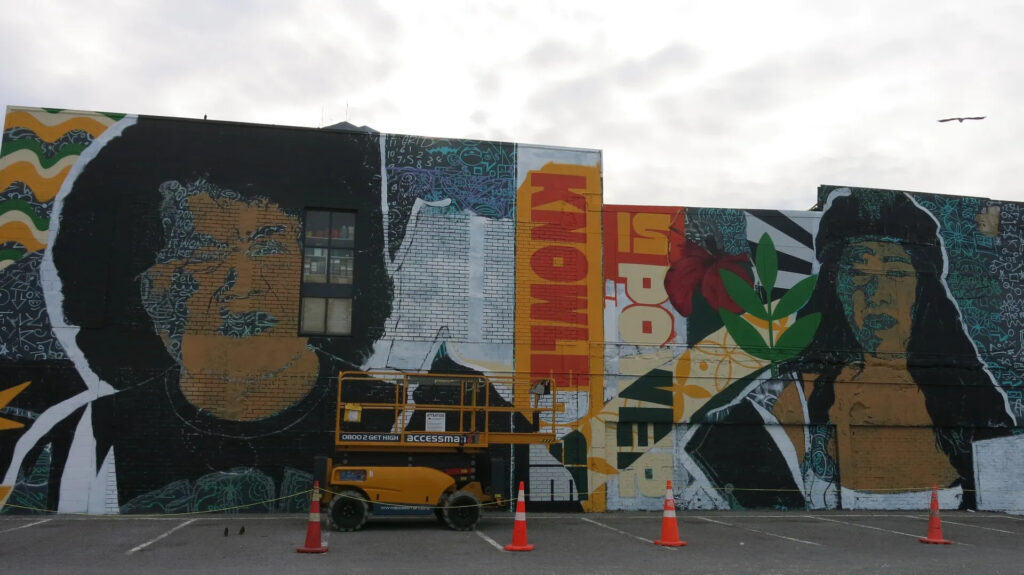
Banner image: Dawn Raids mural by Kophie Loaf (MEEP) taking shape. Image credit: Christchurch City Libraries and DigitalNZ, CC BY-NC-SA 4.0.