Editor’s note: This piece was penned in April 2026, prior to large-scale flooding in the North Island, and the 2026 Budget
The consequences of environmental destruction and climate inaction are becoming clear. So-called “one-in-a-generation” weather events and extreme weather more broadly are becoming increasingly common. The extreme rainfall that recently devastated North Island communities and caused the 22 January Mt Maunganui landslide which killed six people is, according to climate scientists, only “a peek into the future” on our current trajectory. We know that climate change is human-driven, and primarily the doing of the ruling class. In a recent interview, prime minister Christopher Luxon said the Government is “completely committed to climate change.” This is very true, just not in the way he meant us to interpret it. In this context, it is more than appropriate to give an account of the numerous acts of climate and environmental vandalism committed by the current coalition government.
In the aftermath of Cyclone Gabrielle, the previous government established a “better late than never” $6 billion climate resilience fund. In 2024, scrambling to fund their tax cuts for the rich, the Coalition scrapped the fund, returning some $3.2 billion to the treasury. The government has also been quietly stripping back other resilience and adaptation measures and frameworks, including those contained in the National Adaptation Plan, which was published in 2022.
Firefighters are the frontline defenders of life and livelihood from extreme weather-related events such as floods, wildfires, landslides, and so on, not to mention non-climate-change-related events like earthquakes. This government, in line with those preceding it, is strangling the fire and emergency service. FENZ, the government agency responsible for these services, broke its agreement with union firefighters by refusing to hire additional frontline personnel, leaving the service dangerously understaffed. The government has refused to fund fit-for-purpose trucks and other equipment, despite the equipment currently available to firefighters being critically out of date, often failing at the worst possible moments, and delaying response times. Additionally, FENZ is undergoing a “restructure” set to affect some 700 jobs and outright cut over 140 positions, including important frontline-support roles, and positions aimed at wildfire prevention. The Public Service Association and NZ Professional Firefighters Union are taking FENZ to court over this, arguing it’s unsafe and was done without consultation. NZPFU firefighters have also been bravely fighting the strangulation of the fire and emergency service through regular strike action and marking their trucks with protest messaging.
Early in its term, the coalition government passed the Fast-track Approvals Act, a piece of legislation aimed at riding roughshod over environmental regulations, community input, and other important considerations to allow for the swift approval of projects such as open-cast coal mines. Perhaps the most glaring example of a project currently in the fast-track process is the plan to significantly expand the Stockton open-cast coal mine onto the Denniston Plateau. The Denniston Plateau is a spectacular area containing unique and delicate ecosystems as well as endangered species. Despite the advocacy of groups like Forest and Bird, as well as the advice of many experts, the Denniston Plateau is only “stewardship land”, a supposedly temporary classification before being evaluated for a higher conservation status. Stewardship land, however, can be legally mined and destroyed.
There are, of course, not only conservation concerns but also climate and emissions concerns. The proposed mine expansion is set to extract some 20 million tons of coal to be exported offshore to be burned in the production of steel, with the profits to go to some Australian capitalists. It’s expected that this will release about 50 million tons of carbon into the atmosphere. This is equivalent to the entirety of all emissions produced in New Zealand for a year. The Denniston mine expansion is by no means the only damaging project being put through the fast-track approvals process, but is certainly among the most horrific.
Regarding domestic energy generation, the Coalition has removed the preference for renewables and the renewable energy targets from the government policy statement on electricity. They’ve recently announced a plan to build a liquified natural gas import terminal, which will not only increase emissions but also is set to be funded by a new levy expected to drive up power prices. Electricity inflation over the last couple of years has been very high, disproportionately affecting the working class. Additionally, in close consultation with oil and gas companies, the government has overturned the ban on oil and gas exploration, adjusted legislation to promote oil and gas exploration, allocated $200 million to support new oil and gas projects, and has reduced or, at ministers’ discretion, waived, the obligations of oil and gas companies to clean up their own environmental messes.
Then there are the government’s various heinous acts in relation to transport emissions. They removed addressing climate change as a strategic priority from the policy statement for land transport which means Waka Kotahi (The NZ Transport Agency) is no longer required to prioritise emission reductions. Over the course of its term, the government has cut away at the sustainable aspects of transport in NZ. They’ve reduced funding for walkway and cycleway projects. They cancelled Tāmaki Makaurau’s light rail project, they reduced public transport subsidies, making them significantly more expensive to use, and they abolished the “clean” car discount as well as the tax on high emission vehicles like utes. Instead of moving towards sustainable transport, they’re instead spending some $50 billion on their “roads of national significance” program, including several new four-lane roads.
Even in this dedicated article, there is simply no space to properly cover all of the Coalition’s many attacks on the climate and our environment. That said, here’s a quickfire (though incomplete) list: They changed the Resource Management Act to deprioritise climate and environmental considerations. They cut funding and the staffing levels of the ministry for the environment, as well as the environmental protection agency. They scrapped measures to address agricultural emissions, cut climate science funding, ignored and sidelined the independent climate commission, and scrapped renewable energy storage plans. And they “repurposed” the funds set aside for government investment in decarbonising industry for their tax cuts for the rich.
By massively neglecting the desperate need in our society for climate resilience, emergency response, and emissions reductions, the government is putting lives at risk; in fact, they, along with the rest of the international ruling class, are going to get people killed and are going to be responsible for the destruction of countless livelihoods. The current government, even more openly and aggressively than many past governments, rules in the interest of the rich: the mine owners, oil and gas execs, the shareholders, and property speculators. They rule for the capitalists, and the capitalists cannot get past the competitive value of short-term dirty profits. The worst impacts of the climate crisis won’t be felt by the rich in their secluded mansions or their fancy bunkers but by working-class people whose homes and livelihoods will be swallowed by landslides, wildfires, rising seas, and so on. To have any chance of rising to the challenge of climate change, we cannot afford to leave the political, economic, and social power in the hands of the class who are responsible for the current crisis – the class which is so clearly deadset on the status quo or worse. We must condemn them in the strongest terms and fight for a better world.
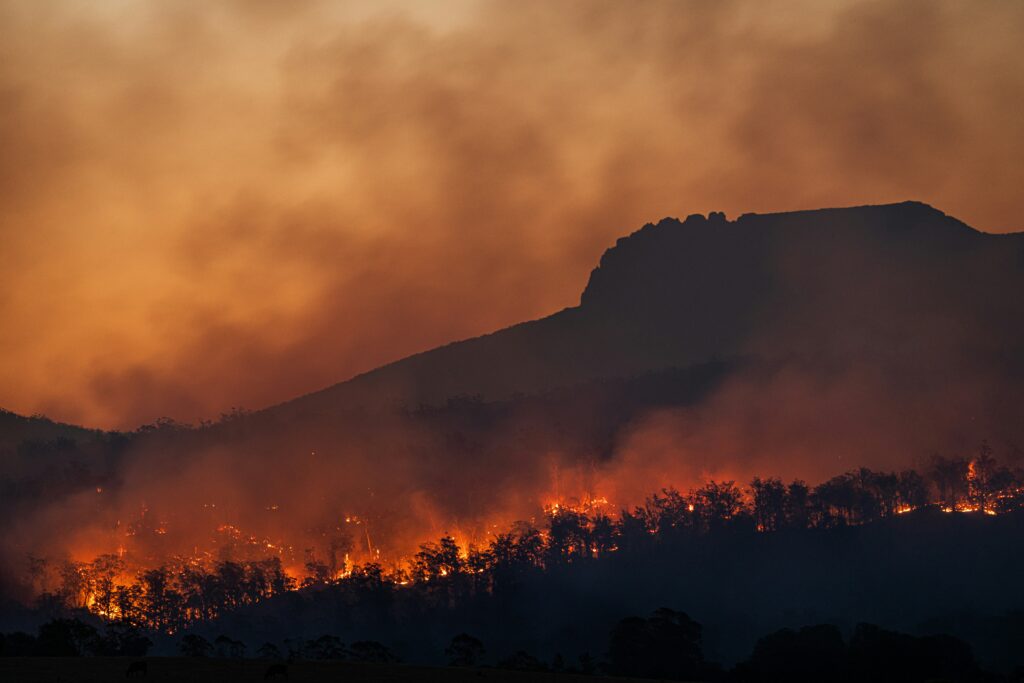
Banner Image: a wildfire. Photo credit: Matt Palmer on Unsplash