Note on translation: Information for this article has come primarily from French websites imperfectly translated into English by Google Translate. All quotations from these translated sources are given in the imperfect English form, but supplemented by further information by the author within square brackets.
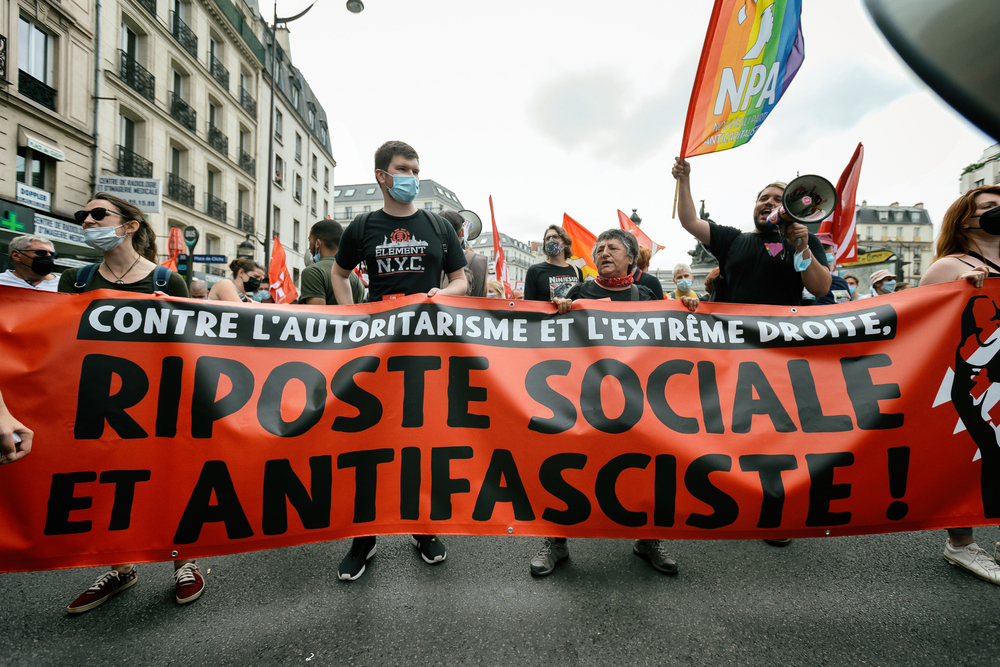
The creep of fascism is advancing over Europe and the United States. At present, attention is drawn to France where consequential developments have taken place since 12 February 2026. On that day, in Lyon, there was a confrontation between small groups of fascists and antifa, which resulted in one of the fascists, Quentin Deranque, receiving head injuries from which he died two days later. The fascists reacted with 3,200, according to Le Monde, marching through Lyon on 21 February, and attacks on offices of La France Insoumise (LFI) and on union offices around the country. LFI is a left-reformist party led by Jean Luc Mélenchon.
The violent incident has been seized upon by the whole of the political right, and the right-wing media, to create a storm of hostility against the LFI and the anti-fascist organisation Jeune Garde. LFI are accused of being politically responsible for the death of the fascist. Jeune Garde, which was dissolved by the French Government last year, is accused of being responsible for organising the response to the fascist squad on that fatal day. One of the founders of Jeune Garde, Raphaël Arnault, is an LFI MP. His parliamentary assistant is charged with “complicity to murder by instigation.” A former Arnault intern is among 11 people reported to have been arrested.
Léon Crémieux, writing in International Viewpoint, explains the origins of Jeune Garde.
The Jeune Garde was created in 2018 in Lyon and has since developed in several cities in France in the face of the multiplication of anti-immigrant and anti-LGBT attacks by far-right groups, particularly in Lyon, and attacks on the workers’ and associative movement, premises and meetings and demonstrations. The Rue89 website has recorded 102 attacks, assaults and hateful acts in Lyon since 2010. The Jeune Garde in Lyon, acting in unity with the left-wing parties, EELV, LFI, NPA, PCF [Europe Écologie – Les Verts (Greens), Nouveau Parti Anticapitaliste, Parti Communiste Français] among others, the CGT, Solidaires, FSU [union federations] and the social movement, succeeded in combating the upsurge in far-right attacks and in obtaining the closure of premises and the dissolution of several fascist groups. Since then, it has played a very dynamic role in the organization of anti-fascist protection action. In October 2021, for example, it demonstrated in Lyon against far-right violence with Planned familial [supporters of sexual violence survivors], Alternatiba [a left-wing organising premises in Lyon], the CGT, Solidaires, UNEF, EELV, LFI, the NPA and the PCF.
…The Jeune Garde, presented as ‘the praetorian guard of Jean Luc Mélenchon’ or ‘the armed wing of LFI’, is therefore quite simply an anti-fascist organization that works with the entire workers’ movement and contributes to building the self-defence of organizations and activists. It is now criminalized to make it almost a terrorist organization, at the instigation of Nemesis [a racist women’s organisation] and the far right, widely followed by the government and many media outlets. It is a question of using it as a lever to isolate LFI, which has been ordered to break its ties with the Jeune Garde, and to push Raphaël Arnaud to give up his mandate [resign as an MP].
Crémieux describes what happened on 12 February.
He [Deranque] was on February 12, in front of the premises of the Sciences Po Lyon university campus, where a meeting was being held with Rima Hassan, MEP [Member of the European Parliament] for France Insoumise and Palestinian activist. As had already been the case on several occasions, the right and the far right had sought to obtain a ban on [her] meeting. Having been unable to obtain it, a group of activists from Nemesis, a racist and identitarian far-right collective, decided to organize a picket in front of Sciences Po with a banner (“Islamo-leftists out of our universities”).
… This group was demonstrating in front of Sciences Po with the distant support of about fifteen ultra-right activists, including Quentin Deranque. A first altercation took place between Nemesis’ group and anti-fascist activists protecting the meeting. A second clash took place a little later, next to Sciences Po, between the group of ultra-right activists and an equivalent number of antifa activists. Following the response of the antifa, the ultra-right group retreated, dispersed, leaving only three of them, including Quentin Deranque. It was at this moment that, on the ground, he received several violent blows to the head. … He died two days later as a result of his trauma.
Crémieux, however, is critical of this type of anti-fascist action.
Even before his death, the media surge took up the narrative of Nemesis spokesmen [more likely spokeswomen] saying that the fascist militant had been ambushed and lynched by a group of the ultra-left Jeune Garde, and the news channels only played a loop of the video of the last moments of the confrontation when he was knocked to the ground. A self-defence action by anti-fascist activists cannot justify these blows. This act is also far from the conception of the antifa struggle put forward by the Jeune Garde, which has always advocated the action of collective self-defence, has always been to act in connection and in unity with all the organizations of the workers’ movement, to build a collective and unitary anti-fascism in the face of the fascists, as opposed to a virilist private war. And therefore, also the opposite of what happened on February 12 when the antifas hit this fascist militant on the head.
Crémieux makes the case for collective action, not specialist squads that make confrontation with fascists their central activity.
But this should only highlight the risk, in the face of the rise in aggressions and attacks by the far right, of not putting at the heart of the concerns, in all the organizations of the workers’ movement, the construction of a collective self-defence based on the members of these organizations, with the right training. Otherwise, it is the groups that devote themselves centrally to anti-fascist political action that risk finding themselves invested with these tasks of protection and it is from this specialization that excesses or individual acts outside the framework and collective recommendations can arise. Whatever the involvement of Jeune Garde activists on February 12, what happened should not put anti-fascist self-defence on the back burner, but on the contrary make it more present in all organizations.
The Right and far Right are taking the opportunity to demonise LFI with an eye to the presidential election next year. This demonisation of LFI had begun before the fatal street fight. Earlier in February the Ministry of the Interior had officially classified candidates in the upcoming local elections endorsed by LFI as “far-left”. Formerly, LFI candidates were classified as “left”. Exploiting the death of Deranque, the Right are painting LFI as far-left even more. The whole of the genuine far Left is accused of being violent alongside LFI.
Municipal elections being held in two rounds on 15 and 22 March will provide evidence of the effects of the attack on LFI and the far Left.
Crémieux states:
Manuel Bompard, coordinator of La France Insoumise, sent the newspaper Libération a list of names, indicating that ‘since 2022, in this country, the far right-wing groups linked to the far right have killed 12 people.’: Federico Aramburu, Éric Casado-Lopez, Emine Kara, Mahamadou Cissé, Angela Rostas, Djamel Bendjaballah, Rochdi Lakhsassi, Hamid G. and Hadi R. Aboubakar Cissé, Hichem Miroaoui. Ismaël Aali, killed last January in Lyon, should be added to this list. Their murders have triggered fewer reactions than the death of the Lyon identitarian activist. Immigrants, or people of foreign origin, for the most part, which is clearly part of this obsession with a race war. Fascist activities and aggressions are increasing, stimulated by the rise of the RN [Rassemblement National] and anti-fascism is a demand and a necessity of the first order.
The opportunist demonisation of the Left in France is reminiscent of the Trumpian reaction to the killing of Charlie Kirk, pinning the violence badge on the US Left.
The Nouveau Parti Anticapitaliste – L’Anticapitaliste (NPA-A) has issued a protest against the “reversal of truth”.
In recent days, the entire media and political sphere has attacked La France Insoumise (LFI) for the death of a young fascist activist in Lyon on February 14th. LFI and the Jeune Garde (Young Guard) are accused of fostering a climate of violence in France. And for the first time since 1945, the National Assembly observed a minute of silence in memory of a far-right activist.
The violence comes from the fascists! Anti-fascist self-defense groups like the Young Guard exist because, for many years, and particularly in Lyon, the far right has been attacking, injuring, and killing. For example, when identitarian activists armed with knives attacked the Pride March in 2021, or when they assaulted Moroccan football fans on the sidelines of a match in 2022.
Yet, on the continuous news channels, everything is turned upside down: the real fascists, the nostalgics of the Third Reich, become peaceful activists, those responsible for racist attacks are victims and the anti-abortion femonationalists pass for feminists …
This complete reversal of guilt is also a reversal of truth. Because constant lying is necessary to prop up a failing capitalist system, long enough to install the far right in power, LFI must be portrayed as a violent far-left organization. Neo-Nazis must be portrayed as poor innocents, and those who fight them as bloodthirsty fanatics.
The NPA-A has sounded the alarm. On 26 February its front page headline in its weekly newspaper, L’Anticapitaliste, was ‘A disturbing complacency towards fascism.’ On 27 February the executive committee of the NPA-A issued an open letter to the entire Left calling for unity against fascism, and named 14 March as a possible meeting date. On 4 March the NPA-A published an article, ‘Building the anti-fascist response’, which again called for unity. The author declared that there was nothing more urgent than the fight against fascism and pleaded that differences on the Left should not prevent anti-fascist unity.
Let us hope that the French Left rises to the challenge of unity. Let Trotsky’s writings on the united front be their guide. Otherwise France may become a very dark place.
Image Credit: Photothèque Rouge / Martin Noda / Hans Lucas