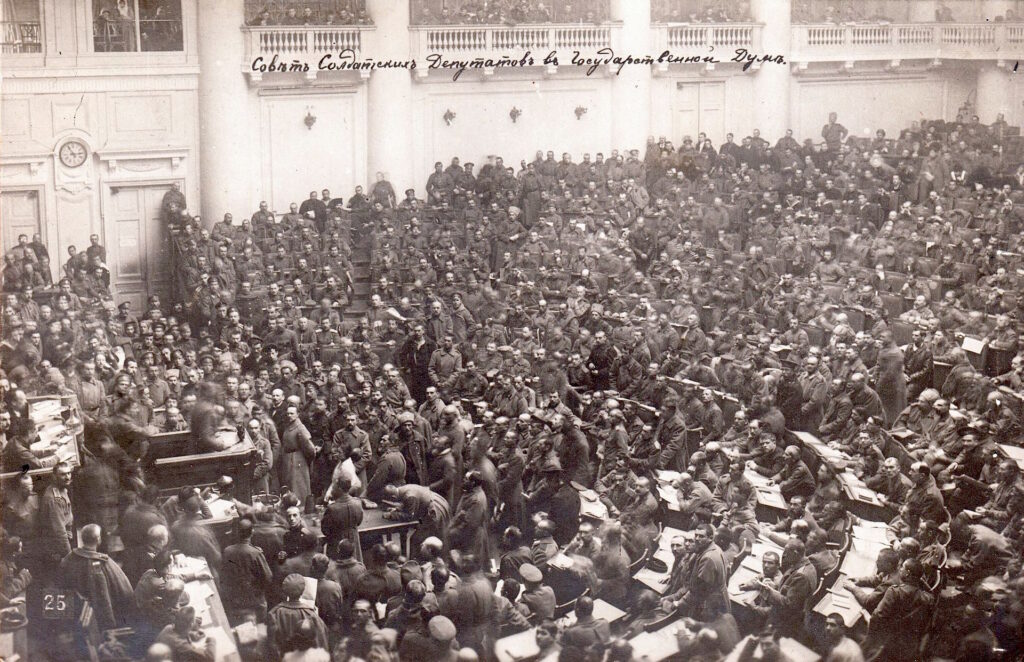
A Soviet assembly in 1917. Petrograd
The Soviets, workers’ councils, first formed in 1905. They emerged after decades of repression and out of the lack of democratic ability afforded to the people. These organisations of the working people replaced officials of the Duma, the legislative body historically appointed through the Tsar. It was the Soviets that were eventually solidified, becoming organisational units of the USSR.
The first soviet, founded in Ivanovo, consisted of around 150 people representing no more than 250 workers each. Many representatives were elected negotiators for one factory or another in previous strikes. The soviet quickly made changes, negotiating collectively instead of per workplace, but also by organising certain aspects of town life to better living conditions. Unfortunately, they also quickly faced repression, as the Tsarist governing bodies recognised how effectively the soviets were meeting demands.
Soviets quickly spread nationally. By the end of 1905, there were soviets across more than 50 towns and cities, emerging alongside strike actions and quickly becoming revolutionary bodies against the Tsarist autocracy. Lenin claims that in 1905 there were over 4,300 economic strike events, consisting of over one million people. A million more participated alongside these in political strikes.
These aforementioned events led to the Tsar’s begrudging promise of basic civil rights and an elected parliament. Four of these “Duma” were created and dissolved between 1906 and 1917, with the longest-standing formations being dominated by the gentry, landowners and businesspeople.
None of the Duma alleviated repression of rebellious workers and peasants, so the soviet councils were quickly stamped out. Strike rates died down through 1906 and 1907, and it wasn’t until 1912 when strike activity jumped back up to the levels seen five years prior. The number of strikers dipped again late in 1914 at the onset of WWI as a semi-patriotism swept through the ranks of the working class. Numbers sharply rose once more through 1915 and 1916 as workers’ formations started to develop again.
The Return of Workers’ Organisations
Petrograd, the heart and capital of the Russian empire, hosted a significant number of strikers. There were also large numbers elsewhere, but the metal workers of Petrograd incited 45 percent of political strikes in the empire leading into 1917. These strikes quickly spread to the cotton factories, and it was these female textile workers who first took to the streets in February 1917 to bring about the beginning of the Russian Revolution.
Several days after that historic walk-out, on 27 February 1917, the Petrograd Soviet, led by the Mensheviks, was declared. The next day, the revolutionary masses of Moscow also seized their city. Before long, factory committees saturated the industrial centers of European Russia.
These events show us that the workers took it upon themselves to make victory an assured thing. As put by Trotsky, “…the February revolution was begun from below, overcoming the resistance of its own revolutionary organisations, the initiative being taken of their own accord.”
Workers’ committees formed rapidly during the strike actions. Thirty trade unions sprung up in Petrograd in March and April of 1917, representing 200,000 to 300,000 workers.
The Soviets led by Moderates
While the workers and their committees expected to take control over factory management, the Petrograd Soviet wanted the committees to take a more union-like approach. They wanted the committees to merge with the unions to be negotiators between the workers and the owners, rather than have the workers take on the roles of leadership themselves.
The state would soon be led by a Provisional government, and it was the Soviet that wanted to act as a mediator between the unions and the state, rather than have the workers assume state power. In fact, it was the Petrograd Soviet that formed the left half of this government in concert with the bourgeois Provisional Committee.
Despite the awkward positioning of the Petrograd Soviet, the workers’ committees would go their own route, and across the nation they continued to strike, participating in committee and union activity. The Kronsdtat Soviet, for example, declared themselves Kronsdtat’s sole governing power. The factory owners held back on concessions knowing that the Government would be on their side, and discontent among the workers would soon grow.
The Road to Workers’ Power
As the workers grew disillusioned with the establishment, the War, which was a major driver for revolutionary change in the first place, continued to take its toll on the population.
By June, the population was tired of the lack of change, and from July, the validity of the Bolshevik path, the path of armed revolutionary masses, was taking hold.
Over the next few months, workers carried on the revolutionary work they had already started. The economic problems were still crushing but the workers blazed the way. Simultaneously, across the nation, peasant riots increased in frequency. They seized land and tools, and attacked landlords and the agents who oppressed them. The movement wasn’t going to roll over.
By October, workers’ efforts had filled workplaces with revolutionary vigour. Many factories were closing, but where work continued, workers’ committees stayed strong.
The Bolsheviks were steadily agitating all through October, maintaining that the time was ripe for insurrection. The Red Guards, the revolutionary forces of armed workers, were preparing themselves, sleeping in factories with their rifles, ready to clear the way for the advance of the revolutionary masses.
On 24 October 1917, they seized all but one of the bridges crossing the Neva river, and held important points in the city. By the morning of 25 October they seized the post office, train stations, power stations, the state bank, the telephone exchange, and many Government buildings.
That night it was decreed that all power in the localities was to be passed to the Soviets of Workers’, Soldiers’ and Peasants’ Deputies, and workers’ control over production was formalised. Decrees such as that on peace and on land were issued and a new government was formed.
The Collapse of Workers’ Power
The years following were exceedingly difficult as civil war took hold, and the monarchists, backed by the capitalists, attempted to take governance from the revolutionaries.
As the situation escalated, instead of taking the approach of workers’ control and selective nationalisation, the Government found itself taking on whole industry nationalisations. This was in response to things like the development of illegal free markets for grains, which incentivised producers to hold on to anything they could, or the tearing apart of the railroad system for firewood, as the trains weren’t running anyway.
In the years following, hopes of democratic workers’ control were effectively ruined. The workers were either exhausted, inexperienced or did not care for such organisation, and as most of the new workers would move to the cities from the country, they did not have the same understanding of the history of workers’ organisations.
The NEP
Seeking to undo some of the mistakes made during the Civil War, the Soviet Government released the New Economic Policy (NEP). They apologised, saying that they attempted appropriation and redistribution of grains too soon, and declared that they would replace this with a taxation system. They recognised that this strayed from socialism, that “concessions to foreign capitalists … and leasing enterprises to private capitalists definitely mean restoring capitalism,” but claimed this would allow for a proletarianisation of the peasant masses and a reinvigoration of a revolution.
While the NEP was eventually phased out, the workers’ councils were yet to have power returned to them. Once Stalin took power, he introduced central planning and collectivised the land in attempts to direct industrialisation towards a more defined trajectory. This position, while a step away from the more right-wing approach, retained profit as a goal of production.
The repression of the party’s more left-wing elements and the onset of WWII, meant that the same power afforded to workers’ committees at the outbreak of the Russian Revolution was never reestablished. The goals ingrained in the population following the struggles of the early 1900s were lost, and the dreams of a strong socialist future withered away.
Conclusions
The embryos of the revolution were found in the workers’ and peasants’ formations emerging against the repression of the Tsar. Their actions brought about the first democratic revolution. Decades of struggle were the backdrop for their decisiveness.
No revolution was able to happen again until the workers, of their own accord, decided that more needed to be done to help their cause. Yes, the revolutionaries had a heavy hand to play in terms of the education and agitation of the masses, but the masses were the ones that took to the streets and acted as they thought was needed.
Workers’ control atrophied in the face of counterrevolution, and there was a failure to re-establish the consciousness required for the workers’ to once again take control.
These events can still guide our thinking today. This illustrates why workers’ participation is of utmost importance and why we must support class struggle internationally. We ask ourselves, while we are organising among the working class, in what ways can we learn from the working class to bring about real socialist change?