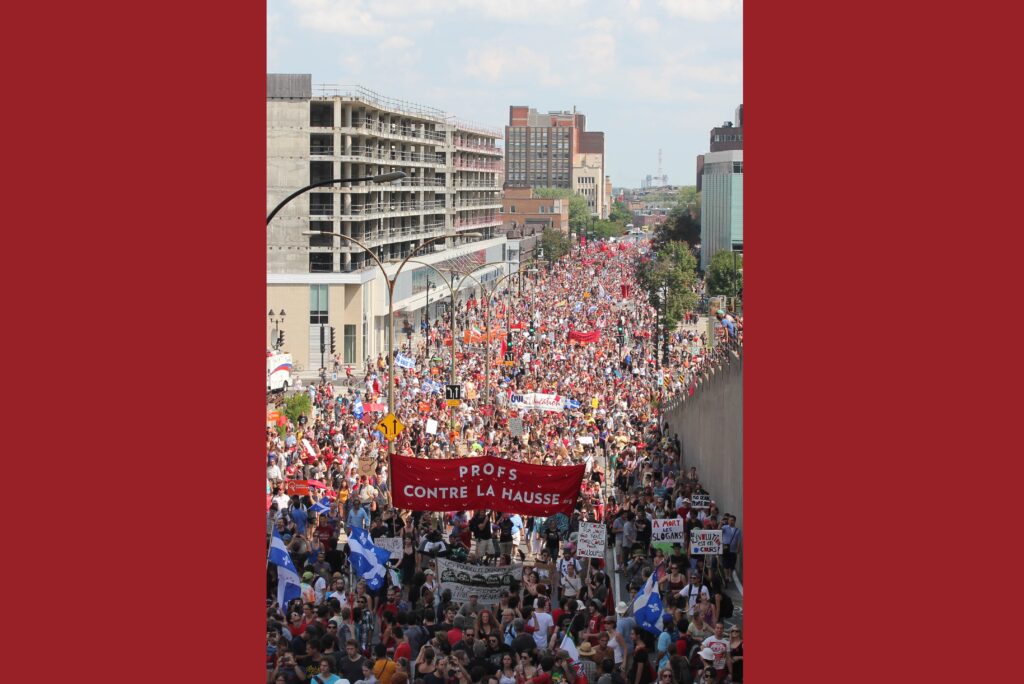
In March 2011, the Executive Council of Quebec, led by Liberal premier Jean Charest, proposed a hike in university tuition fees. Over the five years between 2012 and 2017, annual fees for Québécois students were to rise from C$2,168 to C$3,793, a 75 percent increase. Over the rest of 2011 and into 2012, students responded with massive protests and strikes, peaking in March 2012 when around 310,000 out of 400,000 students in the province were on strike, and demonstrations reached 200,000. Though faced with violent repression from the police and the Quebec government, these students resisted counter-protest legislation in the form of the anti-democratic and restrictive Bill 78 and shut down the proposed hike.
History of the Quebec Student Movement and the 2012 Student Strike
Quebec has a long history of successful student demonstrations and strikes. Through these protests, which often follow a tuition fee hike, students achieve the freezing of tuition payments. After one of the first successful Quebec student strikes in 1968, tuition fees were frozen at around C$500 until 1990. This cycle of increasing fees, student protest, and (temporarily) freezing fees has repeated multiple times in Quebec (for example, in 1996, which had a student strike that resulted in an 11-year fee freeze; and in 2005, where students shut down the budget cuts the Liberal party – already led by Jean Charest – were proposing for universities).
The 2011 plan for a hike in annual tuition fees came after four subsequent years of fee increases. The proposition was for an increase ofC$325 per year for five years, an increase of C$1,625 overall. At this point, fees had already been increasing by C$100 per year since 2007. Alongside a strong protest tradition, Quebec universities have student unions with mandatory membership and dues structures. It is through these organisations that the students of Quebec vote to strike in protest against government actions like budget cuts and fee hikes. There is also an “Association for Student Union Solidarity” (ASSÉ), where members of the student unions of each of the universities can organise inter-university actions. In December 2011, ASSÉ became CLASSÉ (‘Broad Coalition of the Association for Student Union Solidarity’) to encompass a wider group of activists. At the beginning of the movement,a majority of students were in favour of the increase to fees. Its leaders put a lot of hard work into persuading the student body of their cause. When the strike officially began in February 2012, 9 percent of students in Quebec (36,000 people) went on strike. Just a month later, ten times this number and more than 50 percent of students were striking. During the spring of 2012, demonstrations numbering in the hundreds of thousands flooded the streets. Media outlets began to call the movement Printemps érable(the Maple spring) after the Arab spring(s) (Printemps arabe)of the early 2010s. Students and their supporters participated in strikes, walkouts, marches, occupations, sit-ins, blockades, and more.
By May, a “counter-revolutionary” sentiment was sweeping Quebec. While hundreds of thousands of students stayed on strike, some began to wonder about the potential length of the strike and withdrew. The police had been consistently violent throughout the course of the strike, beating protesters with clubs and using tear gas, rubber bullets, and flash-bang grenades at marches and sit-ins. This violence escalated into the late spring. The Liberal government, in a desperate attempt to crush the movement, passed Bill 78 on 18 May 2012. Bill 78 was an emergency law thatmade it illegal to protest or have picket lines on or near university campuses, and required protest organisers to submit the route/venue, date, and time for approval by the government if they wanted to hold a protest. Demonstrations after 18 May were not just against the fee hikes, but also this repressive bill. Many were vehemently opposed to Bill 78 in its own right, and joined the students’ cause. Students and their supporters wore red squares pinned onto their clothes and bags to signal their allegiance. One slogan of the movement that embodies this union is “la grève est etudiante; la lutte est populaire” (“the strike is student-led; the struggle is a people’s struggle”). Strikes and protests, though somewhat diminished, continued until the September 2012 election. Jean Charest and the Liberal party were voted out in favour of the sovereigntist Parti Québécois, who repealed Bill 78 and announced another tuition freeze.
While the government has not put in place another considerably large fee hike for Québécois students since 2012, tuition is no longer frozen: there is a 3 percent increase in fees per year, and both Canadian students from outside Quebec and international students have seen enormous increases in tuition fees if they want to study at a Quebec university (interestingly, many of the students in favour of the 2012 fee increases were non-Québécois Canadians who reasoned that even the proposed price for tuition fees was lower than the equivalent price throughout Anglophone Canada). The annual tuition fees for Quebec universities for the 2026–2027 academic year vary depending on the university, but the average price is slightly lower than what it would have been in 2017 had students not protested. However, though these current fee hikes are small, they are still hikes, and the students of Quebec still have much to protest in the management of their education systems.
The Student Movement Here and Now
The students of New Zealand in 2026 are experiencing far more egregious transgressions on their education than the students of Quebec in 2012. While they, by the end of the five-year scheme, would have been paying an extra C$4,875 for a three year degree, with the cutting of the Fees Free scheme, New Zealand students will be paying over NZ$8,000 more over the course of their degrees. This is not to mention the allowed 6 percent yearly increase in tuition fees in 2025 and 2026, which is double the inflation rate. This amounts to even more money extracted from students. As of 2026, we also pay more than twice what a Québécois student does in tuition. We have just as much, if not more, reason for organised student protest as they did in 2012. The movement in Quebec was incredibly politically and ideologically well-prepared for militant struggle. Alongside the long tradition of student protest in the province, the organisers of the 2012 strike led a lengthy campaign of persuasion. Almost a year passed between the government first proposing the hike and the official beginning of the strike. Before the unlimited strike could happen, they made sure students understood what the fee hikes were, why they should be opposed, and why a strike would be effective. They led day strikes, marches of tens of thousands of people, and the occupation of campus buildings.
Some make the argument that Quebec, having a strong tradition of successful student protest and cheap tuition fees compared to the rest of Canada, is somehow more primed for a student strike than other places. This is not necessarily the case. The tradition of protest in Quebec had to start somewhere, and furthermore, the organisers of the 2012 strikes had to work extremely hard to get the general student body on board with a strike. It is not as though the student body in 2012 had decades of strike experience to draw from: the last major student strike in Quebec had been in 2005, and student body turnover happens over much less than seven years. If we are persistent, stubborn, militant, organised, and politically sound, there is no reason that the students of New Zealand cannot effectively protest against the austerity of our own government. We also have historical precedents for both student protest and cheap (or free) university tuition. And if our government continues to insist on austerity measures that reveal a callous disregard for students and workers alike, then protest we must.
Photo caption: National demonstration on 22 July, 2012, in Montreal, as part of the strike against tuition fee hikes in Quebec, 2012. Photo credit: Chicoutimi, Wikimedia Commons, Public Domain