On the eve of World War One, New Zealand’s labour movement was approaching a crossroads. Down one path lay an end to imperialist slaughter on foreign fields and liberation from colonial capitalist oppression at home. Down the other, government by two alternating parties who differed over how to administer capitalism, but who were equally committed to maintaining the brutal system of exploitation and war.
Today, we know the path our history took. As working class uprisings shook the capitalist world in the aftermath of the war, leading briefly to a beacon of hope in revolutionary Russia, this country laboured under its most authoritarian, far-right government in history – even more oppressive even than today’s Coalition. The revolutionary potential of the pre-war years was extinguished. By 1919, Aotearoa’s leading union newspaper declared: “The very forms of what is called democracy were set aside”, as the government “passed needless regulations restricting freedom of speech, act, and movement, and generally acted as dictator and autocrat.”
It is said that those who do not learn from history are doomed to repeat it. So the question is, how did this disaster happen?
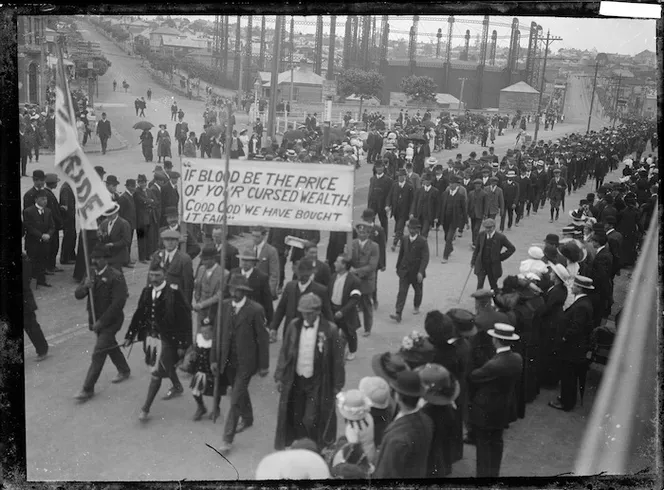
It didn’t have to be this way. Although few today know it, striking workers courageously battled armed militia on horseback, backed by Royal Marines with machine guns, in running street fights during a general strike in 1913. Editorials, like one in the West Coast Times, fumed and fretted that, “The seed of revolution is here, nevertheless. During the last few weeks sedition, anarchy and the worst form of syndicalism have been preached from housetops; lawlessness and riot have been indulged in; there have been revolver shots in our streets and plants of explosives have been found.”
But as author Martin Gregory explains, the “real turning point” for the labour movement came the year before. His newly-revised and updated pamphlet, The Significance of the 1912 Waihi Strike, describes and analyses this decisive struggle of 1912 – one which would determine the course of history. Rich in detail and vivid first-hand accounts, it’s a must-read for every socialist.
The dispute at the Waihi Gold Mining Company began over whether unionised workers would have the right to negotiate and take strike action if necessary, or whether their terms and conditions of employment would be taken out of their hands and decided by a specialised tribunal called the Arbitration Court.
In 1911, members of the Waihi Miners’ and Workers’ Union had voted to cancel their registration with the Arbitration Court and deal directly with the company. Immediately, pay rates went up and a competitive tendering system, which pitted miner against miner for the right to work, was abolished. They joined a small but growing number of other unions moving in the same direction. These unions were organised nationally as the New Zealand Federation of Labour, known as the “Red Feds”.
“But all the gains could be put at risk by an arbitrationist union being recognised”, explains Martin Gregory. “A tiny registered union at Waihi could become the recognised union and the awards of the Arbitration Court would then be binding on all 1,200 workers in the Waihi mining industry.”
Company executives set about luring workers to leave the Waihi Miners’ and Workers’ Union, create a rival union and register with the Arbitration Court. By May 1912, the company had convinced a sufficient number – some 25 to 30 workers – to commit this treachery. So began the six-months-long Waihi Strike.
The 1912 Federation of Labour Conference was timed for the end of May. “At once”, says Martin, “there was a call for the Federation to support the Waihi strike.” But there was disagreement among delegates over what kind of support to provide, and whether other unions would strike in solidarity with the miners. “The upshot of the conference, as far as Waihi support was concerned, was that the Federation would levy members at 10 percent of their weekly pay to support the strikers, but the action would not be extended.”
Midway through the conference, “the Liberal government was defeated on a confidence vote. William Massey’s right-wing Reform Party was to take office in July.” This would prove a momentous development.
“From May to August the Waihi Strike passed peacefully… For the first phase of the strike, the employers relied on hunger to work its wonders; then it became clear that the strikers’ families were not going to be starved into submission. The new Right wing Massey government and the employers made their plans.”
“In early September, police commissioner Cullen went to Waihi to personally supervise a crackdown.”
“On 2 November mounted police charged a crowd of strikers.” This was just a taste of the violence to come. Nine days later, “a force of thugs and scabs attacked the union hall with a hail of missiles as the Police looked on.” The following day, police and scabs ransacked the union office, gun shots rang out and miner Fred Evans was fatally struck by a police baton. Hundreds of strikers and their families were run out of town. “The strike was effectively over, although not officially declared off until 30 November. Before the year was out, the competitive contract system was back.”
As well as describing these events, The Significance of the 1912 Waihi Strike goes on to analyse why they happened. As the author has it, “The lessons to be drawn from the strike are profound and are still relevant to the working-class movement today.”
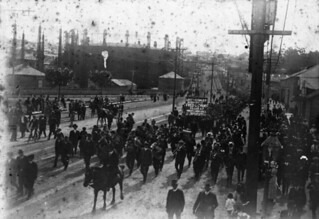
The first key lesson in the pamphlet is this: “The union side’s mustering of financial aid to prevent the strikers from being starved back to work was not equal to the brutal intent of the goldmining companies. Only by drawing other workers into the struggle could the capitalist class have been strategically outflanked and the Waihi strikers defended from violence.”
The second key lesson is about why other workers were not drawn into the struggle.
The Red Feds, to which the Waihi Miners’ and Workers’ Union belonged, did not represent the majority of union members. “By February 1912 the Federation had 43 affiliated unions with 15,000 members out of 67,000 unionists all told.” A larger number belonged to arbitrationist unions, grouped together under local Trades and Labour Councils.
“The Federation of Labour was known as the ‘Red Fed’, with good reason: the Socialist Party and the Federation of Labour were intimately bound together.” The Red Feds’ constitution proclaimed: “Instead of the conservative motto: “A fair day’s wages for a fair day’s work,” our watchword is “Abolition of the wages-system.”
On the other hand, the Trades and Labour Councils were connected to the United Labour Party, a forerunner of today’s pale Labour Party. Under this collaborationist leadership, appeals for solidarity met responses like the one from the Wellington Trades and Labour Council: “we are not prepared to assist in any way, nor can we recommend our affiliated unions to render any assistance.”
Yet the pamphlet also argues that, “the tactics pursued by the leadership of the Waihi Strike were fatally flawed.”
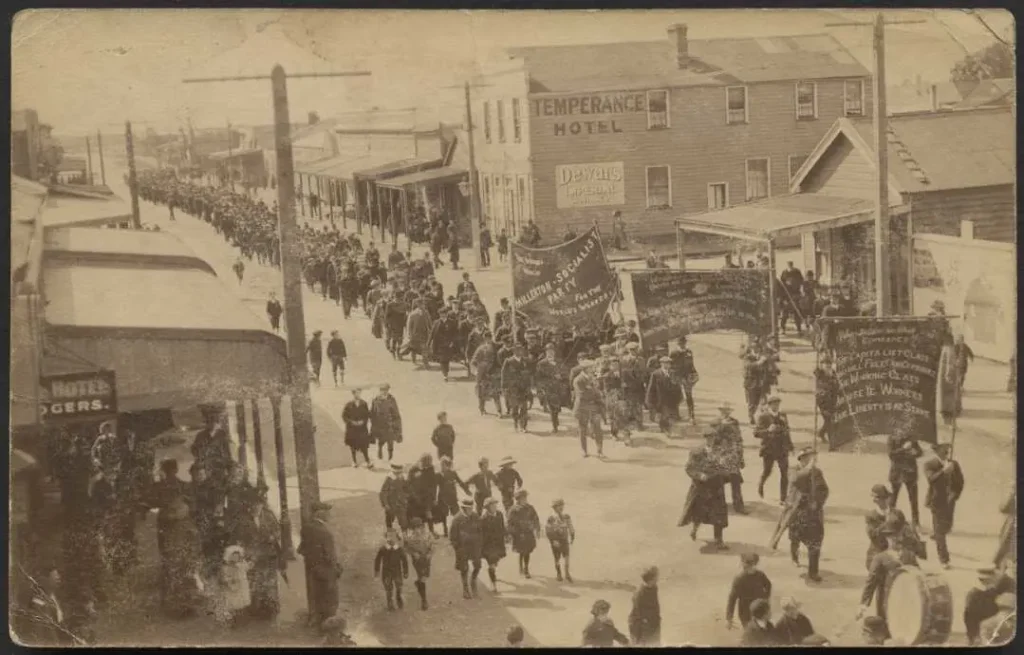
Founded in 1901, the Socialist Party was “nominally Marxist and revolutionary”, yet it “contained a diverse range of reformist and revolutionary tendencies.” Some members also showed signs of a white supremacist colonial mindset, hindering the party’s ability to unite Māori and Pākehā.
Even among the revolutionaries there were three competing schools of thought. “The first attached equal weight to the twin pillars of revolutionary politics and industrial unionism.” “The second strain of revolutionary ideology took only one of the two wings, industrial unionism, and placed it at the centre of the struggle for socialism.” Swayed by these syndicalist ideas, the second group downplayed the critical significance of developments in parliament. The third group made the opposite mistake, eschewing industrial struggle, believing instead that, “the revolution would be achieved by a class-conscious working class via the ballot box.”
Increasingly divided among themselves, the Socialist Party leaders in the Red Feds wavered at critical moments, failing to take decisive action and draw other workers into the struggle. At one point boasting a membership of thousands, by the end of 1913 the Socialist Party had largely collapsed.
The Significance of the 1912 Waihi Strike concludes with this:
“The Waihi Strike and the Great Strike of 1913 took place when the New Zealand working class reached unparalleled heights of militancy that have not been matched since.”
“The strike precipitated the process by which the working class rid itself of the hold of Liberalism and hence forward increasingly support its own party for decades to come. However, this party would be the Labour Party, so very different to the Socialist Party that had inspired so many workers to fight for the replacement of capitalism with socialism. Frederick Evans, the Waihi strikers and their families will be avenged when once again the working class has a party dedicated to the abolition of the wages system.”
The Significance of the 1912 Waihi Strike, 2nd Edition, by Martin Gregory is published by the International Socialist Organisation Aotearoa. If you are interested in a copy, please contact contact@iso.org.nz