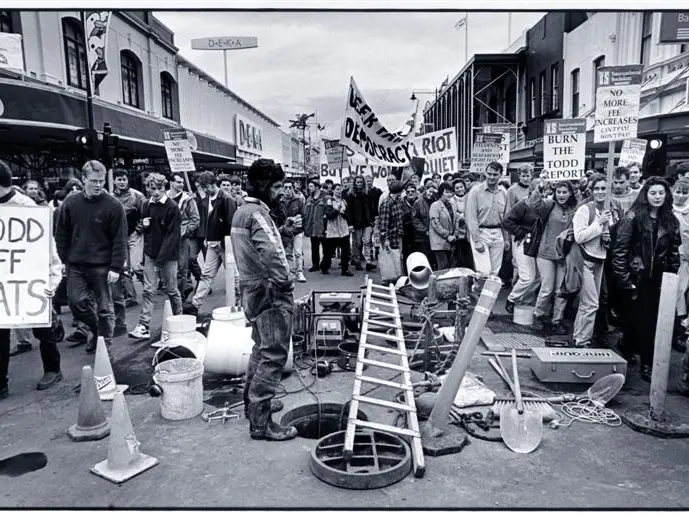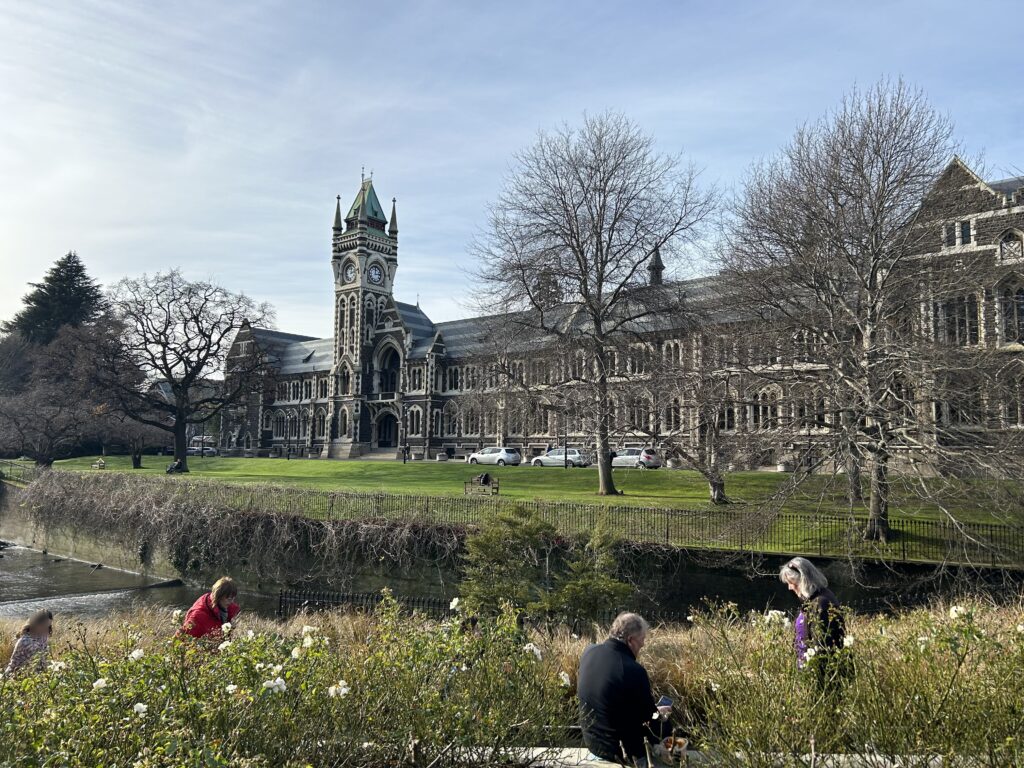
Universities in New Zealand today are well-known to be structurally underfunded, being handed funding shortfalls (in real terms) by consecutive governments. That puts these institutions in a precarious position: balancing staff, student, and alumni interests, while securing funds in a market-driven world. From neoclassical liberal grounding, to Keynesian economy-funded mass institutions, to the neoliberal university, higher education in New Zealand has moved through various forms over its roughly century and a half of existence. Today, our institutions risk becoming entirely subservient to the interests of state and market collaboration – including the rotten Five Eyes-aligned military-industrial complex.
How Did We Get Here?
New Zealand’s first university was the University of Otago, founded in 1871, following campaigns by European settlers. Thomas Burns, for example, wished to import the higher education he valued to the fledgling colonial project, while Edward Gibbon Wakefield’s neoclassical liberal theories called for an educated, homegrown ruling class as well as a more populous and landless working class. Wakefield’s fantasy of building a society free of Britain’s class conflict (noting here the irony, given his advocacy for the dispossession of Māori) was predicated on egalitarian ideas of broad access to higher education, though in reality, universities continued to function as a reproduction of the ruling class, much as they had done in Britain. Wakefield’s belief in a classless meritocracy, and the adoption of this belief by the settling classes, can be understood through the lens of Giddens’ well-known assertion:
…class awareness may take the form of a denial of the existence or reality of classes. Thus the class awareness of the middle class, in so far as it involves beliefs which place a premium upon individual responsibility and achievement, is of this order.
Throughout the late 1800s and early 1900s, universities were mostly funded by meagre government grants, and fees from students who could afford to pay them.
While growth in university attendance tapered off in the leadup to and during the Great Depression (and teachers’ colleges even closed due to the inability of graduates to find employment), brighter prospects were ahead in the post-war boom of the late 1940s through to the 1970s.
During New Zealand’s post-war consensus, social democratic values were made reality through Keynesian economics. Progressive taxation funded strong investment in the public good, including tertiary education, which came to be viewed as a right of citizenship which generated positive externalities for all of society. In this period, New Zealand’s universities transformed over time into mass institutions, both providing an education for the ruling class of the next generation, as well as more broadly generating a skilled labour force with more highly productive labour. As the broader economy flourished in this post-war period, consecutive governments were able to generously fund tertiary education without also significantly increasing that funding as a proportion of GDP, and so this funding was sustainable and relatively free of political challenge.
This stability was threatened following the long 70s as the post-war focus on collective societal interest was eroded and slowly replaced by individualised thinking, especially in the world of bourgeois economic theory. Eventually in the late 1980s, this coalesced as a fully-fledged neoliberal revolution. Brian Roper summarises this succinctly:
…the prolonged economic crisis, union power being undermined by mass unemployment and anti-union legislation, the growing industrial militancy and political influence of employer and business groups, the paradigm shift in economics from Keynesianism to neoliberalism and the highly-centralised unitary institutional structure of the NZ state, were major factors causing the historic shift in politics and policy-making from Keynesianism to neoliberalism.
At this point, the height of student activism in the 60s and early 70s was in the rearview mirror. Heightened assessment workloads had led to the lively campus life, self-organisation, and political activism of students being slowly replaced with more intensive study and gradual atomisation of the student population.
The neoliberal view of tertiary education represented a complete break from the Keynesian ideas that preceded it. Rather than a right of citizenship that contributed to society, tertiary education was now sold as a commodity. Rather than learners, thinkers, and an investment in skilled labour, students are consumers to be attracted, who take on massive debt in pursuit of higher future incomes.
Rather than regulate the growing private tertiary education sector, the New Zealand Treasury argued instead to embrace free market ideology (and the large-scale reduction of student funding this entailed), asserting that:
Central decision-makers and government funds can no more realise the full diversity of latent demand for tertiary education than government soup kitchens could realise the dining demand of Wellington.
This laid the groundwork for the “neoliberal university”.
Elected in 1999, the fifth (Clark) Labour government reformed the existing neoliberal framework, but did not challenge it. In 2002, the Ministry of Education named one of the new focuses of tertiary education “Stronger linkages with business and other external stakeholders”. In 2002, the government introduced the Performance Based Research Fund (PBRF) to allocate funding according to research productivity. In 2003, the Labour government established the Tertiary Education Commission, a body whose function is ostensibly advice and implementation of tertiary funding matters, but whose legacy is the implementation of austerity. In a 2023 aide memoire (which to this date has not been released in its entirety) the Tertiary Education Commission supported sweeping cuts to the tertiary education sector.
Like many capitalist ruling classes across the globe, John Key’s National Government responded to the post-Global Financial Crisis’ long recession with a campaign of neoliberal austerity after an initial period of stimulus. The financial result of this government’s nine-year series of targeted attacks on tertiary education funding and student support was a historical level of underfunding. The Tertiary Education Union stated in 2018:
Funding to tertiary education has been held constant since 2009, meaning that as the costs of running the sector have increased public institutions have not been able to keep up. Over the last 9 years this has led to a shortfall of $3.7 billion.
Alongside this underfunding came two devastating attacks to democracy on campus: the introduction of Voluntary Student Membership which siphoned power away from student unions and left them more reliant on the goodwill of their associated university than ever before, and then-tertiary education minister Steven Joyce’s reforms to university governance, which stripped away representative positions on university councils and increased the proportion of government-appointed positions on those councils.
The following Ardern-Hipkins Labour Government made a series of promises to begin tackling the paradigm of the neoliberal university, including fully-funding three years of tertiary education. This promise was famously broken in the wake of the COVID-19 pandemic. The inflationary crisis that followed resulted in hundreds of millions of dollars being reappropriated away from tertiary education, while the University of Otago, Victoria University of Wellington, and Massey University endured hundreds of job cuts throughout 2023 and beyond.
The Threat:
While tertiary sector funding has declined in real terms overall, the damage has not been felt by all disciplines. STEM subjects in particular saw increases in funding even when funding to other disciplines was frozen.
Roper argues:
As the partial autonomy of universities from business and government has been reduced by the neoliberal restructuring of tertiary education, and as neoliberal public sector management has been implemented, universities have become increasingly authoritarian and coercive spaces…
The number one priority of the TES [Tertiary Education Strategy] is ‘delivering skills for industry’ involving “more explicit cooperation between industry and TEOs [Tertiary Education Organisations] about the types of skills that are most needed, and how best to develop them. TEOs need to create opportunities for industry involvement in planning and delivering education”…
University staff have become increasingly concerned about “the ascendency of entrepreneurial university managers who emphasise a market-based rationality in which education becomes a consumer good, and who have a correspondingly anxious eye on consumer satisfaction and public relations as well as governments concerned with fiscal constraints, corporate ties and short term priorities [according to a 2014 TEU report]”.
In other words: the ideological hegemony of the market has become the primary driver of education, on a system-process level. While individuals in specific roles may hold dissenting views, they are functionally stripped of actualising these ideas in the face of neoliberalism. Our universities are required, by virtue of the financial precarity placed upon them, to go begging cup-in-hand to whomever offers enough money. If it is the state offering that money for a specific project, it would be very difficult for a university to turn down such an injection of funds.
This is a troubling truth in the present national and broader geopolitical moment. Nation states across the globe are investing higher levels of state funds into the military-industrial complex. In NATO states, this is at the behest of the United States of America, while other states are gesturing at heightened sabre-rattling of the great powers and outright imperialist aggression as evidence of a world that is a “more volatile place” that requires more firepower as a deterrent. Labour and National of course differ in their rhetoric, but both parties support increasing funding to the so-called defence sector, implying that New Zealand could be an unaligned military power. The reality of course is that the US empire is atrophying, and the New Zealand ruling class is scrambling to re-align its position in the imperialist pecking order as the world stage shifts around them. Paris Marx summarises this, stating:
Since Trump’s return to office, governments have been ramping up defence spending to ensure they can defend themselves in a world where the United States is no longer a security guarantor and possibly even a security threat.
In 2025, the University of Otago announced its partnership with Palo Alto Networks (PANW) to co-develop “cybersecurity programmes”. It should be noted here that in the context of modern warfare, cybersecurity and cyberwarfare are inextricable. In a painful AI-generated slop statement, New Zealand’s Palo Alto country manager Misti Landtroop states:
Our partnership with the University of Otago is designed to bridge the gap between academic theory and real-world defence. We see a massive opportunity for students to engage directly with industry leaders. This isn’t just about guest lectures; it’s about creating a pipeline from the classroom to the front lines of global cybersecurity.
Palo Alto Networks grew out of the infamous intelligence division “Unit 8200” of the Israeli military, a unit which has developed and deployed artificial intelligence systems to create targets and “kill lists” during the Gaza genocide, such as the psychotically-named “Where’s Daddy?” system. PANW’s research and development lab is located in Israel to this day, despite it now being headquartered in the US. It was also recently dual-listed on the Tel Aviv Stock Exchange, making it the largest company by market capitalisation on the TASE. Over the last decade or so, PANW has scooped up many of the world’s largest cybersecurity firms with a total price tag in the billions, including the recent acquisition of CyberArk, an Israeli firm run by Unit 8200 veteran Udi Mokady. In fact, with this latest acquisition, the US tech sector now employs over 1400 Israeli intelligence veterans/reservists. The real number is undoubtedly higher, given that this number is based on publicly available information. This is an unprecedented level of association between Silicon Valley and the IDF.
Paul Biggar, head of activist group Tech for Palestine, says:
These acquisitions are a way to take people from Unit 8200 in Israel, and bring them into influential positions in the U.S. tech industry. These companies handle their customers’ customer data. If you are a bank, and you are using Palo Alto Networks, the data about all your customers, and their transactions, are passing through servers that are controlled by spies, or former spies.
That list is now going to include the University of Otago.
Alarmingly, the University of Otago has also responded very positively to a New Zealand Defence Force Request for Information. The response outlines the University of Otago’s appetite for hosting a “Tech Accelerator” (the same language used in the Ministry of Defence’s 2025 Defence Capability Plan (DCP), which is considerably shrouded in opaque technobabble). Among other things, the University of Otago states that its tech accelerator could focus on:
Offensive Weapons Tech: The DCP calls for enhanced strike capabilities, and a DTA could evolve concepts out of a locally conducted fundamental science to deliver on this requirement.
There are countless moral arguments that could be levelled against the knowledge production of research institutions being literally weaponised, but this article takes as granted that on the socialist Left it is well understood that New Zealand is an imperialist nation. It is integrated into the West-aligned geopolitical bloc through defence agreements and spy agencies, with support for this imperialism clear by both major parties and beyond, and will intervene in the South Pacific when needed.
What is to be Done?
In this context, it is understood that New Zealand is likely to enter the theatre of war when the US empire fractures and demands support from its allies in the imperial core. If and when New Zealand once again enters the fray of an imperialist war, our role as socialists in this country is to engage politically in revolutionary defeatism: the call to defeat our own government and build independent class power instead. In the meantime, an arms economy in obvious service of global imperialism must be opposed by “formal” methods in our institutions (trade unions, student lobbying, academic senates), and otherwise.
This is easier said than done. New Zealand’s trade union movement is still recovering from its destruction at the hands of the Employment Contracts Act 1991, slowly building its strength. The rank-and-file membership has not reached the level of consciousness and confidence necessary to use its strength beyond the straitjacket of current employment relations legislation. But there are signs of hope that must be encouraged, such as the NZCTU’s effective endorsement of the Palestine liberation movement in supporting mass anti-genocide mobilisations in 2025.
We should agitate for industrial action, even where it is illegal, against the slow integration of death machines into our workplaces. This is aspirational, of course – depending on the conditions, a call to strike without sufficient organising and confidence can be merely ultra-left grandstanding. Where broad action of the rank-and-file is not possible, staff at institutions like the University of Otago should intervene using the democratic channels that do exist. Leverage council meetings, senate bodies, and forums. Organise and make the case at academic seminars. This is likely to be slow, thankless work, but once militarism is openly embraced in our institutions, it will be very hard to reverse course.
While lacking workers’ level of power at the point of production, organised students can act more radically and disruptively without risking their livelihoods. Taking advantage of speech protections in the sector, students can leaflet, hold teach-ins, and co-organise with staff. In order to halt further integration of the university and military-industrial complex, especially in a situation where a university is committed to doing so, students will need to educate their peers, mobilise en masse, and disrupt university business-as-usual.
As US global hegemony atrophies, we will witness a continuing tendency towards wide-reaching militarism in the name of “national security/interest”. If we do not want our work to contribute towards war, death, and the machinery of imperialism, then we need to consciously conceptualise ourselves as the vanguard of its counter-tendency: working-class anti-war militancy.