Capitalism is destroying our planet. Unlike any system before it, capitalism treats the Earth as a “free gift”: something with no value except to be carved up, exploited, and sold no matter the environmental or social cost. Capitalism not only abuses the worker, but also the planet as a whole. This article discusses the socialist perspective on the environment and considers how a socialist economy might supersede the present system of exploitation.
How Does Humanity Fit into Ecology?
As a materialist, Marx understood the relationship between society and nature as being based on flows of matter and energy. The concept and field of ecology expresses this well: it describes networks of material exchange and interaction between organisms, and how these change in time and space. Ecology encompasses plants and algae, herbivores, carnivores, parasites, and decomposers. Each of these categories of life implies a relationship – one born from solar energy and mineral earth that flows through each organism in the biosphere.
Just like any other species, humanity has a material relationship with the biosphere. Describing the relationship between humanity and nature, Marx used the term “metabolism” – the same term used for the process that turns food and water into energy in the human body. Using our labour, we interact with, modify, and use nature for our needs: materials are taken from nature, changed, and circulated throughout society. Marx described this process as a social metabolism; humanity takes up material from nature, uses it, and expels waste back into nature.
Humanity’s relationship with its ecological context is historical and dependent on the mode of production. Prior to capitalism, most production occurred at a small scale through the labour of mostly self-sufficient families. These people fit into various classes, such as peasants, serfs, and tenant farmers, who continue to exist in many places. In Europe, landless peasants grew food for their households but paid rent to aristocrats who owned the land. Production was small-scale, local, and generally kept sustainable through soil management and crop rotation. In general, non-agricultural spaces (like forests and bogs) were important for rural communities as long-term sources of food and fuel. These important spaces were increasingly overexploited by militaries for wood and steel for expansionist conquest, or converted to agriculture. These purposes were against the interests of the masses, led by the desire of lords to expand their area of rented land.
In Indigenous societies, like pre-European Aotearoa, people generally lived more closely within the limits of nature. In many places, first arrival of humans was followed by waves of extinction of large animals, deforestation, and local depletion of resources. However, over time Indigenous societies tended to adapt their production for their new context. In the case of Aotearoa, this meant establishing new styles of horticulture, learning how to use new materials, and developing restrictions (such as rāhui) that enabled society to use resources without depleting them. Nature had to be valued and sustained for the survival of society.
As capitalism emerged from the feudal rule that came before it, the relationship between society and nature changed. Most of the population was torn from the land, often violently, and forced into cities to staff the growing industries ruled by wealthy industrialists (the ancestors of modern capitalists). This process was repeated through colonisation, with the victims being Indigenous people rather than peasants. The result is that nowadays most production is controlled by an extremely small number of people in the interest of financial profits.
How Does Capitalism Relate to Ecology?
Despite our increasingly complex and detailed understanding of the world around us, capitalism is unable to ground itself in an ecological context. Capitalists cannot view themselves as part of nature, because to them nature is something to be exploited to produce private profit. Wild organisms and systems are viewed primarily as resources and service providers for capital, rather than entities with intrinsic value.
The lion’s share of society’s relationship to nature is governed not by democratic collective decisions, but by capitalists. Most production and extraction is privately owned and used only to generate profit. Extraction is concentrated in parts of the world that are the cheapest to exploit – usually the Global South, while consumption is concentrated in the Global North. Waste produced by the system is let loose into the air, rivers, and oceans, buried in landfills, or shipped across the world to be processed in the cheapest place to pollute. The metabolic cycles of humanity are thus unequal, leading to the depletion of resources in some places, and the proliferation of waste in others. This is referred to as the “metabolic rift”, a concept derived from Marx’s analysis of capitalist agriculture. Capitalists alone profit from this, with the costs being forced onto the rest of the planet and society. For extraction to be sustainably managed by industry, it must be profitable to do so. Because capital is highly mobile, capitalists can bypass the need to function sustainably. They invest when it is profitable, but can sell up and reinvest elsewhere when resources run low. Capitalists compete to extract the most efficiently, using up resources before anyone else can access them. In contrast to capitalists, the interests of the masses are in retaining resources for future generations.
Reformists will argue that all that’s needed is to regulate industry. While this is partly true, serious reforms are rarely possible outside of times of plenty, and no reform is permanent. Far from being truly democratic, our world is ruled in the interests of a remarkably small number of people. To maintain their dominance, they use their capital to bribe political parties to act in their interests, rigging democracy in their favour. In short-sighted pursuit of profit, capitalists plunder the world at the expense of humanity and life on Earth.
Socialism and Ecology
Given the size of modern economies, our species has never been more involved in the daily lives of organisms around us. As distant as we may feel from a flower and its pollinator, a fungus and its host, or a whale and its krill, their interactions are changed by the way we consume resources, where our waste goes, and our impact on the climate. With the size of our populations and the vastness of our productive output, it is crucial that we plan our relationship with ecological systems to be harmonious and sustainable. Capitalism is inherently incapable of this.
Our planet is being destroyed by the short-term interests of capitalists from above. In contrast, our vision is socialism from below. Expanding democracy to genuinely represent the wishes of the majority is the key to changing our relationship with nature. Most importantly, to win sustainability we must focus on where economic relationships with nature occur: production!
Class struggle takes many forms. While traditional environmentalism has focused on the “consumer”, a socialist programme could go further. A socialist approach would be to fight where we have power – as and alongside workers – expanding sustainability into the processes of production itself. Through unionising, workers can fight for things that matter to them, using their power to shut down industry and win sustainable goals. This can be highly effective: in the past, unionised workers have undertaken “green bans”, refusing to work on environmentally destructive projects. However, this can only go so far. Regardless of the strength of unions, the end goal should always be revolution, to wrestle control of production from capitalists and hand it to the people who have an interest in changing it for the better.
Dispensing with capitalist control, workers could plan their extraction and production for need, not profit. All workers could be educated in science and sustainability. Through collective, democratic control, workers could combine their ingenuity to reduce waste and increase efficiency. Without the profit motive, solutions thought too expensive or unprofitable under capitalism could be realised, entirely reshaping production and the whole relationship of humanity with nature.
With an understanding that humanity is part of nature, productive spaces could be managed in line with ecological processes, increasing native biodiversity wherever it exists. Surplus time and resources could be used to repair the damage wrought by capitalism rather than being hoarded by capitalists. Imagine universal employment, with people actually being paid to clean up rubbish, plant trees, remove pest plants, trap in their neighbourhoods, or monitor endangered species (all done voluntarily today). Imagine ecological restoration on a planetary scale! Without the need to pay for pointless advertisements, profit-seeking investors, consultants, or militaries, we could downsize our production and spend vastly more on repairing our relationship with the environment.
Socialism is the only sustainable solution: Socialism for a Green Tomorrow!
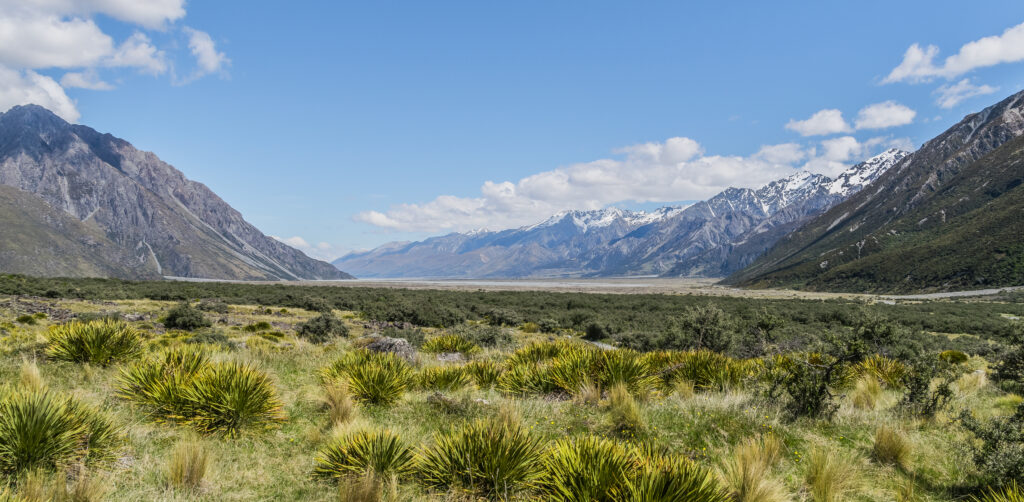
Banner Image: Tasman River valley in Aoraki National Park, Te Waipounamu, Aotearoa. Photo credit: Krzysztof Golik, Wikimedia Commons.