The following was presented as an introduction to a discussion session during the ISO hui-ā-tau in January 2026. An audio recording of this talk is available here.
Hopefully through this introduction and subsequent discussion, we’ll orient ourselves toward tomorrow’s consideration of motions relating to the upcoming 2026 New Zealand General Election. The goal today isn’t to discuss any one particular motion, but to broadly consider the socialist approach to such elections. With that in mind, I don’t expect anything I provide here will be particularly controversial (correct me in discussion if that’s not the case, of course).
Broadly speaking, as socialists we’re in favour of democracy and electoral processes. Our goal of an emancipated future is contingent on ultimately the vast majority of people having an equal say in affairs. Organising toward that future, socialists attempt to implement democratic decision-making processes – numerous examples of such are described in the ISO’s constitution, and are present in this very hui. For now, our organisation is small enough that we have attempted to bring every member from across Aotearoa to our hui-ā-tau – the annual conference – to participate in democratic decision-making. Presence at this hui allows each member a vote on motions that might alter our constitution, on motions which determine our political priorities or messaging for the subsequent year, and in the election of a Coordinating Committee and Appeals Committee. The Coordinating Committee serves as a key part of our democratic centralism – this body is the editorial committee for our major publications, the convener of the next hui-ā-tau and intermediate opportunities for organisation-wide discussion, and is responsible for representative external-facing communications with other organisations. The Appeals Committee provides a centralised “safety net” for the branches’ dispute and disciplinary processes. There are tweaks we might make to our organisational democracy over time, but this provides an inspiring seed for how we envision a socialist world.
The 2026 New Zealand General Election
On the other hand, the upcoming General Election, announced for 7 November 2026, is missing many of the hallmarks of true democracy. This is what we call bourgeois democracy: the democracy which is offered to us while we remain under the control of the bourgeois, or capitalist, class. There is a surface level opportunity for “everyone” to “have their say”, but this “opportunity” has been carefully curated by the capitalist class to ensure that no real threat is posed to their rule.
Numerous barriers to voting have been put in place, including: the The Electoral Amendment Bill which passed its third reading in December 2025 and which denies a vote to prisoners serving sentences less than three years; existing provisions in the Electoral Act 1993 which already denied a vote to prisoners serving sentences longer than three years; system errors that result in removal from the electoral roll; and other Electoral Amendment Bill changes which reduce enrolment flexibility in the period before an election. That’s to say nothing of the limited political options: New Zealand’s current party options arguably range from far-right capitalism to gentler Green capitalism.
There is a massive imbalance of party funding, with coalition partners National, ACT, and New Zealand First raising twice as much between them in 2023 as did Labour, the Green Party, and Te Pāti Māori combined ($16.6 million vs $8.3 million). Then the bourgeois media plays its role in reporting “business confidence”, threats of social policies to “the economy”, and so forth – sewing doubt amongst left-leaning voters and making the further-right parties seem to be a “sensible option”.
So this electoral system is designed to ensure the continuation of our own oppression, while placating us with sufficient illusion of empowered choice. Often, the response of the disillusioned is to opt out of voting altogether. In the 2023 General Election, 22 percent of enrolled voters – over 800,000 people – didn’t cast a vote. An estimated further 500,000 people are eligible to enrol but are not enrolled to vote. Thus, around 1.3 million people, or a third of the eligible population, don’t cast a vote.
What’s a socialist to do?
Thus far I’ve laid out the problem. But we’re not just here to examine problems with disinterest, or to simply whinge about the problems. Our analysis should always be a means to bring us toward decisions and useful action. So here’s a quick, non-exhaustive list of some possible responses, posed as questions to this conference:
- Do we opt out? Because of a nihilistic realisation that there is no point in involvement? On principle? As a tactic?
- Do we try to undermine the process? Demonstrate outside polling booths?
- Do we make a call against a party or parties? How much effort/resource do we put into a campaign against them?
- Do we make a call for support of a party or parties? How much effort/resource do we put into a campaign in support of them?
- Do we mobilise in support of a particular party?
- Do we stand our own party for election? As the ISO alone? In a combined formation with other groups?
Decisions on at least some aspects of our response will come tomorrow when we discuss various motions which intersect with some of these ideas. For the remainder of my time as introducer of this session, I’d like to offer up considerations on some particular aspects of these ideas.
Against nihilism, against dogmatism, against accelerationism
I argue the outcomes of bourgeois elections nonetheless matter. The system might be rigged, but it’s not a game. The sustained, and frankly horrifyingly effective, attacks on the working class by the current coalition government have been a setback in many ways – not least of all the material effects on many peoples’ wellbeing, health, and ability to engage meaningfully in society. It’s hard to find recent data. Ministry of Social Development reports on child poverty are only available through to 2024, and the latest report on household incomes and income inequality is from 2018. But we do know that under this government unemployment has been consistently rising, taonga Māori such as Te Reo have been under threat, the Māori Health Authority was disestablished by an amendment bill whose name literally translated to “demolish health”, and social services have been cut while we’ve simultaneously seen harsher prison sentences and increasing incarceration rates. Compassion alone demands consideration of the very real human gains or costs in terms of human wellbeing, risk, or suffering. The issue of which bourgeois government is in power is worth caring about, is worth engaging with in a real sense with evaluation of contemporary issues and strategies.
Our capacity to challenge
Paul D’Amato, writing in the International Socialist Review, introduces us to an argument from Karl Marx for running in bourgeois elections:
In addition to arming themselves and organizing centralized and independent clubs, the workers’ party should put candidates up for elections in Germany in the event of the creation of a national assembly as a result of revolutionary upheaval: ‘Even when there is no prospect whatsoever of their being elected, the workers must put up their own candidates in order to preserve their independence, to count their forces, and to bring before the public their revolutionary attitude and party standpoint. In this connection they must not allow themselves to be seduced by such arguments of the democrats as, for example, that by so doing they are splitting the democratic party and making it possible for the reactionaries to win. The ultimate intention of all such phrases is to dupe the proletariat. The advance which the proletarian party is bound to make by such independent action is indefinitely more important than the disadvantage that might be incurred by the presence of a few reactionaries in the representative body.’
We have just over 50 members across Aotearoa. I was not able to find membership figures for German socialist parties in the mid 19th century, that time at which Marx was making the above address; certainly by the late 19th and early twentieth centuries European socialist parties’ membership was in the tens and hundreds of thousands. I strongly suspect Marx may have been considering larger formations than ours. And we don’t presently have the strong connections with unions or other organisations that would allow us to make up large numbers.
Our numbers, our capacity, and the reach of our propaganda is limited. Our Socialist Alternative comrade Mick Armstrong, in the 2008 argument From Little Things Big Things Grow: Strategies for building revolutionary socialist organisations, argues against organisations such as ours having too inflated a belief in our capability to effect immediate change:
If we look at the history of the socialist movement, we can see that one of the key reasons why so many small revolutionary groups came to grief is that they overestimated their own capabilities and greatly exaggerated their ability to influence struggles or campaigns. All too often they attempted to leap over the stage of development dictated by the balance of forces between bosses and workers and the limitations imposed by their own small size. They were too impatient. They often spurned the conception of being a propaganda group and tried to act as “agitational groups”.
So we should be realistic about our ability to stand up candidates or a party, and we should be patient. The efforts of the Victorian Socialists – now expanded to being the Australian Socialists – are admirable in terms of bringing socialist ideas to peoples’ front doors and social media feeds. But we should take realistic stock of our own numbers, networks, and capacity, and consider what other activities we might need to lessen in order to run such a campaign.
Our capacity to intervene
Finally I suggest we should consider the capability and limitations of the tools at our disposal, and the other tasks which we also consider important. Whatever the decision we reach on a “line” for the upcoming General Election, how many people do we think we will sway to our side with that line? Do we expect to affect the election outcome? We have a reach of perhaps thousands, optimistically considering our various social media, emailing lists, and newspaper. We certainly have some reach and some sway. But again we should not overestimate or overstate our present capabilities.
Similarly to Marx’s words on standing candidates, there is also the real possibility of engagement in the electoral campaign process in a way that aims to draw people to our wider project. In the long term, our goal differs from simply bringing a preferred candidate or party to power. We should consider whether any particular electoral line can be the start of a conversation to lead that conversation to socialist politics and hopefully membership in the ISO. At the same time, if the electoral line was simply a hook, we should avoid the temptation to demonstrate only superficial political correctness which serves only as a form of “clickbait”. After all, we want to continue to be perceived as a serious political organisation rather than a meme.
This is where we have landed at least during my time in ISO: putting forward political lines which guide our placards and our communications, aiming to draw in ones and twos to further engagement with our analysis. In 2023, we argued “Keep National Out, and Build a Socialist Alternative” and also “Vote Green or Te Pāti Māori, and Build a Socialist Alternative”. In 2020, our line was: “Vote Labour, but Build a Socialist Alternative”. Despite our obvious failure to keep National out in 2023, we have remained consistent in our efforts to build that socialist alternative to bourgeois electoral politics. How we wish to continue those efforts is for this conference to decide.
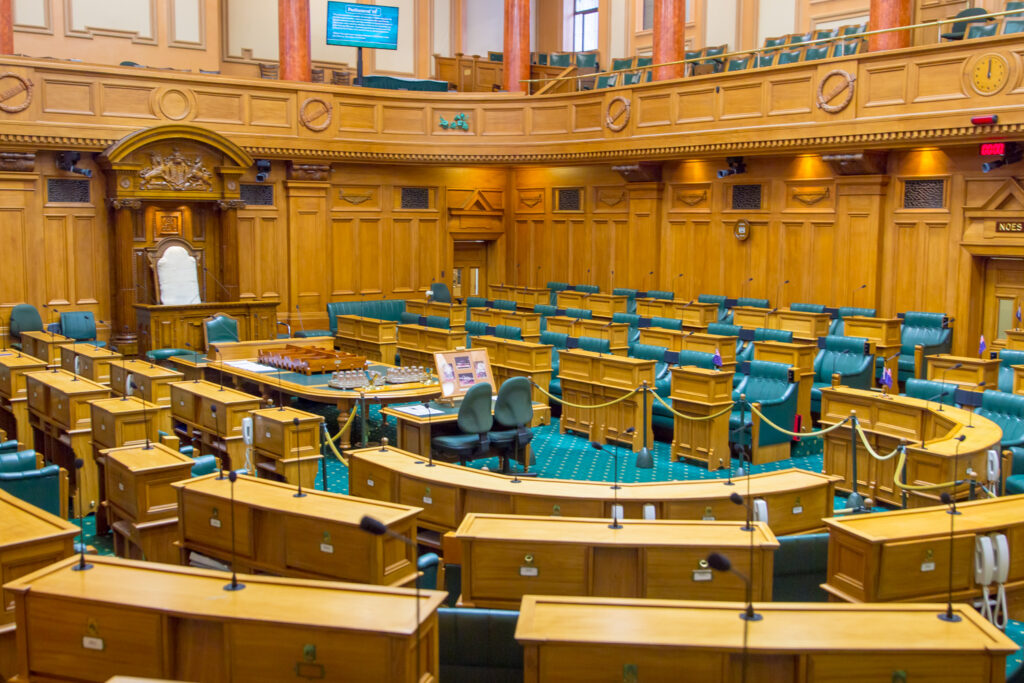
“New Zealand House of Representatives debating chamber” by is licensed under CC BY 4.0