This article was originally published 4 August 2025 in Salient under the title “It’s Right to Strike!”. It has since been edited and updated.
On 30 June more than 36,000 nurses, midwives, health care assistants and kaimahi hauora went on strike for 24 hours after an insulting offer from the government.
That offer for their new collective agreement? A measly 2 percent pay rise from June 2025, and a further 1 percent from June 2026. Because this pay “rise” is below inflation, it’s a pay cut in real terms. In another step back, the June offer removed Health NZ’s obligations to consider safe staffing evidence.
Continued understaffing will mean nurses become stretched even more thinly, and more patients get put at risk.
As the nurses’ union (NZNO) Kaiwhakahaere Kerri Nuku explained last September, “our health system is in total decay, and as nurses we grind ourselves to a pulp to try to fill the gaps. We are pushed and pushed, to tears, to breaking point, to burnout or worse, and still we’re utterly devalued and sidelined.”
The working class is always expected to absorb the shocks of capitalism in crisis, and strikes are one of the most effective ways the working class has of fighting back. Every strike reminds the employer who really makes the wheels turn, and reveals to the workers their collective power.
In this way, strikes are not just means to win: they are victories in themselves. In practical terms they teach us how to write effective slogans for picketlines, perform speeches at rallies, and make political arguments about our jobs. In deeper ways, they build class confidence and strengthen solidarity.
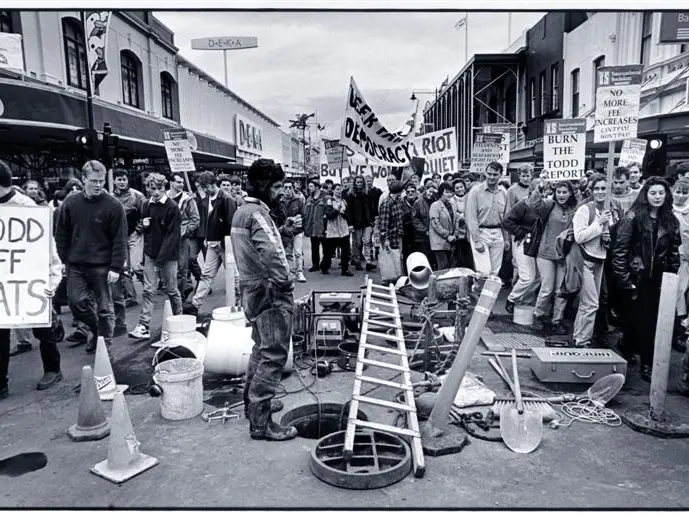
Thanks largely to the Employment Relations Act 2000 and Employment Contracts Act 1991, which both delivered devastating changes to workers’ rights, many of these lessons have been lost. Workers throughout the 19th and 20th centuries struck to oppose racist pay gaps, military conscription, and collaboration with apartheid South Africa. In stark contrast, strike activity in recent decades has hit record lows.
Today it is legal to strike only during collective bargaining (after 40 days, and if a majority of union members vote in favour) or over immediate workplace safety concerns. Striking over political issues, disputes, or in solidarity with other workers, is illegal.
Illegal strikes – called wildcat strikes – however, are still an option. In 2002, wildcat strikes by high school teachers across the country won a vital campaign for more non-contact hours, better pay, and increased allowances. Amid fears of further strike action, threatened court action against the teachers was dropped.
Union membership isn’t a prerequisite for taking strike action – especially when wildcat strikes are considered, as in the case of Mint My Desk in Australia in 2023. But in reality the vast majority of strikes come about from collective organising through union practice and structures. This is something this government is well aware of, which is why the Employment Relations Amendment Bill, currently under consideration, seeks to undermine union recruitment by removing a 30-day rule which automatically signs employees up to collective agreements.
Similarly, this government is seeking to reinstate pay cuts for workers who participate in a partial strike, with the clear intent to deter workers from actions such as working to rule or not adhering to specific company policies. And the worst may be yet to come, as Public Service Minister Judith Collins hints at possible strike restrictions for the public sector. This could even mean a return to an arbitration model, which would remove the workers’ right to fight on their own ground.
The nurses’ strike is another boost to our confidence. With the government slashing health funding and propping up big business, united workers can force them to concede. And what can supporters do? Show up on picketlines, make connections with strikers, and spread the word in your workplaces. We have a chance to make striking a part of the future.
Banner image: June 2021 nurses strike in Wellington. Photo credit: kaitiaki.org.nz