Under the veil of an almost complete Internet blackout, the situation on the ground in Iran is impossible to meaningfully engage with at this moment. The mass protests seem to have quietened, though they will surely be sparked again in the near future, as the conditions that triggered them remain. The exact number of the thousands killed, and any political formations that have developed over these last few weeks will be revealed eventually. The broader political currents, however, are known, as are their histories.
Iran is not the caricature that is presented to us by our USA/UK-aligned news media. It is also no principled anti-imperialist force of human protection, nor are its flaws and anti-democratic crackdowns solely the result of Western intervention. It boasts extensive public infrastructure and institutions. Yes, oil production, but also public health, education and other institutions of public good. At the same time, broad sections of civil society are crushed by the boot of the state. Independent trade unions are effectively outlawed, and political activity is suppressed. Socialists operate under conditions of absolute state suppression, routine incarceration, torture, and execution.
Class polarisation in Iran is widening. The state has responded to the financial crises of the past quarter century with rounds of neoliberalism which funnel wealth upwards over time. This shifting economic paradigm has led to even some of the bazaar merchants, the bazaari, rebelling against the ruling class, despite a long history of class collaboration.
This occurs against a background of persistent ethnic faultlines. While Persians/Fars are an ethnic majority in Iran, Kurds make up a little over 10 percent of the population. Kurdish Iranians, a politically heterogenous population in itself, have been struggling against the Iranian ruling classes for a century in pursuit of recognition, civil rights, and political power. This erupted in a new flashpoint in 2022, intersecting with the Iranian struggle against gendered oppression of women, when Kurdish woman Masha Amini (or Jina Amini, her Kurdish name) died following a brutal assault by Iran’s “morality police”, triggering the Women, Life, Freedom movement. Some analysts and activists consider the 2026 protests as holding continuity with the Women, Life Freedom movement, while others are more sceptical of this claim, given the lack of concrete emancipatory demands and broad economic frustration of the current protest wave. In any case, Kurdish cities have been treated by the Iranian state as national security threats during the new wave of protest action.
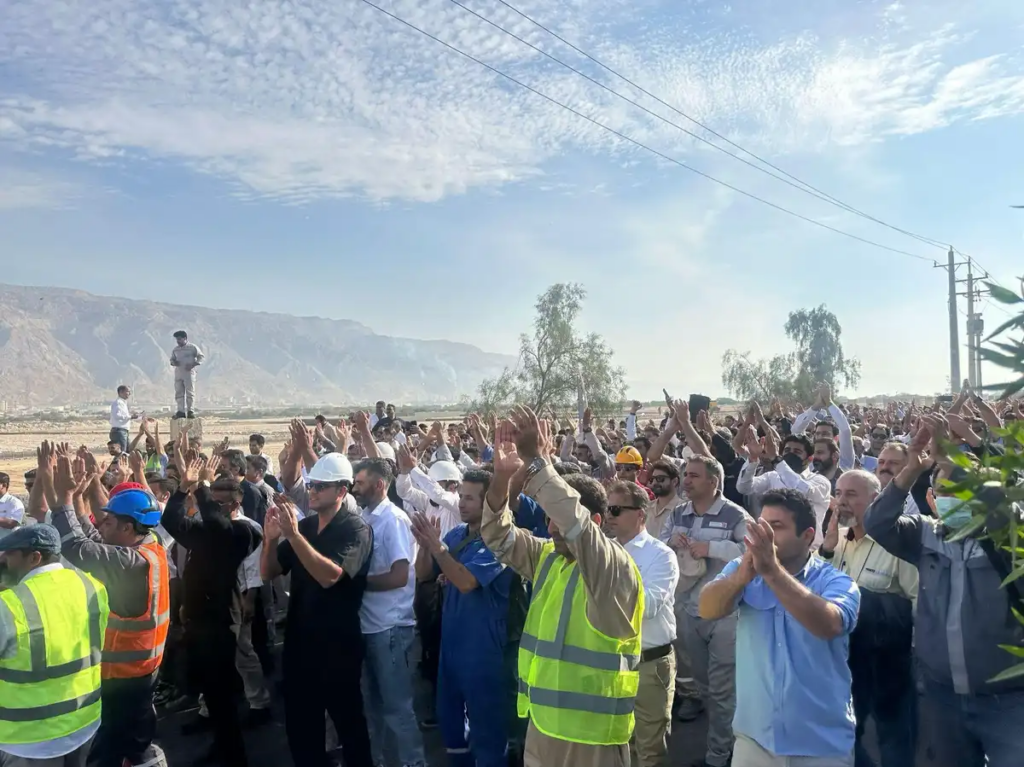
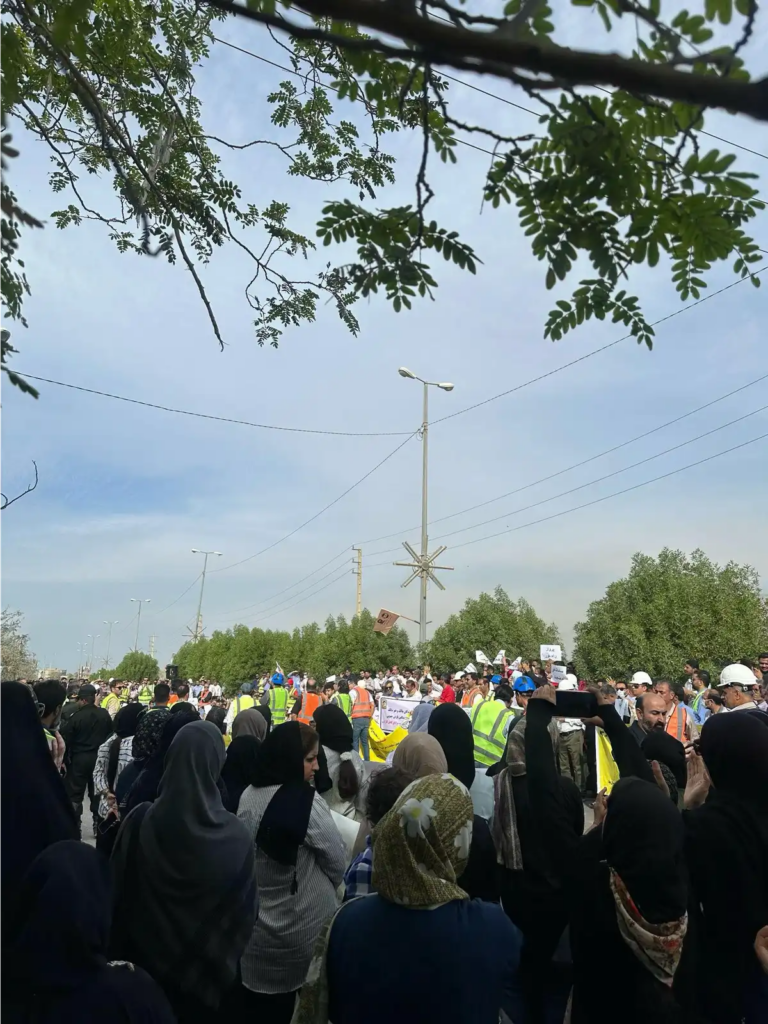
Iran has also been rocked by impressive labour strikes in recent months, particularly impressive given the anti-worker posture of the state. Working class organisation still has a terribly long way to go to reach its old heights and the strength it held when taking an active role in the 1979 revolution. There are signs of hope emerging, but they are fledgeling, and any developing working class power is likely to be once again crushed without a coherent revolutionary party carrying forward the old lessons of the class.
The Iranian people should not have to choose between two poisonous futures: a Pinochet-style “tortured and executed dissidents” neoliberal Iran; or a Libya-style “liberated” neoliberal Iran. An alternative can and must be built. We in the non-Iranian Left cannot wishfully imagine this into being. It is an inconvenient truth, but a state overthrow at this moment would almost certainly lead to capture by USA-Israeli state forces and a controllable puppet leadership. Such a state overthrow, regardless, does not seem likely at this moment, even if such an imaginary Left alternative was poised to seize power. The institutions of power in Iran, especially the powerful clerical class, state military, Basij militia and Islamic Revolutionary Guard Corps, are still perfectly stable and support the existing order.
The people of Iran have been given no choice but to rebel. Iranian-American journalist Alex Shams describes Iranians living in Iran as “caught between state repression and foreign interference”. We support the self-activity and rebellion of the Iranian working class. We have no illusions about the role of agent provocateurs in these protests, and the foreign attempts to direct their anger away from coherent class-based action and towards a more weaponisable chaos or civil war, and the failed state or Balkanisation that would follow at the hands of a West-installed puppet regime. To abandon a popular struggle because of the presence of imperialist propaganda and forces is to abandon working class solidarity itself.
No Western Intervention!
The material conditions under which Iranians live, diverse as they may be, are inextricable from the exclusively Western sanctions, especially those introduced by Obama and amplified by Trump. The purpose of these sanctions are, as always, to “make the economy scream”. This is to materially deprive ordinary Iranians while isolating the state as a whole, and weakening its capacity for self-defence, and also to generate pressure within Iran against its ruling class that can be co-opted and exploited for foreign imperialist gain. This contributes to what we see unfolding in Iran: a rare revolt by the lower strata of the bazaari class, triggered by a currency collapse and massive inflation, joined by sections of the recently-striking working class and politically-activated students.
These sanctions weaken the economy, but also in seeming contradiction, they contribute to the power of the state and especially its militarised economic stranglehold in the form of the Islamic Revolutionary Guard Corps. Shams describes this succinctly:
And although it might seem counterintuitive to Americans, Trump’s sanctions have been crucial in increasing the IRGC’s power over Iran’s economy. The IRGC is a parallel military force to Iran’s regular army. But it emerged as a major economic force when it helped reconstruct Iran’s cities after the 1980-88 Iran-Iraq War. That fueled the growth of companies affiliated with the IRGC that acquired concrete factories, quarries, construction companies, and many other types of economic enterprises.
CIA and Mossad involvement in Iran is plain for all to see. The USA and Israel salivate over the thought of an overthrown Iran, which it can plunge into indefinite turmoil, such as Afghanistan to its east and Iraq to its west. This means a corridor of exploitable chaos from the Mediterranean through to China.
This involvement comes first and foremost in the form of manufacturing support for Reza Pahlavi, the son of the deposed shah (king) Pahlavi, who was overthrown by a cross-class (but primarily an uneasy alliance between the clerics and the working class), nationwide popular revolution in 1979. That king was a brutal figure who allied with the CIA and Mossad to create SAVAK secret police, and to kill and torture dissident Iranians. In contrast to his marginal profile in Iran itself, his son is being promoted by far Right elements of the Iranian diaspora as a leader for an imagined future Iran. Mossad agents’ intervention on the ground was publicly and proudly proclaimed by Mossad at the end of 2025, and reports from Al Jazeera and Haaretz show that Pahlavi’s support has been artificially inflated.
In 2025, Iranian state forces uncovered a secret Israeli drone factory near Tehran. Only recently, USA-made weapons were found, and many of Musk’s Starlink units were seized. The richest man on earth has made a habit of picking and choosing who should have Internet access, a rotten symptom of modern global capitalism. Clearly, the goal of foreign powers is to intervene in ways which do not trigger an open war. War, such as by USA or Israeli attack, would only cause a “rallying around the flag” in a wartime nation, and much broader support for state stability (to mention nothing of the necessary military resourcing required by an already overstretched USA empire). Even gestures at reforms meant to appease protesters will no longer be forthcoming, replaced by absolute repression.
These interventions aim to co-opt and direct the Iranian struggle towards an outcome more palatable to USA-Israeli interest and must be opposed without exception. Any support of the Iranian protestors must be coupled with this condemnation of foreign intervention. This includes opposing New Zealand’s politicians who advocate for such intervention. As an imperialist force largely subservient to the USA-led empire, our own ruling class supports measures such as sanctions and intelligence-sharing which restrict the space for material solidarity with the Iranian working class and support Western attempts to wrangle the sovereign nation into a more vulnerable position.
Against Campism and Anti-Intellectual Evasions
Iran is a living society: a confluence of social structures, ethnic identities, political currents, class layers, and civil society groups. The obfuscation we are seeing, whether by the CIA and Mossad, the ruling bourgeois-theocratic class in Iran, or campist “socialists” is anti-intellectual and anti-human. Every slain Iranian is as much a full human as every person who is killed in USA ICE “detention”. If you respond to every murdered socialist, every disappeared musician, or every student and wage worker unaccounted for as either a psyop or the fault of the Western empire, then your politics have stripped you of your humanity – your love for your international comrade has been shelled out and replaced with a pre-written dogma. We oppose the anti-intellectual flattening out of conceptualisations of Iran to a mere stage on a geopolitical chessboard in which Iranians are at best political pawns; or at worst are an inconvenient voice daring to challenge the killing and public hanging of their countrymen while their ruling class siphons wealth upwards.
The attempt by some sections of the Left to reduce inconvenient social movements to purely externally-manufactured “colour revolutions” is a lazy evasion, one which only serves to justify passivity and an absence of class analysis. In the context of Iran, the Islamic Republic of Iran is positioned by such thought as an “anti-imperialist” bulwark. Analysis cannot begin and end with the (essential, anti-genocide) provision of arms to resistance groups opposing Israel’s occupation and slaughter. This apologia handwaves the role of the clerical class in the crushing of genuine socialist workers’ movements following the 1979 revolutions, and asks us to relegate mass graves of communists to a barely-relevant footnote of history. Somehow this point, very recent in the eye of history, is forgotten: the current leadership of Iran is the continuation of an anti-socialist counter-revolution.
An equally egregious evasion is the refusal to examine the reasons for today’s absence of a workers’ class-based revolutionary party in Iran, and how the international Left has failed to build a project which could act in support of such a body’s development and be supported in kind. This is crucial: such an organisation can hold the memory of the class and integrate the lessons of the past, including but not limited to counter-revolution in the Middle East. It is absolutely crucial to developing the class consciousness of the workers and, in a revolutionary moment, defending against counter-revolution from within and imperialist invasion from without.
The final evasion is the refusal to articulate class struggle within Iran in the present moment, and how workers who have been dispossessed by rounds of neoliberalism should respond. This is an abandonment of solidarity with the Iranian Left: every serious socialist in Iran must resist the repression of its ruling class – no socialist will be taken seriously by their comrades during a working class revolution if they had spent their political life defending the boot of the ruling class above them. In this past wave of protests, the common deflection against the widespread character of the upheaval is to uncritically present high-definition footage of state-organised pro-government rallies released under Internet blackout, as if this propaganda invalidates the grievances of the working and middle classes, or justifies the incarceration and torture of socialist dissidents.
The Task Ahead
What socialists of all stripes can surely agree on, is that our role is to restrain the imperial violence of our own states. Sanctions should be abolished, as they deprive the Iranian people, empower paramilitary forces, and are used as a blunt instrument to manufacture and capture dissent. Any weaponisation of “anti-terrorism legislation” by the New Zealand state must be opposed: its political purpose is to justify violent intervention; empowering it only serves to strengthen its use at home.
Our purpose is not to build a perfect analytical machine capable of predicting outcomes. It is to build solidarity and space for the self-organisation of the working class – both here and abroad. The project of building a revolutionary organisation at home which can challenge the capitalist state is the single most important project any of us in this nation can expend our political efforts on.
The hope of Iran’s future comes from those political figures languishing in prison cells, workers organising in unions and fledgeling workers’ councils, and those who have been trying to develop an independent political formation despite repression. These are the future revolutionaries that international anti-capitalist parties could forge a socialist alternative alongside. This certainly could not be the case with an Iran led by the failson of a deposed tyrant king, nor Israeli and USA puppets.
The International Socialist Organisation of Aotearoa upholds these stances:
- Oppose foreign intervention – USA out of the Middle East!
- Neither the mullahs nor the Shah failson.
- Affirm the legitimate working class struggle of our Iranian comrades.
- For a socialist revolution and workers’ power in Iran!
With all of the above arguments in mind, we wholeheartedly echo the following call from our comrades in the Iranian Revolutionary Marxists’ Tendency:
Let us form a workers’ vanguard party and its military wing based on armed popular militias!
Let us prepare for the overthrow of the capitalist system and establishing a Soviet government in Iran.
Banner image: Workers at the South Pars Gas Refinery. Photo credit: Dr. Helyeh Doutaghi. Creative Commons.
Closing image: Iranian women supporting the South Pars Refinery strike. Photo credit: Dr. Helyeh Doutaghi. Creative Commons.