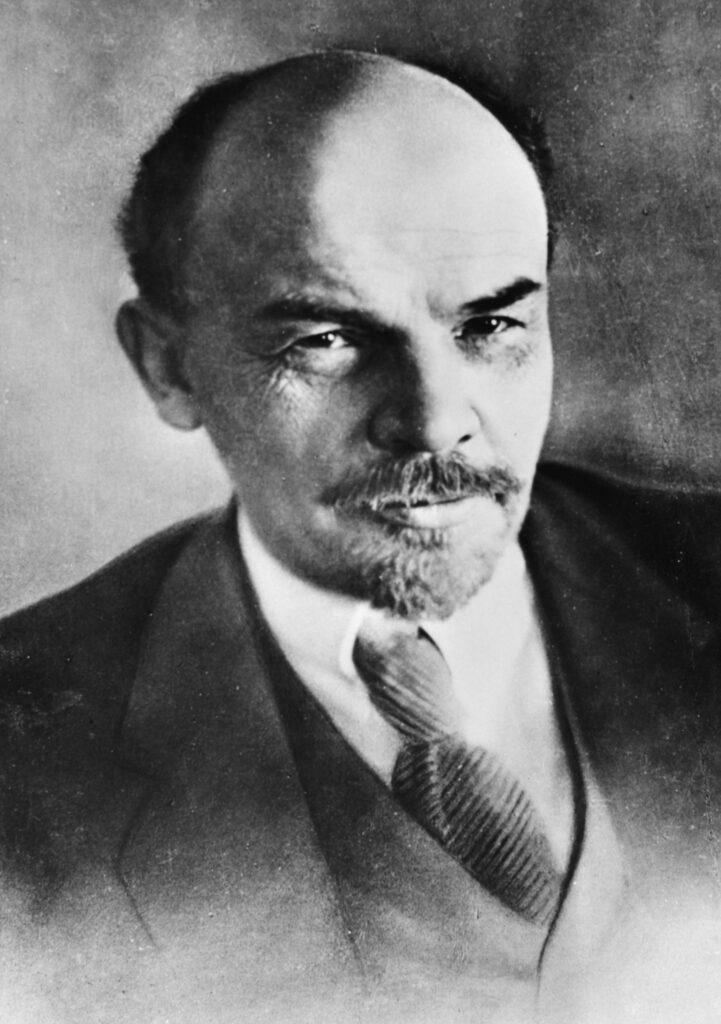
Lenin is a divisive figure, demonised by bourgeois society as a tyrant, and deified by Stalinist regimes who used him as a figurehead to justify their actions.
Vladimir Ilyich “Lenin” Ulyanov’s actual legacy is more interesting. Born to an educated family, Lenin became involved in anti-Tsarist politics while he was studying law. His older brother had already been arrested and executed for anti-government activity. Lenin was initially drawn to the Narodniks, who championed the cause of the peasantry and engaged in radical (and sometimes violent) adventurism. He subsequently saw the limits of individual terrorism and turned towards Marxist politics and the burgeoning working class movement of Russia. Eventually, he would become a leading member of the Bolsheviks, the far-left faction of the Russian Social Democratic Labour Party. Along with his comrades, he endured political repression, including imprisonment and exile. Lenin remained a leading figure in the revolutionary government following the success of the revolution in 1917. He would continue in a leadership role until his death in 1924, following a long period of declining health.
Lenin lived in a time of immense political upheaval and intense political debate among socialists internationally. Lenin was active in these debates, weighing in on questions such as state power and imperialism, among many others. His writing on these questions is still influential today (see our previous column “I for Imperialism”). With his analysis of imperialism as a core feature of “advanced” capitalism came two important positions: critical support for anti-imperialist movements and the right of nations to self-determination, and opposition to WWI. These positions set him apart from many of his contemporaries. Indeed, he ended up in a tiny minority on the question of WWI, with the majority of socialist parties falling in behind their respective governments in support of the war.
Lenin saw the working class as capable of deliberate political self-activity, rather than seeing them as a passive mass to be led from above. He interrogated the question of what form of political organisation was needed to facilitate this self-activity, and what “leadership” would look like in this context. His 1902 pamphlet What is to be Done takes up these questions and puts forward a specific vision of a revolutionary working class party.
The pamphlet is much more a political argument than an organisational guide. Lenin argued that a dedicated revolutionary party could act as an organ of leadership for the working class movement. He argued for an active, politically engaged membership cohered around a concrete political programme; one that connected the conditions of everyday life to larger political questions including, ultimately, the question of political power.
Lenin saw that, while it had initially been students and intellectuals who were drawn to socialist ideas in Russia, rising struggle was heightening political awareness among broader layers of society. He argued that a socialist party should base itself in the “vanguard” – those sections of the working class who were leading the struggle and looking beyond immediate demands and sectional interests to the bigger picture of working class liberation.
Across his writings, Lenin used a variety of evocative phrases and metaphors to describe the role of the party: it was a “tribune of the oppressed”, speaking against myriad forms of oppression; it was also the “memory of the class”, gathering the insights from each struggle. The revolutionary Victor Serge, observing the activities of the Bolsheviks, described the party as the “nervous system” of the working class – a network that could facilitate the transmission of news, debate, and action from one site of struggle to another.
As struggle in Russia rose to a revolutionary pitch, Lenin was largely successful in winning the Bolsheviks over to these principles. He also, crucially, raised the slogan “All Power to the Soviets” in the party paper Pravda in July 1917, making the case that the workers’ councils that had formed during the struggle could run Russian society themselves, undermining the power of the Provisional Government. The success of the Bolsheviks in giving leadership to the “October” revolution of 1917, and how the gains of this revolution were eventually lost, is a story for another day.
Contrasting Lenin’s articulation of a revolutionary socialist party with party politics in Aotearoa today is illuminating. There is no significant political force in Aotearoa today that wholeheartedly represents working class interests, let alone one that is meaningfully based in working class self-organisation. Existing parties see parliament as their main avenue of action; occasionally tapping into mass protest, but not seeing this as their core political work. For many, membership in a political party is a largely passive thing, with very little for the average member to do outside of campaigning for votes in an election year. As a result, workers are encouraged to be passive, and – again and again – their interests are disregarded in the “halls of power”. All of this strengthens the case for building independent, working-class political organisation. Revisiting the work of political ancestors like Lenin reminds us that it is possible to do so.
Image Source: Wikimedia Commons