In November 2025, the United Nations Climate Change Conference (COP30) took place in Belém, Brazil. The outcome was abject failure, bordering on misery, for anyone hoping for a sustainable “green capitalist” future, and victory, in part, for the 1600 fossil fuel lobbyists – one of the largest delegations to attend COP30. There was some hope for a roadmap to phase out fossil fuels but these moves were blocked by oil-producing nations; climate adaptation focused on trade and a “green economy” rather than curbing consumption and extraction; and the world’s largest historic emitter, the United States, didn’t even send a delegation. Beyond the facade of “rational” climate transition – the idea that agreements with states and corporations will steer the world away from incipient climate disaster – there was an air of failure and resignation. Brazil’s minister of the Environment and Climate Change, Marina Silva, said that “even if those earlier versions of us were to say we have not gone as far as we once imagined we would – or needed to – they would nevertheless recognise something essential: we are still here.” Sure, “We are still here,” but the wording of “earlier versions” (and not “later” or “future” versions) signifies a shift in the prevailing attitude around climate change, a sense that the world under global capitalism has failed to fulfill the promises of sustainable development and instead has committed to a nihilistic program of wealth extraction powered by waning fossil fuels in the short time we’ve got left.
This new program is dogma in a slew of right-wing governments around the world and is manifest in Donald Trump’s America. Our own government has been watering down emissions targets, removing consultancy requirements from its emissions plans, and approving mining projects through the Fast-track Approvals Act 2024. Australia’s Labor government has committed to net-zero by 2035 as well as simultaneously expanding coal production. We are living in a capitalist dystopia. Corporations and states expand environmentally destructive industries, burning more fossil fuels in pursuit of “growth”, fully aware that the expansion of these industries will render the earth uninhabitable for most living species in 100 years or so.
Average temperatures in 2024 exceeded 1.5 degrees Celsius for the first time in history, hitting the limit set by the Paris Agreement in 2015. The International Court of Justice has reaffirmed states’ legal obligation to uphold the Paris Agreement, but what justice can we expect from the same court that has failed to intervene in Israel’s genocide in Gaza? For climate accords like COP30 or the Paris Agreement to have any effect, they must rely on the integrity of the states that agree to them. However, these international organisations tend to falter when their rulings contradict state investments. Climate obligations are tentative agreements between states to mutually curb growth in order to reduce emissions. In a system where competition underpins production, these agreements are incredibly suspicious and, as tensions between states increase, nations tend to prioritise growth to expand their power, rather than sustaining the environment. As soon as one nation pulls out of an agreement, the obligation essentially fails and we get a situation like COP30: successive accords offering compromised solutions, leveraging concessions to the same industries polluting our world in order to maintain its legitimacy. The micro-rationality of inter-state competition leads to ecological irrationality on a planetary scale.
A “green transition” under capitalism fails to address the systematic contradictions that underpin this mode of production. Market logic means that investment in renewable energy sources causes a crisis of overproduction where energy prices drop markedly due to oversupply and companies’ costs dip into their profit. The feedback loops that keep ecosystems in balance don’t feature here. An infinitely renewable, abundant, and clean source of energy requires, under capitalism, an infinitely growing rate of consumption to maintain profits. COP30 may be an attempt to bring ecological sanity to the ruling structures, but it has no future couched in these self-destructive systems.
Indigenous Resistance
Belém lies near the mouth of the Amazon River where 200,000 cubic kilometres of sediment-laden water is discharged into the sea. The river drains an area of 7 million square kilometres including most of the Amazon Rainforest, a heaving, co-labouring mass of 390 billion trees, 3 million different animal species, and 30 million people of 350 different ethnic groups. Together, the river and the forest and the people are all interconnected and dependent on each other. The unity of the forest, and the watershed therein, is underpinned by an Indigenous practice, agriculture, and subsistence that remain embedded in the rainforest’s ecosystems. Their metabolism, food waste, and ash return to and enrich the soil. Their cultivation methods ensure that this enriched soil is spread throughout the forest and already cultivated areas are given time to replenish their nutrients. The good health of the forest results in the good health of the people and this balance has maintained the life of this ecosystem for thousands of years. These balances cannot survive within a system that prioritises mass extraction. In only 200 years capitalism has succeeded in destroying immeasurable swathes of rainforest, displacing many of the Indigenous peoples from a relationship with their land, and ensured that the fine balances that maintain its ecosystems are destabilised in a drastically warming world. The fact that these fertile grounds played host for the UN’s climate summit is irrevocably symbolic.
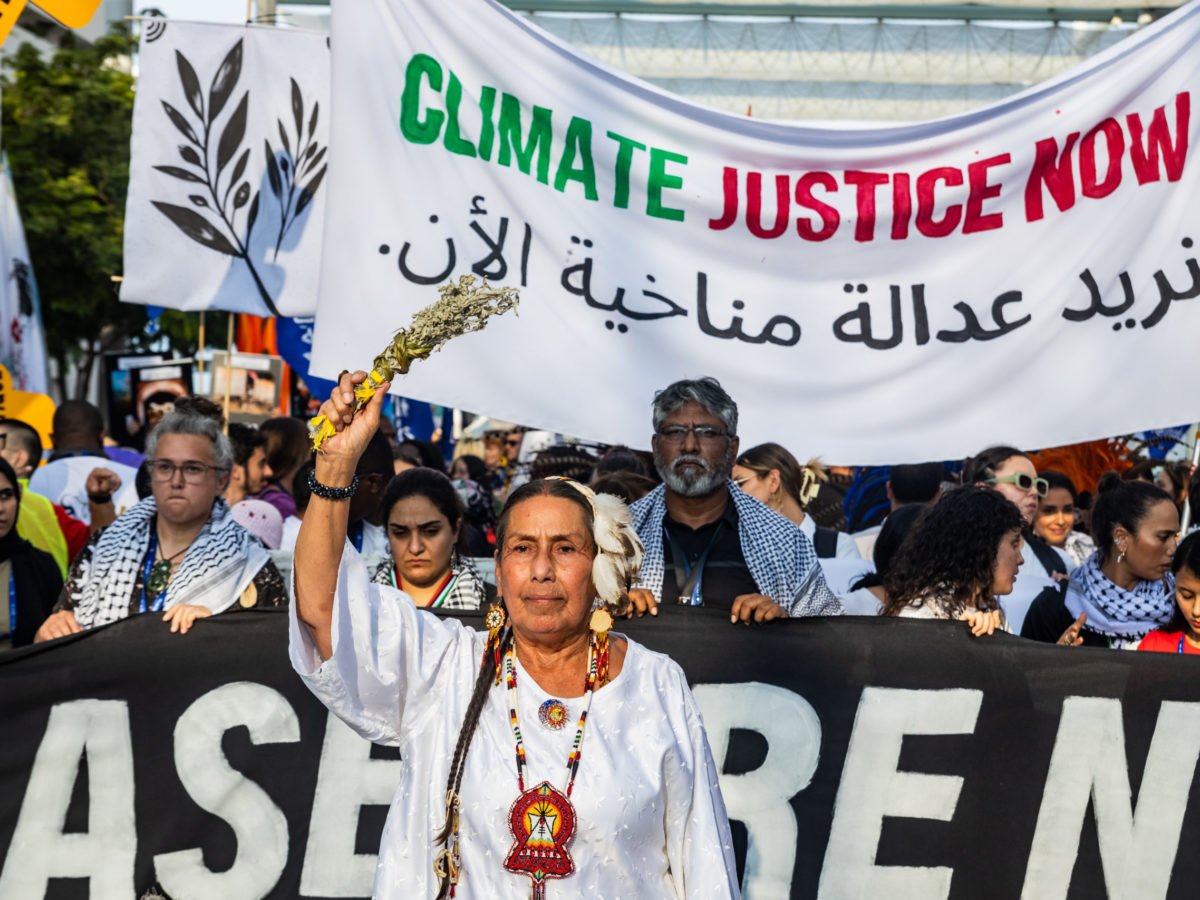
Earlier this year COP30 drew criticism for felling a section of rainforest to construct a new four-lane highway ahead of the summit. As a means of transport, American environmental activist Wendell Berry writes, “a road … embodies a resistance against the landscape. Its reason is not simply the necessity for movement, but haste. Its wish is to avoid contact with the landscape.” It is a symptom of a system that knows no relationship with nature outside of destruction. In contrast, the Amazon River threads a course, from its headwaters in the Andes, to its delta in the Atlantic Ocean, that constitutes an alluvial highway over 7,000km long. Five thousand activists, environmentalists, organisers, and Indigenous people from the remotest parts of Amazonia and around the world navigated this vast network of tributaries and lakes to Belém. The arrival of their flotilla marked their participation in The People’s Conference – an Indigenous-led resistance to the state-led COP30.
The People’s Summit has been a collective effort to unite various social and environmental movements in Brazil and abroad to consolidate an environmental struggle from below. These are Indigenous movements, movements that centre women and workers coming together in solidarity with the ecosystems, biomes, and landscapes they call their homes and have become, increasingly, the site of environmental destruction.
In the environmental movement worldwide, Indigenous Liberation and Land Back movements represent the most tangible and fluent future course. These are communities and peoples whose way of life, traditionally, remains embedded in the natural rhythms and ecosystems of the earth. Their cultural heritage, passed down over time, remembers a relationship with nature before the interruption of capitalism or private property. They have intimate knowledge of the earth’s limits and the facilities of its care. Their struggle for customary rights, communal ownership and, ultimately, liberation necessitates the liberation of nature from capitalism and provides a powerful intervention from those vapid dispensers of “sustainable development” and “green capitalism”.
Fertile Grounds
Tino Rangatiratanga and Tangata Whenua struggles in Aotearoa constitute these interventions in local environmental movements.
“Whenua, meaning land and placenta, reflects the fact that we are born from the womb of Papatūānuku,” Simon Barber writes in his 2020 article “Māori Mārx: Some Provisional Materials”. Māori whakapapa springs from the earth itself, from Papatūānuku. “Tangata Whenua is a relationship of belonging to the earth as the earth.” Under capitalism, humans are seen as a species that has transcended “nature”, our unique intellect has entitled us to a nature that is inert and readily exploited. In contrast, Tangata Whenua envisions humans as an emergent part of nature as a whole. Kaitiakitanga, or custodianship of the land results in the mutual nourishment of the people. The colonial theft of land had the dual effect, therefore, of not only robbing the people of their lands, but also robbing the land of its people. As a result, both have suffered.
I am writing this in the wake of historic rainfall along Aotearoa’s East Coast in January this year. The rivers and wetlands, which are usually free to swell and shift course with higher water volumes, have been encroached upon, developed, and turned into farmland. They are unable to cope with this extreme amount of water. Some of the most affected areas in the Bay of Plenty occurred on land stolen from local iwi in the 1863 Land Confiscation Act. The Rangitaiki River, before this, used to form a wetland over a 40,000 hectare area of land now occupied by dairy farms, land that flooded in 2017. This land was never returned. East Coast towns and communities experienced their wettest days on record and only a week before the government passed, under urgency, its reformed Resource Management Act. This Act has essentially given private industry a blank cheque to transform our earth into a factory floor. Furthermore, proposals to “streamline” or “modernise” Conservation Land Management are means to bypass Te Tiriti obligations. The government wants to develop these vulnerable landscapes. Supposedly, “we need more quarries and mines”. But the contradiction in this relation to nature shows up as forestry slash, floodwaters, and mudslides on our beaches, in our communities, and our towns, every time we see excessive rain. And every single time, the first and most effective response comes from the communities themselves, from local marae opening their doors to provide shelter and kai.
As extraction intensifies and expands, climate-related disasters become more intense and all-encompassing. Soon enough, Papatūānuku herself will overthrow capitalism. The question, therefore, is whether we will be part of the future. Tangata Whenua struggles, like those at Ihumātao and Ōrākei, and the People’s Conference in the wake of COP30, are about providing a liveable world for our children. This begins by redressing the past, by restoring to the land its ahi kā, those original custodians who know how to care for it. As socialists, we know that these solutions won’t come from accords or alliances between global powers. Their goal is to maintain their dominance. Domination, conquest, and competition always engender a loser and, for too long, the greed, prosperity, and power of the bourgeoisie has come at the cost of the proletariat and Indigenous people who have been dispossessed of their land, and the earth. Capitalism can’t save the planet. These systems dwell on disparity. It is only through an organised and militant working class, alongside and in solidarity with generations of Indigenous people around the world, casting off its shackles, that the earth might spring into the future. As soon as the land and its people are reunited, the machines of capitalism will cease to operate.
Banner image: Protest signs at Ihumātao, February 2019. Photo credit: Chris Double