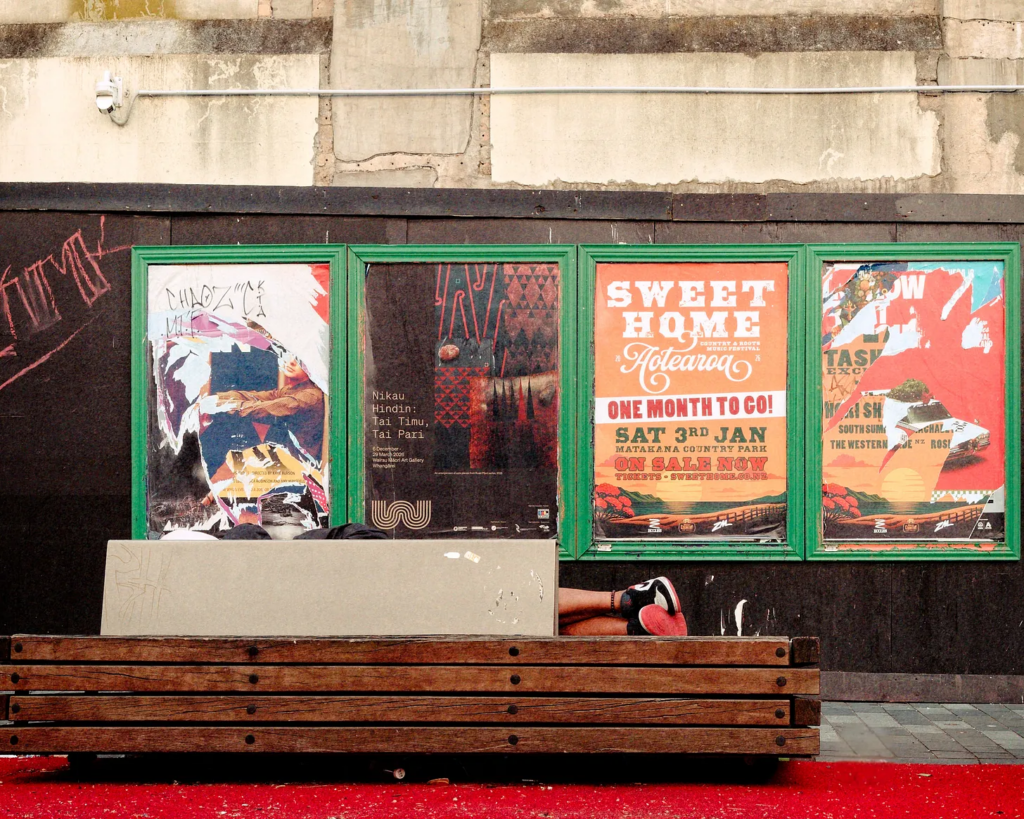
On Sunday 22 February , justice minister Paul Goldsmith announced plans to amend the Summary Offences Act, giving police further coercive powers against the homeless. The amendment would allow police to give 24-hour “move-on” orders to someone sleeping rough, begging, or being “disorderly, disruptive, threatening or intimidating.” Failing to comply would land any individual as young as 14 years old with a $2,000 fine or up to three months in jail. This decision comes as unemployment reaches a 10-year high, one in seven children lives below the poverty line, and wages fail to keep pace with rising inflation.
A torrent of public outcry has followed the announcement, expressing shock and disdain. Legal and social services experts have denounced move-on orders, describing them as punitive and ineffective, punishing society’s most vulnerable for the crime of merely existing in public space. Moreover, such tactics prevent homeless individuals from accessing the services they need. Access to Work and Income offices, probation services, food banks, and health services is made near impossible if one can’t exist in city centres without risk of persecution. The decision falls in line with the Coalition’s “pull yourself up by your bootstraps” attitude – a task, we might note, that is physically impossible – wherein the Government punishes those most vulnerable while actively sweeping away the institutions and mechanisms designed to help them.
The Government’s gross changes to the census late last year are expected to hinder accurate data collection on homelessness ahead of the incoming amendment, and is only one example among many. What we do know, however, is that women, and Māori women in particular, are disproportionately affected by homelessness.
As Marxists, while we should not hide our disdain for such policy, we should also not be surprised. In a climate of fiscal austerity and tough-on-crime rhetoric, the criminalisation of so-called “unwanted” groups is to be expected. Speaking to Newstalk ZB, Luxon put it quite plainly:
The bigger issue is Chuck and Mary coming in for their once-in-a-lifetime trip to New Zealand on a cruise ship, walking around downtown and getting intimidated because someone’s sitting on the doorstop of a shop they’re trying to get into, threatening, shouting at them, abusing them.
But this is about more than simply tidying the proverbial house. In Capital, Marx writes of a “relative surplus population”. The crux is that capital accumulation necessitates an always-available proportion of unemployed workers within the working class. This surplus is the consequence of a growing share of the capital represented by constant capital (raw materials, machinery, land, etc.), relative to variable capital (labour costs). As technology advances and human labour becomes more productive, the demand for labour decreases, relative to the exponential growth of capital accumulation. The resulting excess population is then unnecessary to the needs of production.
However, the “surplus population” remains useful, serving two related functions. First, Marx tells us that this population forms “a disposable industrial reserve army.” This “reserve army” acts as a pool of unemployed workers waiting in the wings, ready to be exploited at the behest of capital. Second, the surplus population acts as a standing threat. In an economy where work is readily available, leverage skews away from employers. If a worker sought better conditions or higher pay, they would simply change jobs. However, if unemployment is kept relatively high, then leaving one’s existing job risks at best complete dependency of a punitive welfare state, and at worst homelessness, starvation, and, death. High unemployment then becomes an implicit warning against taking your labour elsewhere.
The point is, homelessness is a political choice, and its further criminalisation reasserts the threat that keeps workers docile. In this light, the Coalition’s move is painted as a rational response to the contradictions of capital accumulation. As Marxist scholar David Harvey puts it, “we live in a world, after all, where the rights of private property and the profit rate trump all other notions of rights one can think of”.
Thus, we must understand that the lack of efficacy, indicative of the Coalition’s particular brand of politics, is precisely the point. When politicians like Luxon tell us that they do not care about “equality of outcomes”, what they actually mean is that they have no interest in abolishing the inequality of opportunity faced by the most vulnerable workers, such as women, takatāpui, or Māori.
As workers’ struggles continue to surge, following a record year for industrial action, the government sharpens the tools at its disposal to manage and coerce the working class. In turn, we must hone our own tools and continue to escalate class conflict. So yes, “safe housing for all!”, but we must recognise the limits of that horizon under capitalist conditions. Far from dampening the passions of those outraged by this decision, this reservation is offered to crystallise the task ahead: the complete and total abolition of capitalism.
Photo Credit: Rich Greissman