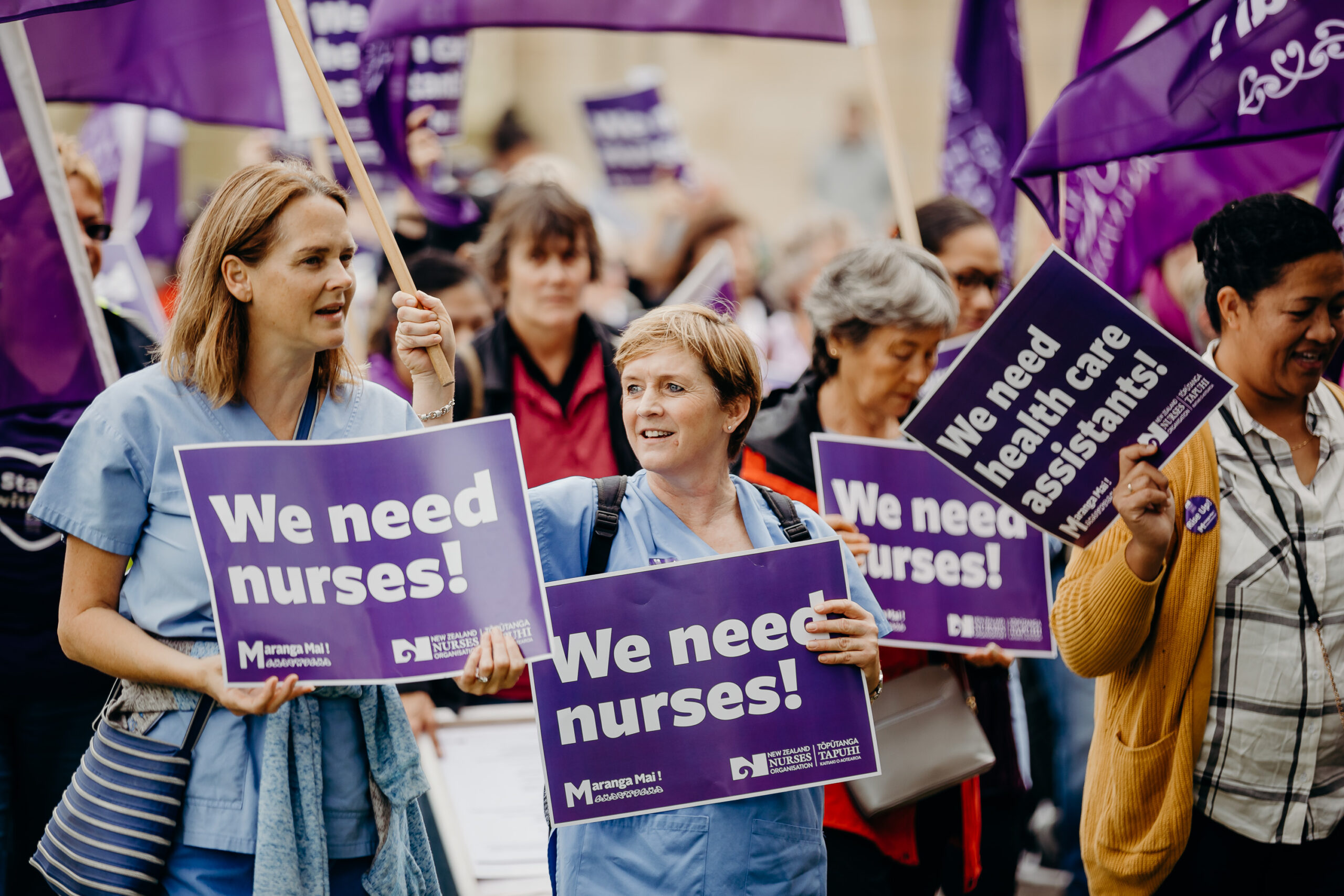
The 23 October public sector strike was the largest industrial action taken in Aotearoa since the one-day General strike in 1979. On 28 October Te Whanganui-a-Tara branch of the International Socialist Organisation hosted a panel discussion on this historic action. Nurse and unionist Grant Brookes was among the speakers, giving his perspective on the struggle. His contributions are published here, edited for clarity.
Grant Brookes is a member of the ISO, a national executive member at Tōpūtanga Tapuhi Kaitiaki New Zealand Nurses Organisation, secretary of Aotearoa Healthcare Workers for Palestine and a member of the Unions Wellington Committee, speaking here in a personal capacity.
The strike last Thursday, with over 100,000 workers, was the largest industrial action taken in Aotearoa since the one-day general strike in 1979. How did we get to this point, and what changes have you noticed inside your own union?
How did we get to this point? Conditions that give rise to struggle like the industrial action last week are shaped by a multitude of factors, which sometimes can only be seen in retrospect. A letter written by German socialist Friedrich Engels late in his life makes the point well:
According to the materialist conception of history, the ultimately determining element in history is the production and reproduction of real life […] The economic situation is the basis, but the various elements of the superstructure political forms of the class struggle and its results, to wit: constitutions established by the victorious class after a successful battle, etc., juridical forms, and even the reflexes of all these actual struggles in the brains of the participants, political, juristic, philosophical theories, religious views and their further development into systems of dogmas — also exercise their influence upon the course of the historical struggles and in many cases preponderate in determining their form […]
In the second place, however, history is made in such a way that the final result always arises from conflicts between many individual wills, of which each in turn has been made what it is by a host of particular conditions of life. Thus there are innumerable intersecting forces, an infinite series of parallelograms of forces which give rise to one resultant – the historical event.
First and foremost, we got to the point of last week’s mass strike through economic conditions – in particular, what’s been dubbed the “cost of living crisis”. Union members, like all workers, are feeling the pinch.
Secondly, there are the “political forms of the class struggle and its results”. These political forms are seen in government actions on the one hand, and the political mobilisations of the working class in all its diversity on the other. I have written about these political forms of the class struggle in a recent article for The Socialist:
In May, the Government took $12.8 billion in budgeted pay equity funding out of working women’s pockets. In June they legalised harsh pay penalties for workers undertaking partial strikes, which are often innocuous actions like wearing union t-shirts or exercising free speech in the media. And this month, Health minister Simeon Brown undermined collective bargaining unlawfully by demanding the senior doctors’ union forget negotiating with Te Whatu Ora and submit to an imposed settlement. The union refused.
After signalling law changes to undermine workers’ democratic rights to free speech, our right to protest, and our right to enrol and vote, this increasingly authoritarian government is again following Donald Trump and is publicly considering draconian law changes to further restrict our legal right to strike across the public sector.
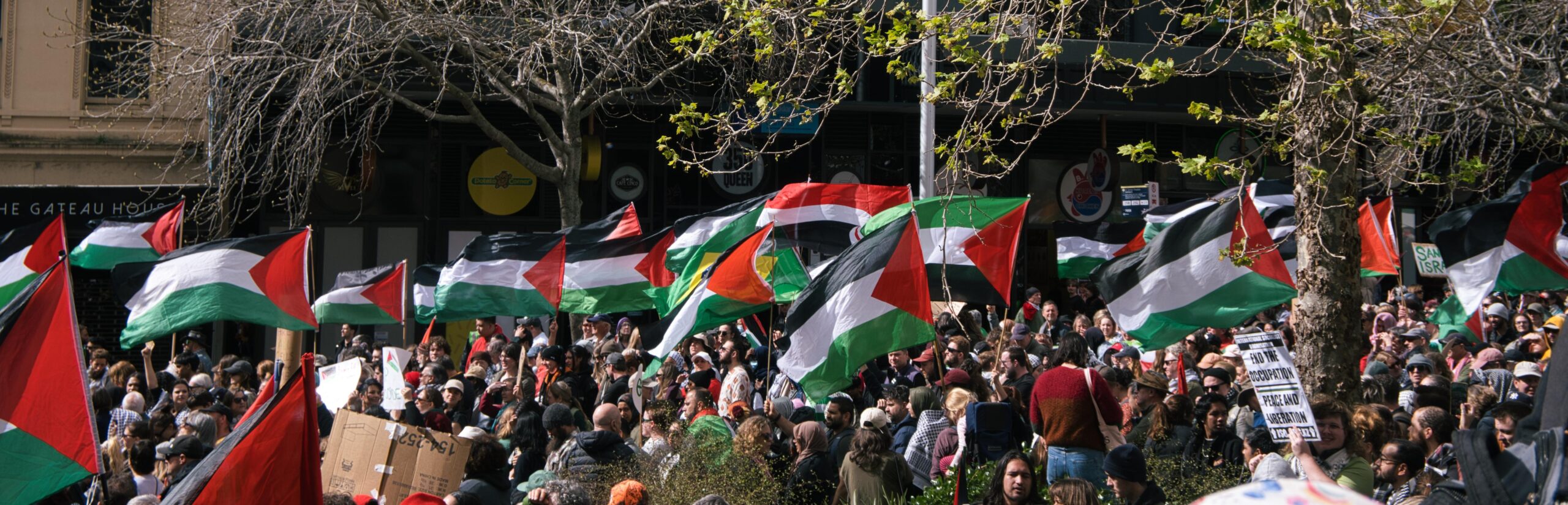
All of this is taking place against the backdrop of mass mobilisations in defence of Te Tiriti o Waitangi and in solidarity with Palestine on a scale never before seen in this country. The historic Hīkoi Mō Te Tiriti last November and the March for Humanity this month are the stand outs. But it’s easy to forget that in between these two mighty pou, other record-breaking uprisings have occurred, such as the 300,000 people who submitted against the ACT Party’s Bill to nullify Te Tiriti, and the weekly unrest over pay equity.
A century ago, Marxist theorist and political leader Rosa Luxemburg observed that:
Every new onset and every fresh victory of the political struggle is transformed into a powerful impetus for the economic struggle, extending at the same time its external possibilities and intensifying the inner urge of the workers to better their position and their desire to struggle. […]
In a word: the economic struggle is the transmitter from one political centre to another; the political struggle is the periodic fertilisation of the soil for the economic struggle.
This combination of factors are some of the “infinite series of parallelograms of forces” which gave rise to last week’s historic public sector general strike.
In terms of the changes I have noticed inside my own union, I can only offer a few anecdotal observations. I have noticed a rise in political awareness among members. This has been seen in more Left Wing policy adopted by members at our NZNO AGM in September. It has also been seen in shifting attitudes towards other groups of workers. I remember back to the teacher strikes in 2021, when some NZNO members didn’t support our union comrades, saying that if the teacher strikes were successful there would be less money in government coffers for nurses. In 2023, some NZNO members attacked striking doctors as “overpaid”.
These narrow, sectional ideas, which fail to see our common interest as workers in standing together against the government, are no longer getting a hearing. Some credit for the shift must go to the firefighters – consistently the most highly trusted occupation, according to regular polls – who have been turning up to every union action, opening the eyes of union members to our shared struggle.
The government has accused unions of “playing politics”, yet in defending gender equity, public services, and Te Tiriti, unions have demonstrated that they have an important part to play in this area. How should we make the argument that politics belongs in union spaces – both within our unions, and to the public?
Health Minister Simeon Brown accused the ASMS union for senior doctors and dentists of “playing politics” when they went on strike in August. Education Minister Erica Stanford accused the NZEI union for primary school staff of “playing politics” last week. Public Service Minister Judith Collins released an open letter saying, “the strike appears to be politically motivated by the unions”, wording later echoed by the Prime Minister. At the same time, government ministers are praising doctors, nurses, teachers and so on.
Their line of attack has two purposes. Firstly, to say that unions are bad and workers are good; unions go on strike and innocent workers are bullied to go along with it – a claim actually made by Stanford. Secondly, to imply that the Labour Party is pulling the strings. “I appreciate the unions are very close with Labour, I get it, they don’t like our government”, said Luxon, “I get it, but actually they’re not serving their members well.”
In response, we need to say first of all, damned right our strikes are politically motivated. But we ain’t playing.
My own personal goal in going on strike is to help bring down this government and put the opposition parties on notice. And I believe the action I was a part of will be another nail in the government’s coffin. In normal times, the New Zealand public is generally averse to conflict, and a good number of them will see the government as creating this large-scale conflict. I expect the government will take another hit in the polls following the huge public sector general strike last week.
Secondly, we need to keep pointing out that “union” is another name for a group of workers. It was workers who all voted to go on strike last week, not these mythical bugbear “unions” that the government is trying to conjure up. This point is being made widely today – even by traditionally hostile media figureheads like Lloyd Burr.
Thirdly, none of the unions which went on strike last week are affiliated to the Labour Party. And all of them – NZEI, PPTA, ASMS, the PSA and my union – went on strike against the Labour-led government during their last term. The idea that the Labour Party directs union strikes is preposterous.
Finally, following on from the two preceding points, we need to say that “politics” isn’t about the Labour Party or even about parliament. Politics is not the preserve of some elite “political class”, which gets to make all the decisions that the rest of us have to passively accept.
And I actually think it’s easy – and getting easier by the day – to make these arguments about politics in union spaces, because the recent government messaging is directed only at the hard core of their base. The Talbot Mills poll before the strike showed two thirds public support and I don’t think the government has won over large swathes of the public since. They’re definitely not winning over union members.
Lloyd Burr’s eyebrow-raising piece includes responses from union spokespeople to the government’s accusations:
NZNO bargaining spokesperson Debbie Handisides says it’s on the Government to explain why the strike action is “politically motivated”…
Having the “politically motivated” label slapped on her by those in the very Government she’s negotiating with isn’t going down well with NZNO members, she says.
“It is pretty insulting. And it’s frustrating, very frustrating. We keep going back to the fact they are refusing to listen, and they’re totally not being realistic in refusing to understand what’s happening on the hospital floor”.
Debbie Handisides is not a paid official of NZNO. She is a low-paid enrolled nurse at Burwood Hospital in Christchurch. The article continues:
PPTA President Chris Abercrombie says because his union is negotiating with the Government, the environment is inherently political, regardless of which party is in power.
“I would point out that PPTA members have taken strike action on many occasions when Labour and Labour-led governments have been in power,” he says.
“Issues such as the secondary teacher shortage and the unmet need of students in secondary classrooms are well known by the Government. We are trying, through our collective agreement claims, to get these issues addressed.
“Addressing them is largely a political act. Equally, our strike action, which is in response to the Government’s refusal to address these issues, can be regarded as a political act,” Abercrombie says.
Executive director Sarah Dalton rejects the claim that her union and its members are “politically motivated”.
“ASMS is not party political, but we’re absolutely health political, and that’s clearly stated in our constitution. Our constitution requires us to advocate for the best public health system we can in New Zealand,” she says.
From these starting points, it’s relatively easy to press on and to argue that gender equity, public services, Te Tiriti, peace and Palestine are all political issues that belong in union spaces.
One of the clearest arguments for why politics belongs in union spaces came from Chlöe Swarbrick. Marching with the striking workers in Tāmaki Makaurau last week, she said, “Of course this is political. Politics is about power and it’s about resources and it’s about who gets to make decisions that saturate and shape our daily lives. And the Greens proudly, vehemently believe that workers should be involved in making decisions about how our economy works”.
Recently we saw Judith Collins attack the secondary teachers’ union for putting Palestine as “the number one item on their agenda” for a negotiation meeting with the Education Minister. Collins is clearly misleading the public here, as the union was asked to bring forward issues separate from bargaining, but this still shows workers are keen to support issues beyond the workplace. Why is it so important for unions to fight for Palestine, and what role do they play in the wider struggle for peace?
There are a range of valid reasons why it’s important for unions to fight for Palestine. I think it’s useful to talk about the range of reasons, because a union is a broad church for members of varying political persuasions.
Firstly, fighting for Palestine involves educating public sector union members on why it matters to care about other people in need who are in some ways different from themselves. This is about recognising shared humanity, which is a fairly basic liberal tenet, but this education also flows progressively back into supporting ethnic and gender minorities in Aotearoa; supporting non-unionised workers in the private sector; supporting members of other public sector unions; supporting lower paid members of our own union and supporting unionised professionals in workplaces different from our own.
In short, fighting for Palestine is part of developing a mass psychology of solidarity among our union’s membership, which is key to any union’s strength.
Another reason to fight for Palestine is to avoid entrapment in pro-US policies, chief among which was Trump’s 2024 demand on US allies to increase military spending to three percent of GDP – a demand Trump later increased to five percent of GDP in 2025. The New Zealand government has capitulated to Trump’s demands for increased spending, doubling the military budget by 2029 with $12 billion of extra funding. Every dollar spent on war, of course, is a dollar less spent on security of public services for New Zealanders. Fighting for Palestine helps to see where the real enemies are and equips union members to resist the scaremongering of defence minister Judith Collins.
Further reasons for fighting for Palestine are contained in this email I sent to the NZNO Board and Chief Executive in November 2023, kicking off NZNO’s solidarity efforts:
Kia ora koutou,
Thank you [redacted] for this response to the upheaval around Gaza. I welcome your decision to hold a Board meeting asap to consider NZNO’s position. In advance of that, I would like to share what I think are a few of the salient issues.
While in San Francisco, [redacted] and I noted in conversation the strong moral purpose which guided the California Nurses Association. Sustaining this moral purpose over the long term is one of the sources of that union’s strength, motivating members to take action today in a wide range of difficult circumstances – much more difficult than any we have faced, in recent memory.
The wave of actions referred to in [redacted] email includes statements from our PSA colleagues in the health sector, the wider union movement (also here), and from our nursing union partners in Australia.
Within NZNO, in addition to the motion passed by our Wellington Te Whatu Ora delegates, other delegate meetings will be considering motions on Palestine in the coming days. Hundreds of our members have signed a healthcare workers’ call for an immediate ceasefire in Gaza (only a fraction of which are showing on the website at the moment). No doubt, the vantage point of the NZNO Leadership Team means they will know much more about this current context. I look forward to [redacted] background words for our Board meeting.
In such a context as this, when our close allies and members are speaking out, saying nothing about the humanitarian crisis would represent a moral position for NZNO. This is not a position I would support. I am also concerned that staying silent would carry repetitional risks for NZNO.
In the wider context, it is my personal take that the current upheaval in Gaza represents an inflection point in world history, which will have far-reaching international and domestic ramifications – much like the attack on the World Trade Centre in New York in 2001. As the acclaimed documentary Operation 8: Deep in the Forest made clear, the “War on Terror” launched by US President George Bush in response to that terrorist attack led directly to the passage of the Terrorism Suppression Act 2002 by Helen Clark’s Labour Government, and then to the “terror raids” in Te Urewera five years later.
Te Pāti Māori understand the historical significance of the Gaza War for Māori. So does the ACT Party, which is targeting people calling for the decolonisation of Palestine as “terrorists”, at the same time as pushing for their referendum on the principles of the Treaty of Waitangi [sic.].
We as a Board are aware that NZNO will be facing difficult circumstances over the next three (or more) years – especially for our moral stand to deepen our commitment to Te Tiriti o Waitangi. Solidarity forged now over the linked issue of Palestine with our close allies – and with our more conscientious members – are what we’re going to need to get us through.
Ngā mihi
Grant
What challenges do you expect to face heading into the next few months, and what lessons or tactics will be the most important for facing them?
It appears to me that the government has badly bungled its approach to public sector workers. At the start of the year, I told a meeting of this group that a challenge for NZNO was sustaining the willingness of members to take action, after some lacklustre rolling strikes in the lead-up to Christmas. The government has now antagonised nurses so much that this is not a challenge heading into the next few months.
For senior doctors and dentists, demands on ASMS to abandon bargaining and submit to binding arbitration have been ignored. Legal action against ASMS strikes by government lackeys at Te Whatu Ora is almost certain to fail. Threats to change the law to remove our right to strike have faded for now, as we called their bluff – although we must be alert to the possibility that the probable failure of the legal action against ASMS could be used to build a case to change the law next year. Meanwhile, their attempts to demonise unions have backfired spectacularly, as union density (the proportion of workers across the economy who are unionised) has reversed its long decline and risen to the highest level in 15 years.
This bungling is due in part to the fact that none of the current generation of government politicians (except for Winston Peters) have ever experienced a strike wave. But there is always a chance they will learn from their mistakes, and heed advice from experienced union-busters.
Our success as workers – as always – has been in our unity. The challenges we should prepare for are efforts to divide and conquer. So far [at the time of this panel] only two very small public sector unions have been persuaded to settle their collective bargaining – MERAS midwives union and a breakaway union for a few primary school principals. One option for the government is to break our unity by buying off the members of one union with a more generous offer, while holding the line with the others and painting them as somehow “bad” for not settling. This would be costly, and risky for them. In response to this possible challenge, the lesson for the others will be to hold out for an offer at least as good.
In a few words, please tell us what everyone in this room can do to support the strikes.
NZNO is balloting this week on our next round of nationwide strikes, which are scheduled to take place between 17-30 November. Members are voting on three different actions, to take place over this period. These are all partial strikes, which means that members are voting on whether to reduce the normal performance of their duties while still providing care for the patients in their area of work. If these partial strikes go ahead, therefore, there won’t be public rallies or marches to join. If we want opportunities to publicly show our support for these strikes, therefore, we will have to make them ourselves.
Other unions (including the PSA) have signalled new strikes which may feature rallies and marches which all supporters can join. And for supporters in unions which are not striking, there is another, more powerful way to support. Section 26 of the Employment Relations Act provides for two paid stopwork meetings per year, for all unions. These member meetings are sometimes needed for a union’s planned organising work. But often they aren’t fully used. So supporters in unions which aren’t on strike can call for their union to hold a stopwork meeting on the day.
Finally, NZNO is also looking ahead to next year and planning for possible strikes in February, so look out for those. In the meantime, we are calling on people to sign onto the Buller Declaration, a petition from Patient Voice Aotearoa due to be presented to parliament next month. A link to the petition is on the home page of our website, nzno.org.nz.