
Housing is a Right
December 16, 2019 By ISO editor
It did not take long for Labour’s flagship KiwiBuild housing policy to come to grief; and if ever there was a minister likely to embarrass the Ardern government it was that rightwinger Phil Twyford. It was he who in 2015 infamously blamed Chinese for Auckland’s high house prices. The failure to get anywhere near Labour’s target of 10,000 KiwiBuild houses a year for ten years forced Ardern to execute a ministerial reshuffle in June. Twyford was dropped as housing minister and demoted to minister for urban development answerable to new housing minister Megan Woods. Kris Faafoi picked up responsibility for public housing, also answerable to Woods. On 4 September Woods announced the abandonment of KiwiBuild targets altogether.
Nevertheless, the toned-down KiwiBuild remains the government’s central housing policy. Under KiwiBuild private developers do the building and the profit making, underwritten by public money. All that the developers are required to do is to include some “affordable” units in their developments. The meaning of affordable price has been ridiculously stretched to mean up to $650,000 in Auckland and Queenstown, $550,000 in Wellington and $500,000 elsewhere. These capped-price units are reserved for qualifying buyers. The whole scheme is predicated on the private development industry and private ownership being the solution to the housing crisis. What has held back the construction of KiwiBuild units so far is the developers holding out for super-profits. In addition to guaranteeing the sale of KiwiBuild units, the industry wants the government to provide easy-to-develop land, to pick up the tab for infrastructure costs and to be allowed higher density under relaxed consenting conditions.
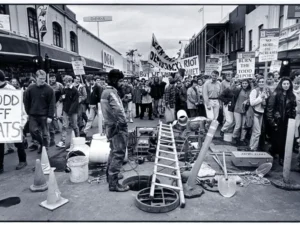
KiwiBuild has nothing to offer low-income working class people. What is really needed is a programme of building state housing. There is a massive demand for state homes to get people out of the clutches of private landlords or out of overcrowded homes and into independent living. As of June there were 12,311 applications for state homes on the Housing Register. Only the state, or local council, can be made accountable through the democratic process, especially when well-organised tenants associations bring pressure to bear on elected politicians. At its best, state housing can provide secure high-quality homes at a low rent. It spares tenants the costs of repairs, updates, rates and insurance. Through the transfer system state housing can be flexible to meet the needs of growing or shrinking families.
Recent articles

Chile: The beginning of the end of neoliberalism?
Samuel F, a former member of the ISO now active in Chile, offers these reflections. After more than 40 days of almost non-stop demonstrations things are on the surface somewhat quieter on the streets of Chilean cities. Quieter does not mean “normal” in any sense of the word – the streets are filled with […]

Land is the Price: colonialism then…and now
By Josh O’Sullivan Throughout history capitalists has searched the world for profitable exploitation. To create a paradise for capital, lands were sought, claimed and the people that lived there forced off their communal property. Those commoners then became the pool of labour that the industrial revolution was built on. From the enclosing of the commons […]

Ihumātao: a Struggle for Justice
By Josh O’Sullivan and Lozza Kiff The fight for land rights in Aotearoa is the essential question for radical social change for both mana whenua and tau iwi. To resolve this question requires challenging some of the most fundamental aspects of capitalism in New Zealand – the rule of private property. Property held purely […]

Questioning The Terrorism Suppression Bill
By Serah Allison On the 16th October 2019, Labour government Justice Minister Andrew Little introduced the Terrorism Suppression (Control Orders) Bill to Parliament. Media suggest this Bill is targeted at one man, New Zealander Mark Taylor, who travelled to Syria to join the Islamic State, and who has been more recently held captive by Kurdish […]

State ‘care’ and stolen generations
By Romany Tasker-Poland “Oranga Tamariki told me I had five minutes to say goodbye to my baby and then they were going to take it… I hung onto my baby but I was worried they were going to hurt me and the baby.” These are the words of a young mother who in May […]

Battling for Abortion Rights
By Andrew Raba Anti-abortion politics have taken centre stage in the media following the passing of “fetal-heartbeat” laws this year in several US states: Ohio, Mississippi, Georgia and Kentucky. The new laws ban abortion beyond six weeks of pregnancy, before most people know they are pregnant. Alabama has passed an even more restrictive law […]

Support the Climate Strikes!
There’s a climate crisis, and Labour and the Greens are failing to act. The climate crisis is upon us, but on some more than others, as more frequent, more extreme weather events take place. In March this year Cyclone Idai affected three million people in Mozambique, Madagascar, Zimbabwe and Malawi, including over 1,000 dead, over […]

Cannabis: End Prohibition!
There will be a referendum on cannabis reform at the same time as the 2020 general election. There will be a yes or no question on the legalisation of cannabis use, but the wording of the proposed legislation is not yet known. The criminal justice system is racist. This has to be our starting point. […]
From the archive
Anzac Day: Against the Carnival of Reaction
April 24, 2014
On Anzac Day 1967, at the height of New Zealand involvement in the ‘American War’ in Vietnam, with New Zealand troops taking part in the suppression of the Vietnamese struggle for national liberation, members of the Progressive Youth Movement in Christchurch tried to lay a wreath following the dawn service in memory of those killed by imperialism in Vietnam. They were arrested and charged with disorderly behaviour. Feminists a decade later faced down a media-driven public outcry when they laid wreaths to the victims of sexual violence during war.
Lest we forget? It’s more like lest we remember. Anzac Day serves as a carnival of nationalist reaction, a day of public ritual aimed at promoting forgetting: forgetting the real legacy of New Zealand imperialism and militarism in favour of a sentimental nationalism, an anti-political celebration of national unity. [Read More…]